Managed to sneak in a couple of hours on The Leam to finish 2011, and with some success.
With virtually no flow to speak of on my favourite bend, I ignored the (not very) shallows in front of me and instead targeted the deeper water downstream with a waggler rig.
This gave me a wider water and more lines to target, which was I think the key to putting together a longer run of bites than hitherto. Either that or it was the new secret ingredient - turmeric on the maggots!
Whatever the reason, I ended up with four nice fish on the bank (a chunky 6oz roach and three chub to 7oz), a few tiddlers, a handful of missed bites and two good fish lost in play - the second of which killed the swim and effectively ended a very enjoyable little session.
1 January 2012
30 December 2011
Thank goodness for the birds
A combination of seasonal fun, seasonal sniffles and seasonal weather has prevented any fishing since the first week of December. While this has been frustrating, my other great love - birdwatching - has continued to deliver plenty of pleasure.
The birds have come through the usual combination of planned trips and chance encounters. As we set off for our Xmas holiday with family in Essex we were 'flapped' on our way by a large flock of lapwing over fields near Napton.
Once in Essex we were accompanied everywhere we went by huge flocks of fieldfare and redwings, and a visit to Hatfield Forest was brightened by a fly-by kingfisher.
Finally, J and I actually managed a trip to Brandon Marsh today, our first in quite some time. Despite the cold and the constant rain, we spent a very pleasant couple of hours in the hides studying the gulls, ducks and waders, with highlights including a pair of goldeneyes and some very well hidden snipe.
Bird of the season: Snipe, a wonderful little wading bird which manages on the one hand to be as distinctive and striking as you could wish, and on the other hand is as discreet and camoflagued as you could imagine possible.
The birds have come through the usual combination of planned trips and chance encounters. As we set off for our Xmas holiday with family in Essex we were 'flapped' on our way by a large flock of lapwing over fields near Napton.
Once in Essex we were accompanied everywhere we went by huge flocks of fieldfare and redwings, and a visit to Hatfield Forest was brightened by a fly-by kingfisher.
Finally, J and I actually managed a trip to Brandon Marsh today, our first in quite some time. Despite the cold and the constant rain, we spent a very pleasant couple of hours in the hides studying the gulls, ducks and waders, with highlights including a pair of goldeneyes and some very well hidden snipe.
Bird of the season: Snipe, a wonderful little wading bird which manages on the one hand to be as distinctive and striking as you could wish, and on the other hand is as discreet and camoflagued as you could imagine possible.
27 November 2011
A smile as wide as the fish was long
Although I'd decided last week to give the Leam a rest for a while, a last minute change of heart saw me back there again this morning.
Instead of the relative simplicity of a commercial stillwater, my heart told me it wanted at least one more crack at finding a 'proper' fish on my favourite stretch running through the nature reserve and into Newbold Comyn.
It was unseasonably warm (12.5 degrees), a fact that became uncomfortably apparent as I trekked a mile or more in full winter gear to reach the very end swim. A strong upstream wind had all but stopped or even reversed the surface flow along the entire stretch, and even here, where the river narrowed to just a few feet, there was no flow to be seen.
It seemed perverse in the circumstances to set up a stick float, so I selected a small insert waggler, set it up with a size 22 on a 1lb 10oz bottom (my lightest ever rig I think), and set it to drift just an inch or so off the bottom of a slight downstream depression.
A steady trickle of maggots soon attracted the roach bites, but nothing of any size was coming out. And then, bang, I suddenly found myself wishing for a slightly less delicate rig as something put a not-inconsiderable bend in my light match rod. Having steered it out of the nearest reed bed with a combination of power and prayer, I then became acutely aware of just how narrow this stretch of river was - to get this fish into my landing net I was going to have to draw it through a gap in the reeds no more than four foot wide.
I already suspected this was a chub rather than the stellar roach I'd initially hoped for, and it pretty much confirmed this suspicion by going straight for those reeds as I drew it into the channel. It was clearly not a giant by chub standards, but it was the best fish I'd managed to hook and hang on to over many weeks on this stretch of river and I was desperate to bring it home. One last burst of prayer was deemed necessary as I teased it from this second reedy refuge and it was in!
I swear to you that no one has ever been happier to see a 13oz chub. You should have seen my grin. It is by a margin the best river fish I've had since I returned to fishing last year (because 95% or more of that time has been spent on lakes). It is also, perhaps a little bizarrely, a PB - for some reason I just don't recall catching any chub at all as a child angler.
OK, the fact that it wasn't quite a pound was initially disappointing (it was quite a long lean creature). But since it had put up a good fight on light tackle, scared the life out of me with two mad plunges into the reeds, and nearly straightened my delicate little size 22 hook, perhaps that was just as well.
If true specimen sized fish really mattered to me then I'm sure I'd have given up on the Leam before I'd even started. But that's just not me. I'm more than happy simply to be on my favourite river, watching the birds and increasing the quality of fish I catch ounce by ounce, week by week. Mind you, I'll be even more happy if the fish that finally breaks the pound mark for me is a roach! Now that really would be worth a grin.
Instead of the relative simplicity of a commercial stillwater, my heart told me it wanted at least one more crack at finding a 'proper' fish on my favourite stretch running through the nature reserve and into Newbold Comyn.
It was unseasonably warm (12.5 degrees), a fact that became uncomfortably apparent as I trekked a mile or more in full winter gear to reach the very end swim. A strong upstream wind had all but stopped or even reversed the surface flow along the entire stretch, and even here, where the river narrowed to just a few feet, there was no flow to be seen.
It seemed perverse in the circumstances to set up a stick float, so I selected a small insert waggler, set it up with a size 22 on a 1lb 10oz bottom (my lightest ever rig I think), and set it to drift just an inch or so off the bottom of a slight downstream depression.
A steady trickle of maggots soon attracted the roach bites, but nothing of any size was coming out. And then, bang, I suddenly found myself wishing for a slightly less delicate rig as something put a not-inconsiderable bend in my light match rod. Having steered it out of the nearest reed bed with a combination of power and prayer, I then became acutely aware of just how narrow this stretch of river was - to get this fish into my landing net I was going to have to draw it through a gap in the reeds no more than four foot wide.
I already suspected this was a chub rather than the stellar roach I'd initially hoped for, and it pretty much confirmed this suspicion by going straight for those reeds as I drew it into the channel. It was clearly not a giant by chub standards, but it was the best fish I'd managed to hook and hang on to over many weeks on this stretch of river and I was desperate to bring it home. One last burst of prayer was deemed necessary as I teased it from this second reedy refuge and it was in!
I swear to you that no one has ever been happier to see a 13oz chub. You should have seen my grin. It is by a margin the best river fish I've had since I returned to fishing last year (because 95% or more of that time has been spent on lakes). It is also, perhaps a little bizarrely, a PB - for some reason I just don't recall catching any chub at all as a child angler.
OK, the fact that it wasn't quite a pound was initially disappointing (it was quite a long lean creature). But since it had put up a good fight on light tackle, scared the life out of me with two mad plunges into the reeds, and nearly straightened my delicate little size 22 hook, perhaps that was just as well. If true specimen sized fish really mattered to me then I'm sure I'd have given up on the Leam before I'd even started. But that's just not me. I'm more than happy simply to be on my favourite river, watching the birds and increasing the quality of fish I catch ounce by ounce, week by week. Mind you, I'll be even more happy if the fish that finally breaks the pound mark for me is a roach! Now that really would be worth a grin.
25 November 2011
Gloomy news on threatened freshwater species
This story caught my eye on the BBC website this morning: EU sounds alarm for threatened freshwater species.
Not great news - 37% of all freshwater fish species are on the EU's threatened species list (not to mention 44% of molluscs, 23% of amphibians, 19% of reptiles, 15% of mammals and dragonflies and 13% of birds).
I was saying to the wife only last night: "If more people were anglers the rivers would be in a damn sight better condition than they are today. Nobody loves the water more than an angler."
Let's hope we can spread the love.
Not great news - 37% of all freshwater fish species are on the EU's threatened species list (not to mention 44% of molluscs, 23% of amphibians, 19% of reptiles, 15% of mammals and dragonflies and 13% of birds).
I was saying to the wife only last night: "If more people were anglers the rivers would be in a damn sight better condition than they are today. Nobody loves the water more than an angler."
Let's hope we can spread the love.
23 November 2011
An early winter wonder
An early winter wonder indeed, and probably not what you are expecting... a low-flying swallow dashing past my car on the Longbridge roundabout near Warwick.
On the occasion of the first frost of winter I couldn't help but think he's cutting it a bit fine. I know some swallows have been found overwintering on the south coast in recent years, or slightly more commonly the south of Spain (as opposed to South Africa where the majority go), but I hope that this fella gets somewhere warm before his food and energy run out completely.
Slightly more in keeping with the season was the delightfully rosy male bullfinch that was flitting around my garden this morning. Time to get the feeders out.
Addendum: apart from that swallow, the frost has clearly triggered 'winter mode' in the bird world - my lunchtime walk just gave me the closest possible view of a redpoll, my first of the year.
On the occasion of the first frost of winter I couldn't help but think he's cutting it a bit fine. I know some swallows have been found overwintering on the south coast in recent years, or slightly more commonly the south of Spain (as opposed to South Africa where the majority go), but I hope that this fella gets somewhere warm before his food and energy run out completely.
Slightly more in keeping with the season was the delightfully rosy male bullfinch that was flitting around my garden this morning. Time to get the feeders out.
Addendum: apart from that swallow, the frost has clearly triggered 'winter mode' in the bird world - my lunchtime walk just gave me the closest possible view of a redpoll, my first of the year.
18 November 2011
Great white bird in sky
As work has got busier and busier through the autumn, so lunches have got briefer and briefer. Truncated perhaps, but not totally unrewarding...
Today's lunchtime stroll was little more than a quick turn round the block, but as I walked through a little housing estate on the edge of Henley-in-Arden, I looked up and rapidly went through the birdwatcher's silent mantra of identification: "it's a long way off, but that looks a bit different... pointy wings, perhaps a big gull... if it just flies this way... OK, long legs, possibly a heron at a weird angle... no, still got pointy wings... surely not a... it is, it's all white, it's an egret!"
So there you go, my first lunchtime egret (I presume little egret, it didn't come close enough to confirm if it wasn't (although it did look suspiciously large...)) since July 2006 when I found one at Wooten Wawen. Last seen heading towards Claverdon, so keep an eye out on waterways near you.
After that it was down to the little river for a satisfying crunch through some fallen leaves. No siskin in the alders yet, but I did see some little chublets racing for cover in the deeper leaf-filled glides. No sign of the big boys this time - hopefully I might find a few on the Leam this weekend...
Today's lunchtime stroll was little more than a quick turn round the block, but as I walked through a little housing estate on the edge of Henley-in-Arden, I looked up and rapidly went through the birdwatcher's silent mantra of identification: "it's a long way off, but that looks a bit different... pointy wings, perhaps a big gull... if it just flies this way... OK, long legs, possibly a heron at a weird angle... no, still got pointy wings... surely not a... it is, it's all white, it's an egret!"
So there you go, my first lunchtime egret (I presume little egret, it didn't come close enough to confirm if it wasn't (although it did look suspiciously large...)) since July 2006 when I found one at Wooten Wawen. Last seen heading towards Claverdon, so keep an eye out on waterways near you.
After that it was down to the little river for a satisfying crunch through some fallen leaves. No siskin in the alders yet, but I did see some little chublets racing for cover in the deeper leaf-filled glides. No sign of the big boys this time - hopefully I might find a few on the Leam this weekend...
13 November 2011
Further up the Leam
In the last couple of weeks I have managed to find time for a trio of trips to the various swims I found during my walk along the Newbold Comyn stretch of the Leam.
Starting my first session on the weediest, narrowest and hardest to reach of them all, it was nice just to see a stick float trotting through at the decent lick after weeks of watching a stationery waggler just a mile downstream.
A regular tickle of maggots soon had the bites coming reasonably frequently, mainly small roach at first, but then a couple of tiny chublet. After a couple of hours of this I moved down to swim two, a wider stretch but again with a bit of pace on the bend.
This morning's session was longer and was another mixed bag, with a few modest fish punctuated by some rank bad angling (the highlight being the 15 minutes I spent rigging up a sliding float, only to lose the lot in the tree opposite first cast out). The final tally was five small roach, a couple of small perch and this 'giant' - a 6oz perch which was the fish of the day.
Starting my first session on the weediest, narrowest and hardest to reach of them all, it was nice just to see a stick float trotting through at the decent lick after weeks of watching a stationery waggler just a mile downstream.
A regular tickle of maggots soon had the bites coming reasonably frequently, mainly small roach at first, but then a couple of tiny chublet. After a couple of hours of this I moved down to swim two, a wider stretch but again with a bit of pace on the bend. Here the frequency dropped, but the quality improved - a slightly larger chub, a better roach and, finally, as I trotted a whole lobworm through to finish the session, a scrappy little perch.
The next session was just a snatched 90 minutes with only a loaf of bread at hand to tackle the same swim. Feeding mashed bread and trotting punch resulted in nothing, but switching to flake on the bomb brought a strong, unmissable bite on the tip. I missed it and went home.
This morning's session was longer and was another mixed bag, with a few modest fish punctuated by some rank bad angling (the highlight being the 15 minutes I spent rigging up a sliding float, only to lose the lot in the tree opposite first cast out). The final tally was five small roach, a couple of small perch and this 'giant' - a 6oz perch which was the fish of the day.Fish aside, it was the most beautiful morning on the Leam, the autumnal reds and yellows resplendent in the autumn sunlight, and the occasional flash of brilliant colour as kingfishers and bullfinches darted by.
I may not have caught much, but couldn't have been happier.
6 November 2011
Where's all the water gone?
Inspired by yesterday's 'triumph' on the Leam, I decided to walk the Leamington Angling stretches of the river upstream from Welches Meadow.
Starting at the Newbold Comyn car park I followed it up through the nature reserve, discovering a few things as follows:
1. It's still slow, low and deep, but there are a handful of places where it narrows, bends or shallows up a bit and actually finds a bit of flow - most of these look fishable and quite inviting.
2. Even if the fishing turns out to be poor, it's worth it at this time of year for the scenery and the wildlife - this one hour walk turned up kingfishers, bullfinches, green and great spotted woodpecker and a pair of noisy nuthatch.
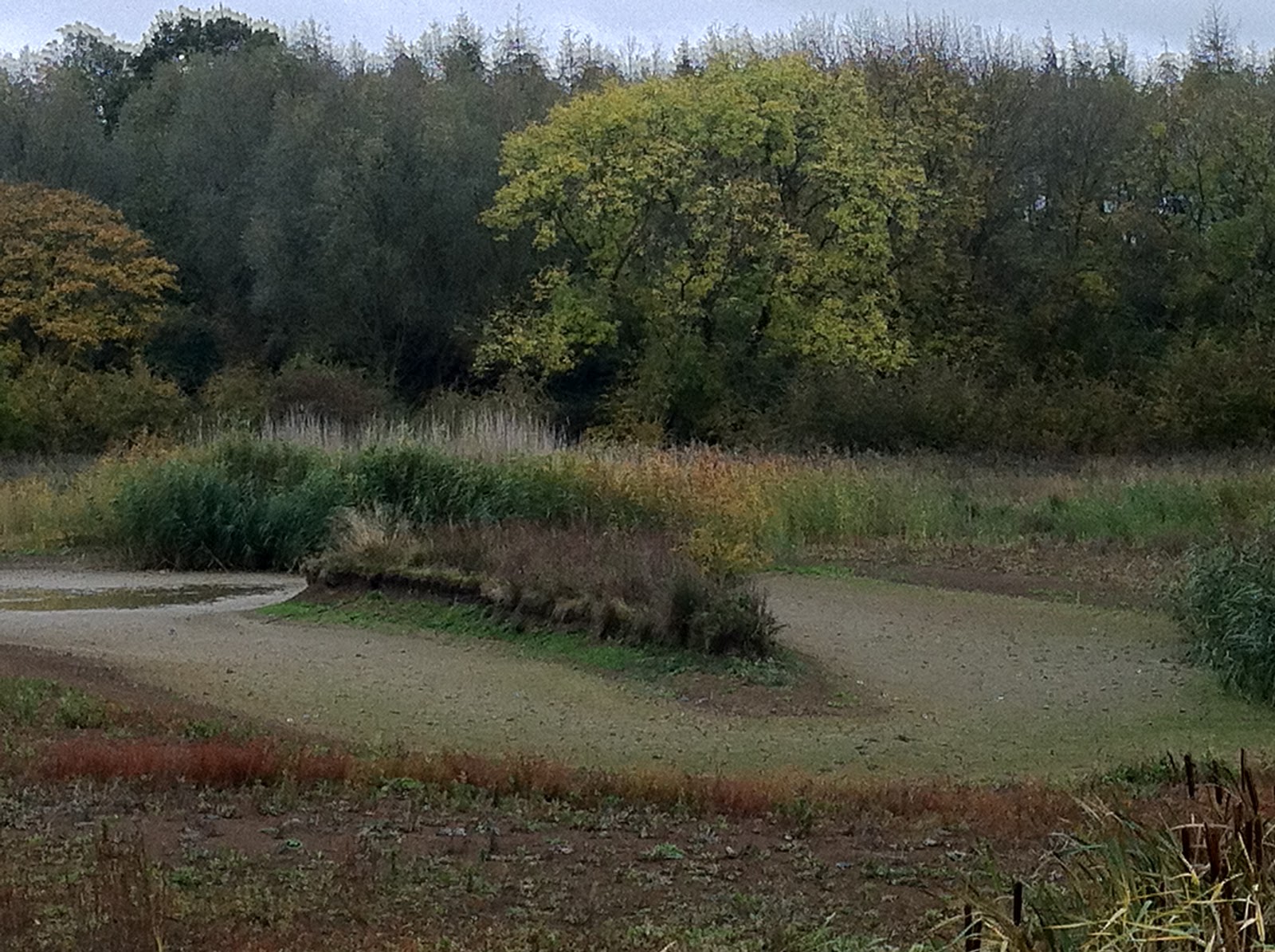
3. We're seriously in need of some water - the picture shows the sight that greeted me from the hide at the far end of the reserve. In case it's not obvious, that's supposed to be a shallow pool of water, a 'scrape', with an island in the middle.
Further upstream and into the Offchurch Bury estate, the river takes on a different character - narrower, shallower and faster. It screams 'chub' at every bend - although the ones I saw were of course holding station in a private / no-fishing stretch of course. Still, if they're here and they're downstream at the Princes Drive weir, then they'll be elsewhere along the river.
Starting at the Newbold Comyn car park I followed it up through the nature reserve, discovering a few things as follows:
1. It's still slow, low and deep, but there are a handful of places where it narrows, bends or shallows up a bit and actually finds a bit of flow - most of these look fishable and quite inviting.
2. Even if the fishing turns out to be poor, it's worth it at this time of year for the scenery and the wildlife - this one hour walk turned up kingfishers, bullfinches, green and great spotted woodpecker and a pair of noisy nuthatch.
3. We're seriously in need of some water - the picture shows the sight that greeted me from the hide at the far end of the reserve. In case it's not obvious, that's supposed to be a shallow pool of water, a 'scrape', with an island in the middle.
Further upstream and into the Offchurch Bury estate, the river takes on a different character - narrower, shallower and faster. It screams 'chub' at every bend - although the ones I saw were of course holding station in a private / no-fishing stretch of course. Still, if they're here and they're downstream at the Princes Drive weir, then they'll be elsewhere along the river.
31 October 2011
And the answer is...
... a single bronze maggot on a size 20 and ultra fine hook length. Pretty much what the answer always was really.
Sorry, I've run ahead of myself a bit there. That answer relates of course to the question that's been driving me mad for the best part of a month - how the hell do I catch anything in the Leam?
Well, I was half way through my third attempt at Welches Meadow when it dawned on me. In fact Inspiration came from an unlikely source - a large branch that I'd snagged and dragged out. It was alive with tiny worms / larvae, which kind of made me realise (durr) that my array of bread, corn, soft pellets and pastes might not be the normal menu on this under fished and 100% natural waterway. Too much of my fishing since I started again last year has been spent on commercials - hence the heavy lines, biggish hooks and man made baits.
So, with the inspiration that naturals might be the way forward here, I fined everything down, dug out the maggots I had leftover from Wednesday on the Avon and lo! we had fish.
I swear no one in the history of fishing has ever been more pleased to see a 3oz roach. It was beautiful, as was the 5oz roach that followed it, a similarly sized perch and the stream of tiny chublet that rallied to the cause. Not much to show for three long mornings on the Leam perhaps, but the 'duck' was broken. The bigger fish are surely now there for the taking.
Sorry, I've run ahead of myself a bit there. That answer relates of course to the question that's been driving me mad for the best part of a month - how the hell do I catch anything in the Leam?
Well, I was half way through my third attempt at Welches Meadow when it dawned on me. In fact Inspiration came from an unlikely source - a large branch that I'd snagged and dragged out. It was alive with tiny worms / larvae, which kind of made me realise (durr) that my array of bread, corn, soft pellets and pastes might not be the normal menu on this under fished and 100% natural waterway. Too much of my fishing since I started again last year has been spent on commercials - hence the heavy lines, biggish hooks and man made baits.
So, with the inspiration that naturals might be the way forward here, I fined everything down, dug out the maggots I had leftover from Wednesday on the Avon and lo! we had fish.
I swear no one in the history of fishing has ever been more pleased to see a 3oz roach. It was beautiful, as was the 5oz roach that followed it, a similarly sized perch and the stream of tiny chublet that rallied to the cause. Not much to show for three long mornings on the Leam perhaps, but the 'duck' was broken. The bigger fish are surely now there for the taking.
16 October 2011
'My' River Leam
The River Leam has been part of my life for 20 years or so. I've lived near it (hard not to in Leamington of course), I've walked its length from Leamington to Offchurch on many many occasions, I've birdwatched around it, and all in all I've grown rather fond of it.
The only thing I hadn't done with the river was fished it, something I resolved a couple of months ago to put right.
The first step was a couple of early morning sessions before work in August, trotting bread punch or maggot down a slow moving stretch up near the Grand Union Canal. These two sessions were very enjoyable indeed - the bread produced pristine hand-sized roach, and the maggot generally some scrappy little perch. But I suspected that autumn might be the the time to really tackle the Leam, so I put it to one side until October.
A bit of rain, I thought. A bit of flow. Perfect for fishing the sections that I know best, down through Newbold Comyn and Welches Meadow. Hmmm.
So, early October has arrived, it's nice and warm and there's been no rain at all. The Leam through Welches Meadow, far from being in 'full flow' (it never exactly races by) is completely static. In fact, thanks to a slight westerly breeze, the float was actually running slowly upstream for most of the morning.
This was my second of two consecutive Sunday's on the river, similar in terms of weather and conditions, identical in terms of results - zip, zilch, nothing at all. A nice opportunity to practice with a slider float (not something I've used seriously before), a pleasant place to sit (or even lie down) and birdwatch (several kingfisher fly-bys, grey wagtails, and today my first fieldfares of the year), but just one twitchy un-hittable bite on the tip to show for nearly 10 hours fishing.
There are plenty of reports of decent bream, roach, tench, eels and even carp in this stretch of river, plus the predators. And I will find them - eventually.
The only thing I hadn't done with the river was fished it, something I resolved a couple of months ago to put right.
The first step was a couple of early morning sessions before work in August, trotting bread punch or maggot down a slow moving stretch up near the Grand Union Canal. These two sessions were very enjoyable indeed - the bread produced pristine hand-sized roach, and the maggot generally some scrappy little perch. But I suspected that autumn might be the the time to really tackle the Leam, so I put it to one side until October.
![]() |
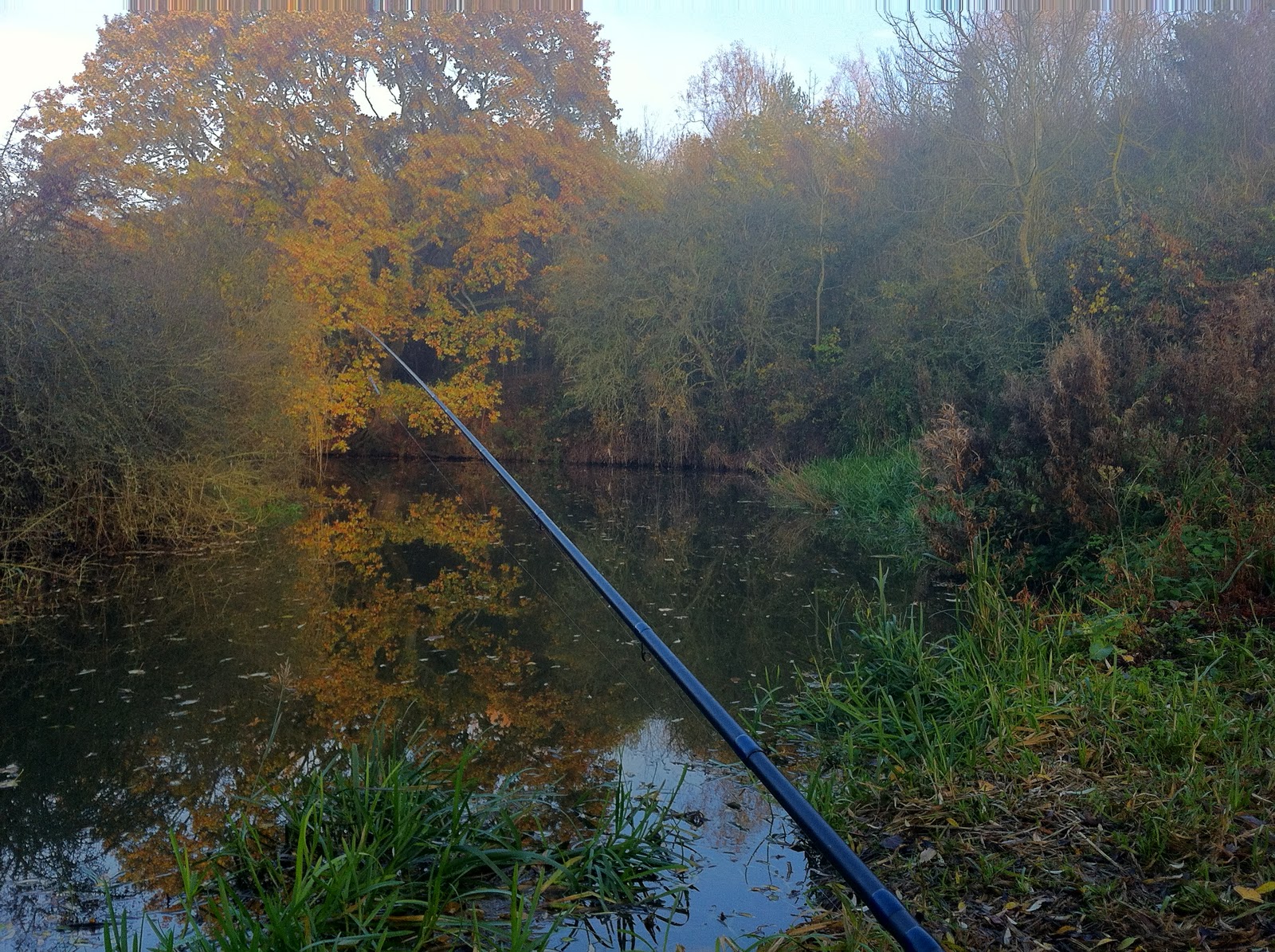
| My view while lying on the bank of the River Leam - a completely inanimate tip rod. |
So, early October has arrived, it's nice and warm and there's been no rain at all. The Leam through Welches Meadow, far from being in 'full flow' (it never exactly races by) is completely static. In fact, thanks to a slight westerly breeze, the float was actually running slowly upstream for most of the morning.
This was my second of two consecutive Sunday's on the river, similar in terms of weather and conditions, identical in terms of results - zip, zilch, nothing at all. A nice opportunity to practice with a slider float (not something I've used seriously before), a pleasant place to sit (or even lie down) and birdwatch (several kingfisher fly-bys, grey wagtails, and today my first fieldfares of the year), but just one twitchy un-hittable bite on the tip to show for nearly 10 hours fishing.
There are plenty of reports of decent bream, roach, tench, eels and even carp in this stretch of river, plus the predators. And I will find them - eventually.
7 October 2011
Harbingers of winter
I heard them as soon as I got out of the car in Henley-in-Arden this morning - the high seep, seep of redwings.
Sure enough, there they were: two of them struggling south / south-west against a blustery wind.
Always a joy to see, of course, but a sobering reminder that the best of the year is very definitely behind us now (Indian Summer not withstanding). I'm fishing a big exposed lake in Hertfordshire tomorrow morning (Stanborough), so time to dig the thermals out I think.
Sure enough, there they were: two of them struggling south / south-west against a blustery wind.
Always a joy to see, of course, but a sobering reminder that the best of the year is very definitely behind us now (Indian Summer not withstanding). I'm fishing a big exposed lake in Hertfordshire tomorrow morning (Stanborough), so time to dig the thermals out I think.
28 September 2011
The unexpected lifer
In the dying hour of a glorious late September day I rushed to Napton Reservoir to see if I could finally set eyes on the long-staying black-necked grebe.
The good news is that I did, the finding made considerably easier for the fact that it was a) less than 10 yards from the shore, and b) enjoying the admiring attention of three birders from Nuneaton.
The grebe was beautiful despite its winter plumage, the red eyes being its most striking feature. Sadly a quick stroll around the water turned up nothing else remarkable, the best being half a dozen pochard, a few skylarks and yellowhammers here and there, and even a little flock of linnets which I don't see nearly often enough.
Napton Hill was all but silent, so I returned home to attend to the blog... only to discover that the black-necked grebe was my first lifer in more than than a year, something I had completely failed to realise. And what is more, it was one which I predicted back in 2006 might turn up at Napton - see here for My Secret Patch Wishlist.
Don't you just love it when a plan comes together, albeit somewhat belatedly and unintentionally!
The good news is that I did, the finding made considerably easier for the fact that it was a) less than 10 yards from the shore, and b) enjoying the admiring attention of three birders from Nuneaton.
The grebe was beautiful despite its winter plumage, the red eyes being its most striking feature. Sadly a quick stroll around the water turned up nothing else remarkable, the best being half a dozen pochard, a few skylarks and yellowhammers here and there, and even a little flock of linnets which I don't see nearly often enough.
Napton Hill was all but silent, so I returned home to attend to the blog... only to discover that the black-necked grebe was my first lifer in more than than a year, something I had completely failed to realise. And what is more, it was one which I predicted back in 2006 might turn up at Napton - see here for My Secret Patch Wishlist.
Don't you just love it when a plan comes together, albeit somewhat belatedly and unintentionally!
26 September 2011
The hallmarks of autumn
One by one the hallmarks of autumn have been falling into place.
The first sign of the season was very punctual indeed. On September 1st I drew open the curtains at the back of my house to catch sight of the season's first early morning mist.
As if alerted by this starting gun, little pockets of swallows and house martins started to gather here, there and everywhere - small fast-feeding families low over river, lake or meadow, preparing for the long journey ahead.
As I gathered the apple harvest in my garden just a few days later I was joined by a handful of juvenile chiffchaffs. These are a regular find in my garden at this time of year, but almost never at any other.
Elsewhere t'internet is full of news of exotic migrant waders and seabirds at hotspots like the nearby Draycote Reservoir (including several manx shearwaters, which I would greatly have liked to have seen). Even litle Napton Reservoir has played host to a black necked grebe for the last couple of weeks.
As the weather has slowly worsened, the temperature of the the water has also dropped notably. This makes the fishing unreliable at best, and without a warming sun it becomes almost impossible to spot the chub in the litte streams I stroll along most lunchtimes.
And of course the darkness, the only bit of winter I truly dislike, draws inexorably nearer - sunset is 7.15pm at the moment and retreating at a rate of knots.
The first sign of the season was very punctual indeed. On September 1st I drew open the curtains at the back of my house to catch sight of the season's first early morning mist.
As if alerted by this starting gun, little pockets of swallows and house martins started to gather here, there and everywhere - small fast-feeding families low over river, lake or meadow, preparing for the long journey ahead.
As I gathered the apple harvest in my garden just a few days later I was joined by a handful of juvenile chiffchaffs. These are a regular find in my garden at this time of year, but almost never at any other.
Elsewhere t'internet is full of news of exotic migrant waders and seabirds at hotspots like the nearby Draycote Reservoir (including several manx shearwaters, which I would greatly have liked to have seen). Even litle Napton Reservoir has played host to a black necked grebe for the last couple of weeks.
As the weather has slowly worsened, the temperature of the the water has also dropped notably. This makes the fishing unreliable at best, and without a warming sun it becomes almost impossible to spot the chub in the litte streams I stroll along most lunchtimes.
And of course the darkness, the only bit of winter I truly dislike, draws inexorably nearer - sunset is 7.15pm at the moment and retreating at a rate of knots.
2 August 2011
Hot. Damn Hot.
It's early August and Warwickshire is hot. Hot and desert dry.
Although the weather of the last few months seems to have involved a lot of rain, it clearly hasn't been enough to counteract the effects of the record-breaking dry spring we had.
The soil is dry and cracked. Lush green grass has been replaced with impressionist smears of yellow, brown, khaki, ochre and every imaginable variation thereof. With the birds lying low after breeding, the fields around me are eerily quiet, with a silence broken only by the occasional tweet, the flap-flap of a wood pigeon taking to the air and the low, persistent hum of a million grass-bound insects. Often the only sign of movement on my lunchtime strolls comes from the few butterflies and bees that are willing to brave the midday sun.
Unsurprisingly, the waterways are low, slow and gin clear. The narrrow, shallow brooks which criss-cross the countryside are currently a great deal more narrow and shallow than normal. I lingered by one today, finding a pool which was just a touch deeper than elsewhere along that stretch. Sure enough, there were the fish - a dozen chub lazily holding position against a soporific current, the largest of them perhaps 10 inches in length. Resisting the urge to rush back to the car for my ever-handy travel rod, I instead stood stock-still and simply watched them.
They were entrancing and calming, and in the bright midday sun they were as clearly visible as wild fish ever become to us land-dwellers. Of course that in turn made me equally visible to them - and with one slight turn of my head I sent them dashing upstream, downstream, hither and thither in search of cover.
However low it might be, water is the key to nature watching at this time of year. While the fields might be empty, sites such as Brandon Marsh and Draycote Reservoir (and dozens of smaller, less well-known waterways) will be home to big numbers of dragonflies, butterflies (and moths), a wide array of birds including migrant waders and raptors, and (of course) those fish.
So water is always worth seeking out in high summer - just don't forget to glance into the water as well as looking all around it!
Bird of the week: Red kite (Milvus milvus), the most graceful bird of prey we have (in my ever-so-humble). Not that I got round to mentioning it in this post, but one flew low over an Oxfordshire campsite at the weekend and give us our own personal display, not long after a Spitfire fighter plane had very generously done very much the same thing.
Although the weather of the last few months seems to have involved a lot of rain, it clearly hasn't been enough to counteract the effects of the record-breaking dry spring we had.
The soil is dry and cracked. Lush green grass has been replaced with impressionist smears of yellow, brown, khaki, ochre and every imaginable variation thereof. With the birds lying low after breeding, the fields around me are eerily quiet, with a silence broken only by the occasional tweet, the flap-flap of a wood pigeon taking to the air and the low, persistent hum of a million grass-bound insects. Often the only sign of movement on my lunchtime strolls comes from the few butterflies and bees that are willing to brave the midday sun.
Unsurprisingly, the waterways are low, slow and gin clear. The narrrow, shallow brooks which criss-cross the countryside are currently a great deal more narrow and shallow than normal. I lingered by one today, finding a pool which was just a touch deeper than elsewhere along that stretch. Sure enough, there were the fish - a dozen chub lazily holding position against a soporific current, the largest of them perhaps 10 inches in length. Resisting the urge to rush back to the car for my ever-handy travel rod, I instead stood stock-still and simply watched them.
They were entrancing and calming, and in the bright midday sun they were as clearly visible as wild fish ever become to us land-dwellers. Of course that in turn made me equally visible to them - and with one slight turn of my head I sent them dashing upstream, downstream, hither and thither in search of cover.
However low it might be, water is the key to nature watching at this time of year. While the fields might be empty, sites such as Brandon Marsh and Draycote Reservoir (and dozens of smaller, less well-known waterways) will be home to big numbers of dragonflies, butterflies (and moths), a wide array of birds including migrant waders and raptors, and (of course) those fish.
So water is always worth seeking out in high summer - just don't forget to glance into the water as well as looking all around it!
Bird of the week: Red kite (Milvus milvus), the most graceful bird of prey we have (in my ever-so-humble). Not that I got round to mentioning it in this post, but one flew low over an Oxfordshire campsite at the weekend and give us our own personal display, not long after a Spitfire fighter plane had very generously done very much the same thing.
6 June 2011
Devonian delights
A family holiday in Devon gave me the chance for just a little birding with, in particular, a trip to Yarner Wood.
This ancient oak forest is an absolute delight, with wooded valleys, heathland, rivers and waterfalls running red with copper mineral, and an absolute abundance of the woodland birds that are under so much pressure in this increasingly tree-less land of ours.
First up were the singing wood warblers, followed by a striking male redstart. Moving out on to the heath we found a tree pipit singing and parachuting between two trees; moving back into the woods there were good views of a pair of spotted flycatchers.
My son had a great time with the challenge trail that English Nature had laid out for half term - and I learned some interesting insect facts along the way. A wonderful and real hands-on experience of nature for any child - recommended.
Of course I was disappointed not to have connected with any of the 50 pairs of pied flycatchers in the wood - and equally thrilled when a male landed on a branch right in front of my car as I rolled out of the car park! Bingo - the 'holy trinity' of oak wood birds achieved (redstart, wood warbler, pied fly).
What a happy boy.
Bird of the day: Pied Flycatcher (Ficedula hypoleuca), a fantastic little bird which is all but impossible to see unless you head west or north. This was only my second or third, and my first in England (the others having been in Wales).
This ancient oak forest is an absolute delight, with wooded valleys, heathland, rivers and waterfalls running red with copper mineral, and an absolute abundance of the woodland birds that are under so much pressure in this increasingly tree-less land of ours.
First up were the singing wood warblers, followed by a striking male redstart. Moving out on to the heath we found a tree pipit singing and parachuting between two trees; moving back into the woods there were good views of a pair of spotted flycatchers.
My son had a great time with the challenge trail that English Nature had laid out for half term - and I learned some interesting insect facts along the way. A wonderful and real hands-on experience of nature for any child - recommended.
Of course I was disappointed not to have connected with any of the 50 pairs of pied flycatchers in the wood - and equally thrilled when a male landed on a branch right in front of my car as I rolled out of the car park! Bingo - the 'holy trinity' of oak wood birds achieved (redstart, wood warbler, pied fly).
What a happy boy.
Bird of the day: Pied Flycatcher (Ficedula hypoleuca), a fantastic little bird which is all but impossible to see unless you head west or north. This was only my second or third, and my first in England (the others having been in Wales).
16 May 2011
Close encounters
One of the joys of fishing is that it often brings me physically closer to water-loving birds than birding ever did - often simply a function of sitting still for hours on end. It is not unheard of for kingfishers to alight momentarily on fishing rods for example.
Sunday was a case in point. I sat just a few feet away from two banks of reeds while reed warblers and sedge warblers flitted past my eyes all morning (distracting when you're supposed to be watching a float). Behind me sang whitethroat and blackcap, across the lake was a persistent turtle dove, a cuckoo had a brief go at about 6.30am and then seemed to give up for the day, and above and around me were swallows, swifts, buzzards and plenty more besides. All very welcome company indeed when the fishing slows a little.
Of many and varied other sightings in recent weeks, the highlight was a modest marsh tit, another addition to my lunchtime Henley-in-Arden list - as is so often the way, I bumped into as I took a stroll along the canal at Preston Bagot.
Sunday was a case in point. I sat just a few feet away from two banks of reeds while reed warblers and sedge warblers flitted past my eyes all morning (distracting when you're supposed to be watching a float). Behind me sang whitethroat and blackcap, across the lake was a persistent turtle dove, a cuckoo had a brief go at about 6.30am and then seemed to give up for the day, and above and around me were swallows, swifts, buzzards and plenty more besides. All very welcome company indeed when the fishing slows a little.
Of many and varied other sightings in recent weeks, the highlight was a modest marsh tit, another addition to my lunchtime Henley-in-Arden list - as is so often the way, I bumped into as I took a stroll along the canal at Preston Bagot.
4 May 2011
Spring unfurled
When I last wrote in these pages (early April, here) spring had just sprung - the first warblers were back, the early flowers were out, and I was busy prophesising one last sting in the tail at the end of a particularly harsh winter.
Well, if you've been in the UK during the subsequent four weeks you may well have noticed that my prophesy spectacularly failed to come true. What we've mainly had (unless you count a week of cool NE winds as a last hurrah for winter) has been clear blue skies, loads of sunshine and the beginnings of an alarming drought. And while that's not been so great for my allotment (which is now starting to take on an alarming dust-like texture), it's been great for getting outside and seeing / hearing spring unfold into summer.
So while the first warblers had just arrived at the start of April, I've since enjoyed: my first cuckoo calls of the year (Easter weekend in Essex's Hatfield Forest); the purring coo of the turtle dove (just after Easter at a lake near Southam); lapwings wheeling and wailing in courtship above Warwickshire fields (near Ufton, Lighthorne and Warwick); a pair of tawny owls calling to each other and showing well above a caravan in Yorkshire's Goit Stock valley (along with two dipper pairs and breeding grey wagtails nearby); and the return of a full complement of summer species (with only the swift still missing from my usual checklist).
The first orange tip and brimstone butterflies have been joined by peacocks, small tortoiseshells, various whites and other I'm too dull-witted to identify with any safety. The same problem pertains to wild flowers - I'm on safe(ish) ground in early spring with wild garlic, lesser celandine, snowdrops and on to the bluebells. Now that a full array of flora is bursting into life, my limited expertise comes to a shuddering halt. Suffice it to say then that there are a lot of flowers and insects around, as well as the birds!
Bird watching has increasingly become less something I specifically go to and more something I just do. It's not often I head out to a nature reserve or set off anywhere with the express intent of watching birds, but wherever and whenever I am outdoors, whether cycling, fishing, gardening, walking, playing with the family or just sitting, I am bird watching, bird listening and bird enjoying.
And while my life list, year list and the rest are suffering no end, my enjoyment of another unfurling spring most certainly is not.
Bird of the month: Tawny owl (Strix aluco); elusive by virtue of its nocturnal nature, but my fairly regular trips to the Goit Stock in Yorkshire give me great opportunities to hear and see this wonderful creature of the night.
Well, if you've been in the UK during the subsequent four weeks you may well have noticed that my prophesy spectacularly failed to come true. What we've mainly had (unless you count a week of cool NE winds as a last hurrah for winter) has been clear blue skies, loads of sunshine and the beginnings of an alarming drought. And while that's not been so great for my allotment (which is now starting to take on an alarming dust-like texture), it's been great for getting outside and seeing / hearing spring unfold into summer.
So while the first warblers had just arrived at the start of April, I've since enjoyed: my first cuckoo calls of the year (Easter weekend in Essex's Hatfield Forest); the purring coo of the turtle dove (just after Easter at a lake near Southam); lapwings wheeling and wailing in courtship above Warwickshire fields (near Ufton, Lighthorne and Warwick); a pair of tawny owls calling to each other and showing well above a caravan in Yorkshire's Goit Stock valley (along with two dipper pairs and breeding grey wagtails nearby); and the return of a full complement of summer species (with only the swift still missing from my usual checklist).
The first orange tip and brimstone butterflies have been joined by peacocks, small tortoiseshells, various whites and other I'm too dull-witted to identify with any safety. The same problem pertains to wild flowers - I'm on safe(ish) ground in early spring with wild garlic, lesser celandine, snowdrops and on to the bluebells. Now that a full array of flora is bursting into life, my limited expertise comes to a shuddering halt. Suffice it to say then that there are a lot of flowers and insects around, as well as the birds!
Bird watching has increasingly become less something I specifically go to and more something I just do. It's not often I head out to a nature reserve or set off anywhere with the express intent of watching birds, but wherever and whenever I am outdoors, whether cycling, fishing, gardening, walking, playing with the family or just sitting, I am bird watching, bird listening and bird enjoying.
And while my life list, year list and the rest are suffering no end, my enjoyment of another unfurling spring most certainly is not.
Bird of the month: Tawny owl (Strix aluco); elusive by virtue of its nocturnal nature, but my fairly regular trips to the Goit Stock in Yorkshire give me great opportunities to hear and see this wonderful creature of the night.
12 April 2011
That lunchtime list in full
I promised last week that I'd sit down and calculate my lunchtime list in full.
So here, in no particular order, is the full list of bird species that I have seen in a series of short lunchtime strolls around Henley-in-Arden, Wooten Wawen and Preston Bagot over the last decade (give or take a bit):
grey heron, little egret, moorhen, mallard, mandarin duck, mute swan, kingfisher, buzzard, kestrel, sparrowhawk, great spotted woodpecker, green woodpecker, nuthatch, treecreeper, wren, robin, blue tit, great tit, long-tailed tit, willow warbler, wood warbler, chiffchaff, blackcap, whitethroat, dunnock, blackbird, song thrush, mistle thrush, redwing, fieldfare, chaffinch, siskin, goldfinch, bullfinch, greenfinch, lesser redpoll, linnet, meadow pipit, cuckoo, black-headed gull, lesser black-backed gull, jackdaw, rook, carrion crow, raven, swift, swallow, house martin, pheasant, red-legged partridge, goldcrest, wood pigeon, collared dove, stock dove, grey wagtail, pied wagtail, magpie, jay, house sparrow.
For the record that's 59 species, of which my personal highlights have been: a wood warbler high on a dead tree near The Mount, a cuckoo on a telegraph wire not to far away, an entire telegraph wire (the same one) full of linnets, a little egret on the weir in Wooten Wawen, a mandarin duck on the tiny river running through Henley-in-Arden, and a nuthatch on the roof outside my office window.
Bird of the decade: Cuckoo (Cuculus canorus), not the rarest of the bunch (that must be the wood warbler) but this cuckoo was entirely unexpected, gave great views at close quarters, and I had a thrilling half hour just leaning against a tree watching it. A magical moment that I can clearly remember 7 or 8 years on; the closest I've come to repeating it was last year when I heard a few snatches of song but could never locate the bird.
So here, in no particular order, is the full list of bird species that I have seen in a series of short lunchtime strolls around Henley-in-Arden, Wooten Wawen and Preston Bagot over the last decade (give or take a bit):
grey heron, little egret, moorhen, mallard, mandarin duck, mute swan, kingfisher, buzzard, kestrel, sparrowhawk, great spotted woodpecker, green woodpecker, nuthatch, treecreeper, wren, robin, blue tit, great tit, long-tailed tit, willow warbler, wood warbler, chiffchaff, blackcap, whitethroat, dunnock, blackbird, song thrush, mistle thrush, redwing, fieldfare, chaffinch, siskin, goldfinch, bullfinch, greenfinch, lesser redpoll, linnet, meadow pipit, cuckoo, black-headed gull, lesser black-backed gull, jackdaw, rook, carrion crow, raven, swift, swallow, house martin, pheasant, red-legged partridge, goldcrest, wood pigeon, collared dove, stock dove, grey wagtail, pied wagtail, magpie, jay, house sparrow.
For the record that's 59 species, of which my personal highlights have been: a wood warbler high on a dead tree near The Mount, a cuckoo on a telegraph wire not to far away, an entire telegraph wire (the same one) full of linnets, a little egret on the weir in Wooten Wawen, a mandarin duck on the tiny river running through Henley-in-Arden, and a nuthatch on the roof outside my office window.
Bird of the decade: Cuckoo (Cuculus canorus), not the rarest of the bunch (that must be the wood warbler) but this cuckoo was entirely unexpected, gave great views at close quarters, and I had a thrilling half hour just leaning against a tree watching it. A magical moment that I can clearly remember 7 or 8 years on; the closest I've come to repeating it was last year when I heard a few snatches of song but could never locate the bird.
Fresh arrival - the reed warbler
I'm doing a lot of fishing at the moment, and while you don't get much time to look around, you do get a lot of time to listen to birdsong. That makes it a great way to notice the fresh arrivals as they return from Africa.
A couple of weeks ago I heard my first swallows overhead as I fished near Southam, then chiffchaffs, and then last weekend I was accompanied all day by at least a couple of willow warblers. This evening it was the turn of the reed warblers, again my first of the year. Their rhythmic chirping was complemented by the musical blackcap, more willow warblers and a single song thrush. Two bold reed buntings flitted around me throughout.
A nice tench, a couple of modest carp and some skimmer bream ensured a pleasant evening all round.
A couple of weeks ago I heard my first swallows overhead as I fished near Southam, then chiffchaffs, and then last weekend I was accompanied all day by at least a couple of willow warblers. This evening it was the turn of the reed warblers, again my first of the year. Their rhythmic chirping was complemented by the musical blackcap, more willow warblers and a single song thrush. Two bold reed buntings flitted around me throughout.
A nice tench, a couple of modest carp and some skimmer bream ensured a pleasant evening all round.
6 April 2011
Growing the lunchtime list
In common with most people I don't automatically qualify for a day off just because the sun's out. I am lucky enough to have some nice spots for a lunchtime stroll though. So with March's good weather continuing into April I have been able to watch spring unfolding in a series of extremely pleasant 40 minute walks.
Today's walk along the canal from Preston Bagot was another little cracker - clear skies, bright sun, a gentle cooling breeze and birdsong filling the air.
A great-spotted woodpecker and the goldfinches were in their customary haunts near the bridge (along with a particularly belligerent mute swan who's taken up residence there). Four or 5 buzzards circled overhead, the chiffchaff song that has grown familiar over recent weeks was accompanied by two male blackcaps, both singing lustily and prominently, and two of our most powerful vocalists - the song thrush and wren - were giving of their best.
Then, just as I reached my 'turnaround point', I found two red-legged partridge running ahead of me on the two path. I haven't encountered this lovely species during more than a decade of lunchtime walks in this area, so that's another one for the lunchtime life list. When I get a moment I must write that list down and work out how it stands.
Bird of the day: Red-legged partridge (Alectoris rufa), an introduced species like the pheasant, and with many of the same characteristics - often found in the same kinds of places, with strong attractive markings and often shot at by hunting types!
![]() |
| Red-legged partridge: here's one I took earlier... |
A great-spotted woodpecker and the goldfinches were in their customary haunts near the bridge (along with a particularly belligerent mute swan who's taken up residence there). Four or 5 buzzards circled overhead, the chiffchaff song that has grown familiar over recent weeks was accompanied by two male blackcaps, both singing lustily and prominently, and two of our most powerful vocalists - the song thrush and wren - were giving of their best.
Then, just as I reached my 'turnaround point', I found two red-legged partridge running ahead of me on the two path. I haven't encountered this lovely species during more than a decade of lunchtime walks in this area, so that's another one for the lunchtime life list. When I get a moment I must write that list down and work out how it stands.
Bird of the day: Red-legged partridge (Alectoris rufa), an introduced species like the pheasant, and with many of the same characteristics - often found in the same kinds of places, with strong attractive markings and often shot at by hunting types!
25 March 2011
A sting in the tail?
Another lovely lunchtime stroll today, on a gloriously sunny March day.
Birds included a great spotted woodpecker, great views of a female kestrel on a telegraph wire, buzzards (plenty), chiffchaffs (now seemingly establishing approx. 3 territories along the stretch of canal from Preston Bagot towards Stratford), goldfinches, tits (blue, great and long-tailed), loads of wren activity and the usual mallards and swans.
So, a lovely 40 minute walk, spoiled only the the insistent lurking voice at the back of my mind. "20 degrees in March," it sneered. "It won't last. Winter's not done with you yet my lad."
And however lovely this week has been, history suggests the voice is right - winter normally has one last sting in the tail. Don't pack away the sweaters just yet.
Birds included a great spotted woodpecker, great views of a female kestrel on a telegraph wire, buzzards (plenty), chiffchaffs (now seemingly establishing approx. 3 territories along the stretch of canal from Preston Bagot towards Stratford), goldfinches, tits (blue, great and long-tailed), loads of wren activity and the usual mallards and swans.
So, a lovely 40 minute walk, spoiled only the the insistent lurking voice at the back of my mind. "20 degrees in March," it sneered. "It won't last. Winter's not done with you yet my lad."
And however lovely this week has been, history suggests the voice is right - winter normally has one last sting in the tail. Don't pack away the sweaters just yet.
22 March 2011
Who turned up the volume?
All new birdwatchers quickly discover that sound pretty much as important as sight in birding - you always hear plenty of species which you don't end up actually seeing, and even when you do see a bird, it was often the sound that helped alert you to them in the first place.
It takes a bit of practice to distinguish even the most common bird calls and songs, and sadly after many years I'm still struggling to be even averagely good at this (although it's a skill of which you don't need much to amaze non-birdwatchers, who nearly always seem to find it mind-boggling that anyone could tell a robin from a greenfinch by sound alone - and in case you're wondering, that particular task really is spectacularly easy).
So for most of us it's a case of practice makes perfect - and if you're going to practice, this is the time of year to get stuck in. Because, quite simply, it is around now that the bird volume gets cranked all the way up to 11.
Monday was a case in point. As I wandered along a stretch of Derby river and path not very far at all from the ring road, I was practically deafened - not by the passing traffic, but by the combined efforts of wrens, blackbirds, robins, a song thrush, goldfinches and greenfinches, all singing their hearts out (and there are some noisy buggers in that little list). Likewise, tonight in the garden was jolly pleasant, but you should have heard the noise from the house sparrows, collared doves and skylarks around me - I could barely hear the planes as they passed overhead!
And tomorrow morning I will be woken, as every morning this week, by an enthusiastic blackbird or two at about 5am. Hmmm, a mixed blessing this birdsong.
20 March 2011
A couple of local notes
While fishing a private lake this morning, not a million miles from Southam, I was lucky enough to have a chiffchaff singing behind me, a song thrush singing in front of me, a noisy green woodpecker roundabouts, a raven overhead and a male reed bunting in fairly constant attendance throughout the morning. Plus a couple of decent tench, which means spring must really be here!
Back in Radford Semele, I went for a teatime stroll through the neighbouring farmland for the first time in ages, and was rewarded with four yellowhammers high in a mature oak tree, the males absolutely beautiful in the bright afternoon sun.
19 March 2011
Springing back to Leam Valley
OK, so I knew I'd been neglecting my patch a bit - but according to my records, it's been nearly 12 months since I was last birding in Leam Valley :-o
Now that's poor.
And ill-advised too, since - as I noted in my last post from the reserve - the place is starting to mature nicely. There's a huge amount of woodland management going on, and the three reed beds on the scrape in particular have finally taken hold in a decisive way, which should bode well for reed / sedge warblers this summer, as well as snipe, teal and perhaps water rail?
Well, today there were none of these on view, but there was a male shoveller on the scrape, my first for this reserve. A pair of reed buntings flitted around, the second pair I found on the day. Also on the scrape were six tufted ducks, in pairs.
Elsewhere, there was a single redpoll in the middle of a loose flock of tit species (there were four here at the same time last year). A few goldcrest were in the conifers near the hide, along with a single coal tit. A single chiffchaff sang near the car park, and a song thrush was singing near the golf course.
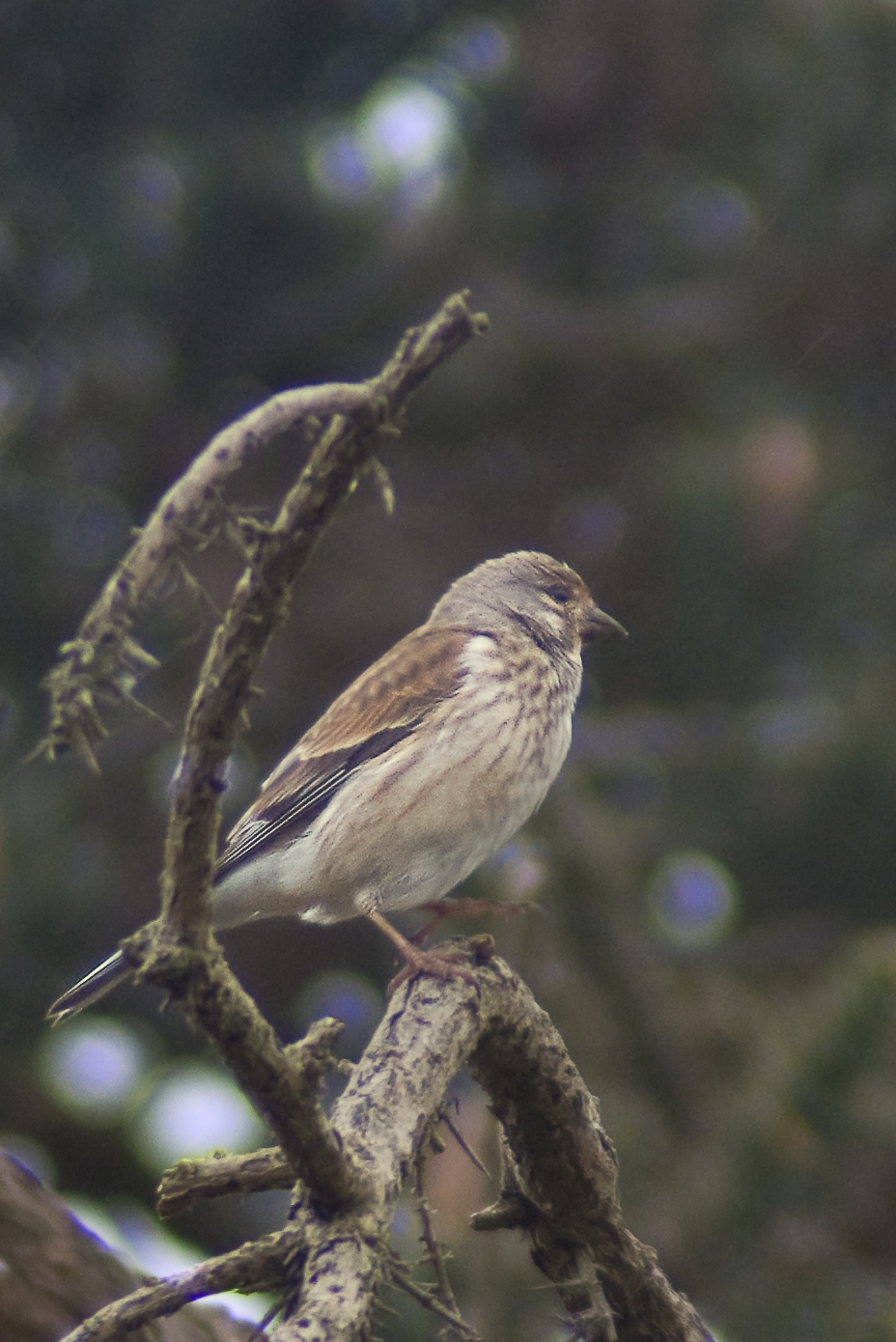
I strolled down to Offchurch Bury weir hoping to find singing yellowhammers, but there were none. What I did find were about a dozen chub (to 15 inches or so, decent fish), just holding their position by the footbridge. I was hoping to find the grey wagtails as well, and there they were, considerably bolder than any I have encountered before - hence the photos, which were taken on a 6x zoom pocket camera.
The kestrel was pictured on the same camera, having been similarly obliging.
Bird of the day: Lesser redpoll (Carduelis cabaret), if only because it was such a good find, high on its own in an alder tree.
Now that's poor.
And ill-advised too, since - as I noted in my last post from the reserve - the place is starting to mature nicely. There's a huge amount of woodland management going on, and the three reed beds on the scrape in particular have finally taken hold in a decisive way, which should bode well for reed / sedge warblers this summer, as well as snipe, teal and perhaps water rail?
Well, today there were none of these on view, but there was a male shoveller on the scrape, my first for this reserve. A pair of reed buntings flitted around, the second pair I found on the day. Also on the scrape were six tufted ducks, in pairs.
Elsewhere, there was a single redpoll in the middle of a loose flock of tit species (there were four here at the same time last year). A few goldcrest were in the conifers near the hide, along with a single coal tit. A single chiffchaff sang near the car park, and a song thrush was singing near the golf course.I strolled down to Offchurch Bury weir hoping to find singing yellowhammers, but there were none. What I did find were about a dozen chub (to 15 inches or so, decent fish), just holding their position by the footbridge. I was hoping to find the grey wagtails as well, and there they were, considerably bolder than any I have encountered before - hence the photos, which were taken on a 6x zoom pocket camera.
The kestrel was pictured on the same camera, having been similarly obliging.
Bird of the day: Lesser redpoll (Carduelis cabaret), if only because it was such a good find, high on its own in an alder tree.
18 March 2011
And the final tally is...
I finished up my week of lunchtime canal walks with not one, but three new ticks for the list.
I balanced up the week by walking for the second time down the stretch of canal running from Preston Bagot towards Lowsonford (but not going so far this time due to lack of time).
The sun was out again, although a chill will kept the temperature down to 10 degrees or so (Celsius, I mean - you won't often find me venturing out with a light fleece on at 10 Fahrenheit (which is -12 Celsius, I just looked it up)).
Alongside the blue tits, redwings and goldfinch that kept me company most of the way, a little side path bursting with wild garlic turned up the first new bird of the week - a goldcrest, flitting through some tree-bound ivy.
Shortly after I caught glimpse of a bullfinch pair that dashed madly in front of me before settling in still-bare hawthorns not too far away. And the moment I'd stopped near the end of my walk to do a mental tally for the week, I heard the tap-tap-tap of a great spotted woodpecker - a female just a couple of metres above my head.
So that tally is: mute swan; mallard; grey heron; pheasant; kestrel; buzzard; raven; carrion crow; jackdaw; jay; magpie; great spotted woodpecker; green woodpecker; nuthatch; blackbird; mistle thrush; song thrush; redwing; fieldfare; robin; dunnock; wren; house sparrow; starling; wood pigeon; collared dove; grey wagtail; blue tit; great tit; long-tailed tit; chiffchaff; goldfinch; chaffinch; siskin; bullfinch; greenfinch; and goldcrest.
That makes 37 (excluding the red kites I saw while on my London train, although that too was technically a lunchtime birding session). Not a bad total with some good birds included, and a useful (to me) reminder that you don't need a nature reserve, three hours and a £500 pair of binoculars to enjoy birdwatching - although the latter would have come in handy on more than one occasion ;-)
Bird of the day: Goldcrest (Regulus regulus), one of those birds which is common enough but which you can never guarantee seeing on any given trip - or indeed in any given week. Probably helped by the fact that it is Britain's smallest songbird.
I balanced up the week by walking for the second time down the stretch of canal running from Preston Bagot towards Lowsonford (but not going so far this time due to lack of time).
The sun was out again, although a chill will kept the temperature down to 10 degrees or so (Celsius, I mean - you won't often find me venturing out with a light fleece on at 10 Fahrenheit (which is -12 Celsius, I just looked it up)).
Alongside the blue tits, redwings and goldfinch that kept me company most of the way, a little side path bursting with wild garlic turned up the first new bird of the week - a goldcrest, flitting through some tree-bound ivy.
Shortly after I caught glimpse of a bullfinch pair that dashed madly in front of me before settling in still-bare hawthorns not too far away. And the moment I'd stopped near the end of my walk to do a mental tally for the week, I heard the tap-tap-tap of a great spotted woodpecker - a female just a couple of metres above my head.
So that tally is: mute swan; mallard; grey heron; pheasant; kestrel; buzzard; raven; carrion crow; jackdaw; jay; magpie; great spotted woodpecker; green woodpecker; nuthatch; blackbird; mistle thrush; song thrush; redwing; fieldfare; robin; dunnock; wren; house sparrow; starling; wood pigeon; collared dove; grey wagtail; blue tit; great tit; long-tailed tit; chiffchaff; goldfinch; chaffinch; siskin; bullfinch; greenfinch; and goldcrest.
That makes 37 (excluding the red kites I saw while on my London train, although that too was technically a lunchtime birding session). Not a bad total with some good birds included, and a useful (to me) reminder that you don't need a nature reserve, three hours and a £500 pair of binoculars to enjoy birdwatching - although the latter would have come in handy on more than one occasion ;-)
Bird of the day: Goldcrest (Regulus regulus), one of those birds which is common enough but which you can never guarantee seeing on any given trip - or indeed in any given week. Probably helped by the fact that it is Britain's smallest songbird.
17 March 2011
Windhover at Preston Bagot
...Of the rolling level underneath him steady air, and striding
High there, how he rung upon the rein of a wimpling wing
In his ecstasy! then off, off forth on swing,
As a skate’s heel sweeps smooth on a bow-bend: the hurl and gliding
Rebuffed the big wind. My heart in hiding
Stirred for a bird,—the achieve of; the mastery of the thing!
Brute beauty and valour and act, oh, air, pride, plume, here
Buckle! AND the fire that breaks from thee then, a billion
Times told lovelier, more dangerous, O my chevalier!
- from The Windhover, by Gerard Manley Hopkins.
My week's 'lunchtime list' grew still further today with another stroll along the canal, this time back along the stretch from Preston Bagot towards Stratford.
First up were a pair of mistle thrushes, and then two infuriatingly elusive and thin-billed birds with very spotty flanks that just wouldn't show themselves properly (I just hope to God they were an obvious thrush species, even those same two mistle thrushes looking a bit too small in the gloom, rather than anything rare, because I never did nail down the id).
A raven flew low overhead shortly afterwards, and then I stood stock still to watch a pair of kestrels performing at close range around me for a good 15 minutes or so. It's far, far too long since I last took the time to watch these beautiful birds in detail, so I was grateful for this opportunity.
Bird of the Day: Kestrel (Falcon tinnunculus) - Gerard Manley Hopkins 'windhover' is a beautiful creature that should never fail to stir the heart. When I were a lad it was Britain's most common raptor; after 30 years of slow decline I suspect it has been long overtaken, round these parts at least, by the buzzard.
High there, how he rung upon the rein of a wimpling wing
In his ecstasy! then off, off forth on swing,
As a skate’s heel sweeps smooth on a bow-bend: the hurl and gliding
Rebuffed the big wind. My heart in hiding
Stirred for a bird,—the achieve of; the mastery of the thing!
Brute beauty and valour and act, oh, air, pride, plume, here
Buckle! AND the fire that breaks from thee then, a billion
Times told lovelier, more dangerous, O my chevalier!
- from The Windhover, by Gerard Manley Hopkins.
My week's 'lunchtime list' grew still further today with another stroll along the canal, this time back along the stretch from Preston Bagot towards Stratford.
First up were a pair of mistle thrushes, and then two infuriatingly elusive and thin-billed birds with very spotty flanks that just wouldn't show themselves properly (I just hope to God they were an obvious thrush species, even those same two mistle thrushes looking a bit too small in the gloom, rather than anything rare, because I never did nail down the id).
A raven flew low overhead shortly afterwards, and then I stood stock still to watch a pair of kestrels performing at close range around me for a good 15 minutes or so. It's far, far too long since I last took the time to watch these beautiful birds in detail, so I was grateful for this opportunity.
Bird of the Day: Kestrel (Falcon tinnunculus) - Gerard Manley Hopkins 'windhover' is a beautiful creature that should never fail to stir the heart. When I were a lad it was Britain's most common raptor; after 30 years of slow decline I suspect it has been long overtaken, round these parts at least, by the buzzard.
16 March 2011
Further adventures on the Stratford-upon-Avon canal
After a great start to my week of lunchtime bird walks near Henley-in-Arden (see Herald's of Spring, below), today took a turn for the greyer, the colder... but it still turned up the goods.
I spent much of yesterday on the train to London and back (red kites over the Chiltern, muntjac deer and hares in the fields of Oxfordshire), so I was looking forward to stretching my legs on a midday stroll along the two miles or so of canal from Preston Bagot towards Lowsonford and back.
The outward stretch turned up nothing much, but shortly after I turned for home I was stopped by the churring of two mistle thrushes in nearby trees. As they moved on, my bins moved past a superb male chaffinch and just caught a flash of movement - movement that was notable for one reason: it was down a tree trunk. That could only mean one thing - a nuthatch, the only UK bird that I can think of able to crawl down, as well as up, a tree trunk. Although they're common enough, I've not seen one for ages, so I was pretty chuffed.
Just a few steps on and I realised I was surrounded on all sides by a mixed flock of perhaps 200 fieldfares and redwings; another hundred yards or so and there were siskins high above me, in a mixed flock with goldfinches.
I finished with great views of a jay, and returned to the office in good spirits.
Bird of the day: Nuthatch (Sitta europaea), a stunning little woodpecker like bird, glorious in yellow and blue.
I spent much of yesterday on the train to London and back (red kites over the Chiltern, muntjac deer and hares in the fields of Oxfordshire), so I was looking forward to stretching my legs on a midday stroll along the two miles or so of canal from Preston Bagot towards Lowsonford and back.
The outward stretch turned up nothing much, but shortly after I turned for home I was stopped by the churring of two mistle thrushes in nearby trees. As they moved on, my bins moved past a superb male chaffinch and just caught a flash of movement - movement that was notable for one reason: it was down a tree trunk. That could only mean one thing - a nuthatch, the only UK bird that I can think of able to crawl down, as well as up, a tree trunk. Although they're common enough, I've not seen one for ages, so I was pretty chuffed.
Just a few steps on and I realised I was surrounded on all sides by a mixed flock of perhaps 200 fieldfares and redwings; another hundred yards or so and there were siskins high above me, in a mixed flock with goldfinches.
I finished with great views of a jay, and returned to the office in good spirits.
Bird of the day: Nuthatch (Sitta europaea), a stunning little woodpecker like bird, glorious in yellow and blue.
14 March 2011
Heralds of spring (the chiffchaffs are here!)
Inspired by a tweet'ed report (how appropriate) of chiffchaffs in Sheffield, I spent lunchtime on a birding walk to find my own.
From Preston Bagot I headed along the canal (Stratford direction) and within 10 minutes could hear my first chiffchaff of spring. It quickly fell silent but soon after I'd turned and started the walk back, I reconnected with not one but two birds, one calling somewhere near and the other feeding rapidly but gracefully in the trees lining the canal opposite me.
It's a moment that never fails to move me - the first of these beautiful, sleek little buff birds refueling, wagging their tails and singing their joy after a gruelling flight of several thousand miles from West Africa to here.
When added to a tally which also included a pair of grey wagtails, three displaying buzzards, a small flock of long-tailed tits, goldfinches aplenty, a grey heron and several calling green woodpeckers, I'd call that a pretty successful 40 minutes.
Bird of the day: Chiffchaff (Phylloscopus collybita), the one true herald of spring.
From Preston Bagot I headed along the canal (Stratford direction) and within 10 minutes could hear my first chiffchaff of spring. It quickly fell silent but soon after I'd turned and started the walk back, I reconnected with not one but two birds, one calling somewhere near and the other feeding rapidly but gracefully in the trees lining the canal opposite me.
It's a moment that never fails to move me - the first of these beautiful, sleek little buff birds refueling, wagging their tails and singing their joy after a gruelling flight of several thousand miles from West Africa to here.
When added to a tally which also included a pair of grey wagtails, three displaying buzzards, a small flock of long-tailed tits, goldfinches aplenty, a grey heron and several calling green woodpeckers, I'd call that a pretty successful 40 minutes.
Bird of the day: Chiffchaff (Phylloscopus collybita), the one true herald of spring.
9 March 2011
The water rule
Where there's water there's nearly always nature - a rule of thumb brought home to me again on Monday as I took a lunchtime stroll along the River Derwent in Derby.
Pleasant surprise #1 was that a female goosander (probably one of the three I first spotted a month ago) had moved up from the edge of town and was now swimming opposite the Council House in the very heart of the the city.
Pleasant surprise #2 came just a few hundred yards further on, when I was able to watch my first ever american mink as it picked its way along the far bank for several minutes.
It never ceases to amaze me what you can find if you've got a patch of water and a spare 20 minutes to explore. Keep 'em peeled!
Pleasant surprise #1 was that a female goosander (probably one of the three I first spotted a month ago) had moved up from the edge of town and was now swimming opposite the Council House in the very heart of the the city.
Pleasant surprise #2 came just a few hundred yards further on, when I was able to watch my first ever american mink as it picked its way along the far bank for several minutes.
It never ceases to amaze me what you can find if you've got a patch of water and a spare 20 minutes to explore. Keep 'em peeled!
6 March 2011
Back at Napton
I'm told that confession (see below) isn't enough on it's own. Nor is the intention to change. One needs to prove the intention to change if one is to be absolved.
So, bright and early (ish) this morning I set off this morning for Napton Reservoir, determined to get my feet and eyes back into the swing of birding things. It turns out that a lot of things haven't changed so very much since I last went birding back in October.
For a start, I only got about 100 yards from the car before I bumped into Richard and Dave, who confirmed that the year had got off to a slow start, and that nothing had dropped in today to change that pattern. Fortunately I have lower standards than either of them (!) and within minutes I was having a wonderful time, if only because it was good to be out again.
Alongside the regulars (c. 40 coot, 25 tufties, a dozen mallard, a few moorhens, a pair of mute swans and a couple of hundred gulls, about 40/60 common and black-headed) were 7 great crested grebes, 12 shoveller, 5 pochard, a few teal tucked into the edge of the reed bed, a snipe which flushed from a drainage dish, a couple of bullfinch near the entrance, plenty of jaunty chaffinches and, high in the sky to my right, a couple of skylark trilling high in the grey sky.
OK, it was hardly a mega haul, but the shovellers were (are) beautiful, the snipe was a nice surprise (thought it was going to take my head off as it flew out), and who doesn't enjoy watching great crested grebes in full courtship?
After a lovely stroll to all corners of the reservoir (and a chat to a couple of the fishermen - I shall be back for Napton tench this spring / summer), I headed up to the hill for something nice to finish the day. Apart from being reminded how beautiful blue tits actually are, there was little added from this short excursion.
Nice to be back though.
Bird of the day: Shoveller (Anus clypeata) - you have to say, that is one striking duck.
So, bright and early (ish) this morning I set off this morning for Napton Reservoir, determined to get my feet and eyes back into the swing of birding things. It turns out that a lot of things haven't changed so very much since I last went birding back in October.
![]() |
| Library photo |
Alongside the regulars (c. 40 coot, 25 tufties, a dozen mallard, a few moorhens, a pair of mute swans and a couple of hundred gulls, about 40/60 common and black-headed) were 7 great crested grebes, 12 shoveller, 5 pochard, a few teal tucked into the edge of the reed bed, a snipe which flushed from a drainage dish, a couple of bullfinch near the entrance, plenty of jaunty chaffinches and, high in the sky to my right, a couple of skylark trilling high in the grey sky.
OK, it was hardly a mega haul, but the shovellers were (are) beautiful, the snipe was a nice surprise (thought it was going to take my head off as it flew out), and who doesn't enjoy watching great crested grebes in full courtship?
After a lovely stroll to all corners of the reservoir (and a chat to a couple of the fishermen - I shall be back for Napton tench this spring / summer), I headed up to the hill for something nice to finish the day. Apart from being reminded how beautiful blue tits actually are, there was little added from this short excursion.
Nice to be back though.
Bird of the day: Shoveller (Anus clypeata) - you have to say, that is one striking duck.
5 March 2011
Confessions of an absent birder
I am far from being a Catholic, but there is an air of the confessional about this post. Forgive me, readers (if any are left), for I have sinned - it has been four months since both I last went birding and I last wrote in this blog.
Not really sins of course, except that the cardinal rule of both birding and blogging is regularity, and in that respect I have fallen dismally short. Of my absence from blogging you will of course be in no doubt, since you can see for yourself the cavernous gap, the epochal time period, between this post and the last. But at least I can try to persuade you that I haven't failed quite so dismally on the birding front, and reassure you that my absence from birdwatching (in the formal sense) has been slightly mitigated by the number of bird moments I have enjoyed during that time.
Such as? Well, heading into winter there were the vast flocks of fieldfare and redwing which followed me everywhere; the less common garden visitors such as long-tailed tits and a great spotted woodpecker; and the occasional 'gem' such as the siskins and the three goosander I found on a lunchtime walk in the very centre of Derby. As I sat fishing, and freezing, near Bishops Itchington not so long ago, I was joined by both a buzzard and a kingfisher in short order. On my journey, five lapwing had been tumbling over the fields near Ufton.
Moving into the very earliest part spring, my short lunchtime strolls have been punctuated by welcome sounds - the first great tit calls, then the song thrush, the chaffinch, the greenfinch and more. A male sparrowhawk flashed past me last week, a red kite swept low over my car as I drove through Oxfordshire, and a raven did the same in Offchurch one day. In significantly more peril were the red-legged partridge and the male pheasant which nearly ran under my car on successive days near Claverdon. And while lunchtimes have proved quite productive, working hours themselves turned up a pair of bullfinches outside one office window and a male great spotted woodpecker outside the other.
So, no birding but plenty of birds. Nothing rare but plenty to enjoy. But definitely no enough blogging. Sorry.
Bird of the winter: Goosander (Mergus merganser), definitely my favourite unexpected moment of the last few months. I could not have imagined that a short stroll along the river, just a few hundred yards from the main shopping area, would have turned up not one but three of these exquisite birds.
Not really sins of course, except that the cardinal rule of both birding and blogging is regularity, and in that respect I have fallen dismally short. Of my absence from blogging you will of course be in no doubt, since you can see for yourself the cavernous gap, the epochal time period, between this post and the last. But at least I can try to persuade you that I haven't failed quite so dismally on the birding front, and reassure you that my absence from birdwatching (in the formal sense) has been slightly mitigated by the number of bird moments I have enjoyed during that time.
Such as? Well, heading into winter there were the vast flocks of fieldfare and redwing which followed me everywhere; the less common garden visitors such as long-tailed tits and a great spotted woodpecker; and the occasional 'gem' such as the siskins and the three goosander I found on a lunchtime walk in the very centre of Derby. As I sat fishing, and freezing, near Bishops Itchington not so long ago, I was joined by both a buzzard and a kingfisher in short order. On my journey, five lapwing had been tumbling over the fields near Ufton.
Moving into the very earliest part spring, my short lunchtime strolls have been punctuated by welcome sounds - the first great tit calls, then the song thrush, the chaffinch, the greenfinch and more. A male sparrowhawk flashed past me last week, a red kite swept low over my car as I drove through Oxfordshire, and a raven did the same in Offchurch one day. In significantly more peril were the red-legged partridge and the male pheasant which nearly ran under my car on successive days near Claverdon. And while lunchtimes have proved quite productive, working hours themselves turned up a pair of bullfinches outside one office window and a male great spotted woodpecker outside the other.
So, no birding but plenty of birds. Nothing rare but plenty to enjoy. But definitely no enough blogging. Sorry.
Bird of the winter: Goosander (Mergus merganser), definitely my favourite unexpected moment of the last few months. I could not have imagined that a short stroll along the river, just a few hundred yards from the main shopping area, would have turned up not one but three of these exquisite birds.
7 November 2010
The fastest twitcher in the West
Thanks to various reports on Friday that the great grey shrike was still showing at Napton, I went to bed feeling reasonably confident that I'd been able to track it down in the 45 minutes or so I had free on Saturday morning.
Well, it wasn't looking good when I first turned up. For one thing, there was no one else about. Did everyone know something I didn't? I trekked up and down Brickyard Lane, stopped to check out how the fishing was going at the little farm pools there, and then wandered up to the quarry.
![]() |
| Library photo |
Although I still didn't find the shrike, I did get good views of a sparrowhawk, a cormorant heading towards the reservoir(s), large flocks of long-tailed tits, a few smaller groups of small finches (I'm guessing goldfinch and linnet), and a small group of twitchers / photographers down the hill towards the canal. Since they were all settled but chatting , my guesses were a) that was where the bird had been sighted most often and b) it hadn't showed yet.
Right on both counts. But with my 45 minutes having already stretched beyond the hour (boy, was I going to be in trouble) I spotted it on a wire above the canal, not far from where this group had set up. A quick jog of a few hundred yards and there I was, locked on to a great grey shrike just 20 yards of so away. I enjoyed it for 10 minutes or so, and crept away for family duties and a where-the-hell-have-you-been telling off.
Worth it though ;-)
Bird of the day: Great grey shrike (Lanius excubitor), a stunning predator that is a real autumn / winter gem for UK birders - rare, but not so rare that one can't turn up on pretty much anyone's patch given a bit of luck.
1 November 2010
Hurray for my patch (boo for me)
Well, it's been an absolutely bumper autumn for my patch - that little stretch of land which runs east out of Leamington Spa, as far as Napton-on-the-Hill.
Napton alone has thrown up a magnificent treble of bearded tit, waxwing and great grey shrike, all in the last fortnight. Any one of them would be a patch birder's dream in this part of the world.
Unfortunately this is not the best place to read about them, because I haven't been there :-(
This was partly my own fault (a bit too much time spent fishing, for example) and partly the usual excuses about work / family commitment (violins at the ready please), but it's still jolly annoying.
Anyway, my advice for anyone wanting to know what's happening on my patch would be to visit www.onemanandhispond.blogspot.com and Richard Mays can tell you (since he found all three in the first place). Well done that man, just rewards for many, many hours patient patch birding.
Oh, and by the way, don't give up on me completely - normal service will be resumed soon.
Bird of the season: Frankly, any of the above would have floated my boat!
Napton alone has thrown up a magnificent treble of bearded tit, waxwing and great grey shrike, all in the last fortnight. Any one of them would be a patch birder's dream in this part of the world.
Unfortunately this is not the best place to read about them, because I haven't been there :-(
This was partly my own fault (a bit too much time spent fishing, for example) and partly the usual excuses about work / family commitment (violins at the ready please), but it's still jolly annoying.
Anyway, my advice for anyone wanting to know what's happening on my patch would be to visit www.onemanandhispond.blogspot.com and Richard Mays can tell you (since he found all three in the first place). Well done that man, just rewards for many, many hours patient patch birding.
Oh, and by the way, don't give up on me completely - normal service will be resumed soon.
Bird of the season: Frankly, any of the above would have floated my boat!
8 September 2010
Back at birding - migrants and a mega
Just as I thought I was going to miss the whole of Warwickshire's autumn migration, I was finally able to find an excuse for a day off and a trip to some of the best local spots.I set off in a pretty jolly mood, but my hopes were no longer high as I stood high on Napton-on-the-Hill just before 7am. The graveyard was as quiet as a... well, a graveyard I suppose. After a bit of scouring I managed to find a few quietly calling chiffchaffs and a single spotted flycatcher skulking deep in the hedges, but where was the migration hotspot I had been reading about lately?
More than a little disappointed, I headed to Draycote Reservoir to hunt for some of the most recent sightings, notably yesterday's red-necked phalarope. Starting from Hensborough Bank I found both ringed and little ringed plover, a few freshly arrived wigeon, a snipe which flew fast and low past me, a great spotted woodpecker which did likewise, and the usual assortment of wildfowl (including a couple of pochard).
Turning my attention to the open water, I scoured in vain for the phalarope, failing to locate it but picking up the pretty considerable consolation of two little gulls and three black terns as I went. Moving on to Tofts I found up to a dozen juvenile yellow wagtails and a wheatear on Farborough Bank. Ayoung tern moving between Toft and Farborough was identified as a little tern, although I'm afraid juvenile terns are generally beyond my humble powers of identification.
Although I wasn't able to locate the phalarope, I did bump into a man who could - the original finder, Richard Mays. And, given a little time and a stroll back to Hensborough, he repeated the trick, finding this tiny later wader flitting and bobbing out in the deep water. Fantastic - a definite county tick and only my second red-necked ever.
After a refreshing (i.e. massive) breakfast at the Long Itch Diner, I gave Napton-on-the-Hill one last go. And what a difference a couple of hours had made. The churchyard had come alive: there were at least a dozen young spotted flycatchers around, young chiffchaffs and willow warblers hanging from every tree (the latter so brightly yellow that I thought for a moment I'd hit on a flock of a dozen wood warblers!), swallows and house martins swooping all around, a mistle thrush watching on from a nearby telegraph wire, and even a tawny owl calling in the middle of the day.
It was a real migration marvel; a lovely end to the morning and a reminder of what I had been missing.
Bird of the day: Red-necked phalarope (Phalaropus lobatus), a delicate little wader which, unlike most waders, spends much of its time bobbing on the water. It has a notably frantic, twitching manner, spending all of its time pecking, preening or making short nervous flights hither and thither.
21 July 2010
Still here!
I haven't stopped blogging, I've just stopped birding - temporarily at least.
Not that I've stopped watching birds, you understand. Or butterflies, bees, dragonflies, fish, plants and everything else from the world around me. It's just that I've not had any time over the last couple of months to settle down for an hour or more to study, appreciate and record them in detail - hence the lack of posts on The Hornet's Nest.
Instead I've been doing what I always do - taking every opportunity to pause for a moment and look at what's around me. So while I've been working, travelling, camping, cycling or gardening I've had loads of great little finds and encounters.
So I've been (literally) buzzed by a buzzard; marvelled at marbled whites; bewitched by brown trout; and entranched by a canalside kingfisher. I've lain on the grass and watched swifts scream overhead; I've found chub gently holding their position against the flow of a lazy summer stream; and I've struggled, as I do every year, to tell my small whites from my green veined, my gatekeepers from my meadow browns.
All of which means that despite the lack of 'proper' birding trips, 2010 has been a vintage summer for me in Warwickshire. Long may it last.
Not that I've stopped watching birds, you understand. Or butterflies, bees, dragonflies, fish, plants and everything else from the world around me. It's just that I've not had any time over the last couple of months to settle down for an hour or more to study, appreciate and record them in detail - hence the lack of posts on The Hornet's Nest.
Instead I've been doing what I always do - taking every opportunity to pause for a moment and look at what's around me. So while I've been working, travelling, camping, cycling or gardening I've had loads of great little finds and encounters.
So I've been (literally) buzzed by a buzzard; marvelled at marbled whites; bewitched by brown trout; and entranched by a canalside kingfisher. I've lain on the grass and watched swifts scream overhead; I've found chub gently holding their position against the flow of a lazy summer stream; and I've struggled, as I do every year, to tell my small whites from my green veined, my gatekeepers from my meadow browns.
All of which means that despite the lack of 'proper' birding trips, 2010 has been a vintage summer for me in Warwickshire. Long may it last.
27 May 2010
Rambles at lunchtime
I'm lucky enough to work close to hills, fields, some fragments of woodland, a stream and a canal; and while the wildlife they hold isn't generally remarkable, it does provide a very pleasant backdrop for lunchtime strolls (whenever work allows).
This week has been a case in point. As I have wandered through the fields and along the stream I have seen and heard species including: kestrel, buzzard, carrion crow, jackdaw, green woodpecker, great spotted woodpecker, nuthatch, chaffinch, goldfinch, chiffchaff, blue tit, great tit, robin, whitethoat, pied wagtail, grey wagtail, blackbird, song thrush, chub, rainbow trout, various butterflies (sorry, can't remember which, but it's a good spot for marbled white later in the summer) and, just as I was about to head back to the office today, the loud clear call of a cuckoo.
It's not a bad haul for a little lunchtime ramble.
Bird of the week: Cuckoo (Cuculus canorus), one of the most distinctive sights and sounds of May, now sadly all too uncommon.
This week has been a case in point. As I have wandered through the fields and along the stream I have seen and heard species including: kestrel, buzzard, carrion crow, jackdaw, green woodpecker, great spotted woodpecker, nuthatch, chaffinch, goldfinch, chiffchaff, blue tit, great tit, robin, whitethoat, pied wagtail, grey wagtail, blackbird, song thrush, chub, rainbow trout, various butterflies (sorry, can't remember which, but it's a good spot for marbled white later in the summer) and, just as I was about to head back to the office today, the loud clear call of a cuckoo.
It's not a bad haul for a little lunchtime ramble.
Bird of the week: Cuckoo (Cuculus canorus), one of the most distinctive sights and sounds of May, now sadly all too uncommon.
Senses working overtime
This morning was too perfect to spoil with anything as frantic as listing or twitching or even 'proper' birding – I resolved instead to simply wander around Fingringoe Reserve and embrace the sights, sounds and smells of the Colne Estuary in May.
The whole place was alive in the sunshine. The very first field that I wandered across held two red-legged partridges, two moorhens and a song thrush. Swallows swooped low over the rough grass and in the distance a little egret flapped past.
Over at the nearby lake, two red-jewelled birds swam briefly on the surface before diving under – little grebes in their finest plumage. Nearby, the first of the chaffinches, whitethoats and blackcaps sang – then suddenly the nightingale song started. It is an explosive, distintive and beautiful sound and, here at least, it is everywhere.
I strolled down to Robbie's Hide to check the tide: it was just heading out, already exposing a wide expanse of undulating mudflat, silvery in the sun. Herring gulls passed lazily by, black-headed gulls busied themselves, and a pair of shelduck just sat, their terracotta panels vivid against the silvery blue all around them.
As I headed back up the hill I started to hear more of the common birds I might expect: a dunnock, a wren, a green woodpecker and a chiffchaff. Then another familiar sound joined in: a turtle dove, drawing me back towards to the trees. Sadly I didn't find it – and it was the same story when a cuckoo started calling just a few minutes later.
Down in the far corner, where the reserve meets farmland, I found familiar farmland birds including skylarks and yellowhammer. Reed warblers sang in nearby reedbeds, and a male marsh harrier made several magnificent overhead passes.
Bird of the day: Marsh harrier (Circus aeruginosus), a magnificent sight which is all too uncommon for those of us living in the west – fortunately they are increasingly common along the east coast.
The whole place was alive in the sunshine. The very first field that I wandered across held two red-legged partridges, two moorhens and a song thrush. Swallows swooped low over the rough grass and in the distance a little egret flapped past.
Over at the nearby lake, two red-jewelled birds swam briefly on the surface before diving under – little grebes in their finest plumage. Nearby, the first of the chaffinches, whitethoats and blackcaps sang – then suddenly the nightingale song started. It is an explosive, distintive and beautiful sound and, here at least, it is everywhere.
I strolled down to Robbie's Hide to check the tide: it was just heading out, already exposing a wide expanse of undulating mudflat, silvery in the sun. Herring gulls passed lazily by, black-headed gulls busied themselves, and a pair of shelduck just sat, their terracotta panels vivid against the silvery blue all around them.
As I headed back up the hill I started to hear more of the common birds I might expect: a dunnock, a wren, a green woodpecker and a chiffchaff. Then another familiar sound joined in: a turtle dove, drawing me back towards to the trees. Sadly I didn't find it – and it was the same story when a cuckoo started calling just a few minutes later.
Down in the far corner, where the reserve meets farmland, I found familiar farmland birds including skylarks and yellowhammer. Reed warblers sang in nearby reedbeds, and a male marsh harrier made several magnificent overhead passes.
Bird of the day: Marsh harrier (Circus aeruginosus), a magnificent sight which is all too uncommon for those of us living in the west – fortunately they are increasingly common along the east coast.
20 May 2010
Brandon in the evening
After a long day at work I decided to make an evening trip to Brandon Marsh for the first time this year, picking up a few wonderful sightings in the process.
The headline birds were a temminck's stint (my first since 2005, that also at Brandon) and the pair of garganey (my first of the year, the male already well into moult).
But alongside these I had a generally wonderful evening in the sunshine, passing a tranquil hour watching lapwing flying lazily over teal pool, a redshank sweeping the far bank, three separate sightings of cuckoos in flight (again, my first of the year), a female great crested grebe carrying at least one youngster on her back, little ringed plovers running all around the main island on east marsh pool, and loads more besides.
I normally do my birding in the morning, but there is something special about a summer evening. This one was no exception.
Bird of the day: Temminck's Stint (Calidris temminckii), a tiny but elongated wader which breeds mainly in the arctic - fewer than 100 are seen every year in England as they pass through on migration, so every sighting is a little bit special.
The headline birds were a temminck's stint (my first since 2005, that also at Brandon) and the pair of garganey (my first of the year, the male already well into moult).
But alongside these I had a generally wonderful evening in the sunshine, passing a tranquil hour watching lapwing flying lazily over teal pool, a redshank sweeping the far bank, three separate sightings of cuckoos in flight (again, my first of the year), a female great crested grebe carrying at least one youngster on her back, little ringed plovers running all around the main island on east marsh pool, and loads more besides.
I normally do my birding in the morning, but there is something special about a summer evening. This one was no exception.
Bird of the day: Temminck's Stint (Calidris temminckii), a tiny but elongated wader which breeds mainly in the arctic - fewer than 100 are seen every year in England as they pass through on migration, so every sighting is a little bit special.
19 May 2010
Wonderful moments in May
Assuming the weather behaves, May is probably (in my ever so humble opinion) the finest month in the British calendar. Although I remain busy with family and work commitments, I take every opportunity to sneak out for a few minutes to remind myself of that.
Lunchtime walks in the fields around my office have provided particularly fruitful this week: a best-ever nuthatch experience on Tuesday as one of these little blue gems failed to notice me less than three metres away; trees and hedges full of warbler song; not one but two pairs of grey wagtails on the little stream behind my office; and kestrels and buzzards hunting over the rough fields that make up the land around the 'mount'.
And it's a similar story in the garden, with house sparrows and starlings busy making nests and getting ready to feed their young, blue tits dashing hither and thither, and this magnificent male bullfinch (see picture) making a prolonged appearance outside my french doors tonight as I settled down to watch some tv.
Bird of the day(s): Nuthatch (Sitta europaea), a wonderful woodpecker-like bird which never fails to delight on the rare occasions it shows itself - generally it is easier to hear than to see.
Lunchtime walks in the fields around my office have provided particularly fruitful this week: a best-ever nuthatch experience on Tuesday as one of these little blue gems failed to notice me less than three metres away; trees and hedges full of warbler song; not one but two pairs of grey wagtails on the little stream behind my office; and kestrels and buzzards hunting over the rough fields that make up the land around the 'mount'.
And it's a similar story in the garden, with house sparrows and starlings busy making nests and getting ready to feed their young, blue tits dashing hither and thither, and this magnificent male bullfinch (see picture) making a prolonged appearance outside my french doors tonight as I settled down to watch some tv.
Bird of the day(s): Nuthatch (Sitta europaea), a wonderful woodpecker-like bird which never fails to delight on the rare occasions it shows itself - generally it is easier to hear than to see.
16 May 2010
A day 'off patch'
I joined up with a friend today for a morning's birding away from my usual haunts.
The early rain as I drove to our meeting point turned out to be a false alarm - the shower passed over, the chill north wind quickly died down and we were left with a superb morning.
It turned out to be even more superb as the birds turned up: as many as 10 ringed plover, three pairs of little ringed plover, skies full of swifts and sand martins, a pair of summer plumaged dunlin, a redshank, plenty of warblers in full song (including several lesser whitethroat and a particularly showy sedge warbler), linnets and meadow pipits aplenty, and lot more besides.
Alongside these were butterflies and dragonflies enjoying the steadily rising temperatures: orange-tip, speckled wood, small copper and brimstone, plus several superb broad-bodied chasers (pictured).
Bird of the day: Swift (Apus apus); despite all the waders and warblers, it was the low flying and ever-wonderful swifts that did most to captivate me this morning.
The early rain as I drove to our meeting point turned out to be a false alarm - the shower passed over, the chill north wind quickly died down and we were left with a superb morning.It turned out to be even more superb as the birds turned up: as many as 10 ringed plover, three pairs of little ringed plover, skies full of swifts and sand martins, a pair of summer plumaged dunlin, a redshank, plenty of warblers in full song (including several lesser whitethroat and a particularly showy sedge warbler), linnets and meadow pipits aplenty, and lot more besides.
Alongside these were butterflies and dragonflies enjoying the steadily rising temperatures: orange-tip, speckled wood, small copper and brimstone, plus several superb broad-bodied chasers (pictured).
Bird of the day: Swift (Apus apus); despite all the waders and warblers, it was the low flying and ever-wonderful swifts that did most to captivate me this morning.
13 May 2010
And a nightingale sang...
Another weekend away from home, so again no Warwickshire birding (missing in the process a pair of Wood Sandpiper at Brandon :-( good job I've long since given up worrying about the size of my patch and county lists).Instead I was back in Essex, and so took a couple of quick trips to Fingringoe, the Essex Wildlife Trust reserve on the shores of the Colne Estuary, not far from Colchester.
The reserve is famous for its nightingales - perhaps 30 or 40 singing birds each spring. This weekend they were in full voice, and I finally managed to lock on to one for good views as well - sadly the only photograph I managed was massively out of focus through the foliage.
There were, however, good photo opps for two birds I don't often get that close to - first a red-legged partridge, of which there were dozens running around the site, and second a pair of linnets, perched on gorse near the salt marshes.Other decent birds across the two days including a pair of marsh harriers, a cettis, a lone reed warbler, and among the shoreline waders a pair each of summer plumaged dunlin and grey plover, neither birds I see much of in Warwickshire at this time of year.
Bird of the day: Nightingale (Luscinia megarhynchos), dull brown and skulky little birds, about the size of a robin: a bird who's ordinariness is forgiven and forgotten the moment it starts to sing an astonishing array of songs and noises.
26 April 2010
A week of firsts
No 'proper' birding this week, but spring rolled on without me and I still had opportunities to snatch a few minutes here and find a succession of 'firsts' for the year.
Last Friday (16th April), I saw my first swallow in Radford Semele, a male who flashed low past my bedroom window. Within a week there were a few of them about, swooping regularly over my garden, and the first house martins had also arrived to join then (first noticed Saturday 27th).
The first pink blooms opened on the red campion in my garden on Saturday; and on Sunday I took a brief family trip to Brandon Marsh and found my first bluebells of the year.
Brandon itself was alive with bird song, the wood (New Hare Covert?) being particularly noiseome with blackcap, chiffchaff, willow warbler, wren and an active great spotted woodpecker. I also found my first whitethroats of the year, and heard my first sedge and reed warblers.
I'm guessing / hoping it will be the swifts next - I know there are a few around, but I've yet to spot one. Assuming this year follows the pattern of recent times, the air right over my work car park usually starts to deliver about now, so fingers crossed.
Last Friday (16th April), I saw my first swallow in Radford Semele, a male who flashed low past my bedroom window. Within a week there were a few of them about, swooping regularly over my garden, and the first house martins had also arrived to join then (first noticed Saturday 27th).
The first pink blooms opened on the red campion in my garden on Saturday; and on Sunday I took a brief family trip to Brandon Marsh and found my first bluebells of the year.
Brandon itself was alive with bird song, the wood (New Hare Covert?) being particularly noiseome with blackcap, chiffchaff, willow warbler, wren and an active great spotted woodpecker. I also found my first whitethroats of the year, and heard my first sedge and reed warblers.
I'm guessing / hoping it will be the swifts next - I know there are a few around, but I've yet to spot one. Assuming this year follows the pattern of recent times, the air right over my work car park usually starts to deliver about now, so fingers crossed.
18 April 2010
It's a wonderful world
Just a lovely morning's birding and walking; I simply couldn't have asked for more.
The remnant of a late frost was still on the ground when I arrived just after 7am at Leam Valley, with mist rising from the river and a slight chill in the air. All of this quickly burned off as the clear blue sky and brilliant sun set about their work; by 9am I was in shirt sleeves.
The most notable change from a couple of weeks ago was the number of chiffchaffs calling - the one that greeted me in the car park was the first of five in all. The other notably 'spring-y' birds were a lone willow warbler and two singing blackcaps - the first of which gave me my first decent sighting of one for quite some time (see photo).
Aside from these classic spring sightings, there was bird song and frantic activity to enjoy right the way across the reserve: song thrushes in full voice; a sparrowhawk cruising overhead; a couple of treecreeper (nearly got a photo of one of the buggers at last, see attempt below); and a pair of snipe on the scrape.
A total of 31 species represents a good morning's birding at Leam Valley, but actually my favourite sighting of the morning wasn't a bird at all - it was a small cluster of fritillaries in a little clearing in the woods. These are stunning little flowers, and a huge favourite of mine that I rarely see.
So, a great morning, and set to get better. I went to Brandon for a quick walk with the family, and as usual I dashed off down to East Marsh for a quick look-see on my own. Half way down the track I was pointed in the direction of the day's surprise visitor - the avocet from earlier in the week had returned! I hot-footed it down to River Pool and sure enough, there it was. A wonderful bird wherever you see it, but all the more wonderful in Warwickshire (I might be biased here).
And there was plenty more on East Marsh pool including little ringed plovers (3), snipe (5), oystercatchers (3), a redshank, and a freshly returned common tern.
The grand total for the day reached 51 species, a pretty decent haul for a bit of gentle wandering round two of my favourite reserves.
Bird of the day: Avocet (Recurvirostra avosetta), it simply has to be. A symbol of hope for the conservation movement and a beautiful elegant bird to-boot.
Flower of the day: Snake's head fritillary (Fritillaria meleagris); it is so unusual and beautiful it is hard to believe that it's a genuinely natural and native wildflower, rather than an exotic import or some specially-bred garden centre special. Rather rare these days, so a real gem of a find.
Oh, a just a word on the photographs. The usual hotchpotch, some OK, others little more than record shots. The treecreeper and cetti's warbler are included because I've been trying to photograph these little %^**&ers for years, and these are both the closest I've come - in both cases I couldn't get a clear focus because of intervening foliage (plus slow lenses plus no talent).
The willow warbler was at least clearly visible, if distant; but the award for obliging behaviour goes to the dunnock, who sat about two metres in front of me singing his little heart out while I photographed him. Thanks fella.
The remnant of a late frost was still on the ground when I arrived just after 7am at Leam Valley, with mist rising from the river and a slight chill in the air. All of this quickly burned off as the clear blue sky and brilliant sun set about their work; by 9am I was in shirt sleeves.The most notable change from a couple of weeks ago was the number of chiffchaffs calling - the one that greeted me in the car park was the first of five in all. The other notably 'spring-y' birds were a lone willow warbler and two singing blackcaps - the first of which gave me my first decent sighting of one for quite some time (see photo).
Aside from these classic spring sightings, there was bird song and frantic activity to enjoy right the way across the reserve: song thrushes in full voice; a sparrowhawk cruising overhead; a couple of treecreeper (nearly got a photo of one of the buggers at last, see attempt below); and a pair of snipe on the scrape.
A total of 31 species represents a good morning's birding at Leam Valley, but actually my favourite sighting of the morning wasn't a bird at all - it was a small cluster of fritillaries in a little clearing in the woods. These are stunning little flowers, and a huge favourite of mine that I rarely see.
So, a great morning, and set to get better. I went to Brandon for a quick walk with the family, and as usual I dashed off down to East Marsh for a quick look-see on my own. Half way down the track I was pointed in the direction of the day's surprise visitor - the avocet from earlier in the week had returned! I hot-footed it down to River Pool and sure enough, there it was. A wonderful bird wherever you see it, but all the more wonderful in Warwickshire (I might be biased here).And there was plenty more on East Marsh pool including little ringed plovers (3), snipe (5), oystercatchers (3), a redshank, and a freshly returned common tern.
The grand total for the day reached 51 species, a pretty decent haul for a bit of gentle wandering round two of my favourite reserves.
Bird of the day: Avocet (Recurvirostra avosetta), it simply has to be. A symbol of hope for the conservation movement and a beautiful elegant bird to-boot.
Flower of the day: Snake's head fritillary (Fritillaria meleagris); it is so unusual and beautiful it is hard to believe that it's a genuinely natural and native wildflower, rather than an exotic import or some specially-bred garden centre special. Rather rare these days, so a real gem of a find.
Oh, a just a word on the photographs. The usual hotchpotch, some OK, others little more than record shots. The treecreeper and cetti's warbler are included because I've been trying to photograph these little %^**&ers for years, and these are both the closest I've come - in both cases I couldn't get a clear focus because of intervening foliage (plus slow lenses plus no talent).
The willow warbler was at least clearly visible, if distant; but the award for obliging behaviour goes to the dunnock, who sat about two metres in front of me singing his little heart out while I photographed him. Thanks fella.
16 April 2010
Spring rolls out
Spring continues to bloom in Radford Semele, although I am only getting a few fleeting opportunities to see it unfold :-(In the garden, the daffodils are gradually fading; in a matter of days they will be replaced by the few tulips that I have. Bird song still wakes me every morning, most notably our resident song thrush. He might be a bit early for my liking, but at least he is more musical than the house sparrows living in my loft space!
Meanwhile the two jays have become regular garden visitors for the first time ever (one pictured left), and there are signs that we might have breeding blue tits again, possibly in our bird box.
This morning saw a real spring landmark though - my first village swallow of the year, flashing past the front of our house at 10am this morning.
Bird of the week: Barn Swallow (Hirundo rustica); agile, beautiful and a quintissential bird of the British spring and summer.
11 April 2010
A big spring morning
With the family away for the weekend, it was just like the old days today - an early start, five hours 'in the field', four sites, 50 odd species of birds - bloody marvellous.
I started at Ufton Fields, always a lovely walk if not always the easiest site for birding. I quickly found my first Willow Warblers of the year; they were showing well along with 4/5 song thrushes, a similar number of chiffchaffs and other favourites such as green and great spotted woodpeckers, three jays, two bullfinch pairs, a treecreeper and a reed bunting. As I packed up to leave, I was chuffed to hear my first blackcap of the year, singing near the car park.
I moved on to Napton Reservoir, which was rammed with fishermen (presumably taking part in a match; they all looked very serious). A stroll from one end to the other added the usual (tufted ducks, mallards and coots, two pairs of great crested grebes and a total of 11 mute swans) as well as at least one cetti's warbler, skylarks over nearby fields, two more bullfinch pairs and two swallows.
I drew an almost complete blank on nearby Napton Hill, adding only stock dove and kestrel to my morning haul. So I moved on to Brandon Marsh where there was plenty about for a big finale: scores of sand martins (my first of the year) buzzing around the artificial nesting bank; a pair each of ringed plover, oystercatcher and redshank; nine snipe; and good numbers of lapwings.
Bird of the day: Willow warbler (Phylloscopus trochilus), although it's a tough call between these and the sand martins, both favourite arrivals at this time of year. The soft floating call of the willow warbler carries the day though; from now until September this will be my favourite sound of the English countryside.
I started at Ufton Fields, always a lovely walk if not always the easiest site for birding. I quickly found my first Willow Warblers of the year; they were showing well along with 4/5 song thrushes, a similar number of chiffchaffs and other favourites such as green and great spotted woodpeckers, three jays, two bullfinch pairs, a treecreeper and a reed bunting. As I packed up to leave, I was chuffed to hear my first blackcap of the year, singing near the car park.
I moved on to Napton Reservoir, which was rammed with fishermen (presumably taking part in a match; they all looked very serious). A stroll from one end to the other added the usual (tufted ducks, mallards and coots, two pairs of great crested grebes and a total of 11 mute swans) as well as at least one cetti's warbler, skylarks over nearby fields, two more bullfinch pairs and two swallows.
I drew an almost complete blank on nearby Napton Hill, adding only stock dove and kestrel to my morning haul. So I moved on to Brandon Marsh where there was plenty about for a big finale: scores of sand martins (my first of the year) buzzing around the artificial nesting bank; a pair each of ringed plover, oystercatcher and redshank; nine snipe; and good numbers of lapwings.
Bird of the day: Willow warbler (Phylloscopus trochilus), although it's a tough call between these and the sand martins, both favourite arrivals at this time of year. The soft floating call of the willow warbler carries the day though; from now until September this will be my favourite sound of the English countryside.
2 April 2010
Napton - fantasy vs reality
When I close my eyes and picture Napton in the springtime, I see a vibrant, bustling migration hotspot; a hillside and reservoir alive with opportunity. I see wheatear hopping on every quarry rock; whinchat bouncing on every fence post; bushes dripping with firecrest; and the water alive with the spectacle of a hundred dancing sand martin (with a few more wheatear and perhaps an early wader thrown in for good measure). Unfortunately, when I open my eyes and actually go there, it tends not to live up to this fantasy.
Not that it's a poor place to go birding: far from it in fact. Napton Hill has already thrown up one of the best birds of early spring; one of the aforementioned firecrests. It's just that... well, it's inevitable that if you get very few opportunities to go birding, then you invest each and every visit with the kind of wishful thinking that is unlikely to ever come true.
Having said all of that, and despite today's lack of firecrest and whinchat (not to mention passage waders, rare warblers and even sand martin), I rather enjoyed my little visit to Napton Hill and the nearby reservoir today.
First of all there was the sheer joy of being out and about in the springtime, even if it did feel a little autumnal at times. Second was the satisfaction of being safely back home by the time the forecast rain set in for the day. And third, there were enough birds around to at least satisfy, if not to truly set the pulse racing.
At the top of the hill there were plenty of goldfinch, greenfinch, chaffinch, blackbird and wren. There was loud birdsong all around, including several singing song thrushes (easier to write than to say). On the hillsides there were great tits, blue tits and long-tailed tits aplenty; a treecreeper scurrying through them; a male reed bunting down in the quarry; and a few redwing and largish flocks of fieldfare and starling, presumably preparing to set off 'home' for the summer. Not one but two pairs of buzzards circled overhead, and four singing chiffchaffs confirmed that this was definitely time to celebrate spring.
That sentiment was given a further boost when I arrived at the reservoir and found two male swallows criss-crossing the surface. For all the talk of a return to a 'normal' (i.e. later) spring this year, April 2nd equals my earliest sighting for a swallow across the six years I have kept records. Other birds around the reservoir included: ten mute swans (an unusually high number; I also found 24 in a nearby field); a pair of reed buntings; three lapwings in a neighbouring field; skylarks in the same field; two calling Cettis Warblers; and two pairs of great crested grebes.
Bird of the day: Barn Swallow (Hirundo rustica); one of iconic birds of a British summer, newly arrived back from its south african wintering grounds.
Not that it's a poor place to go birding: far from it in fact. Napton Hill has already thrown up one of the best birds of early spring; one of the aforementioned firecrests. It's just that... well, it's inevitable that if you get very few opportunities to go birding, then you invest each and every visit with the kind of wishful thinking that is unlikely to ever come true.
Having said all of that, and despite today's lack of firecrest and whinchat (not to mention passage waders, rare warblers and even sand martin), I rather enjoyed my little visit to Napton Hill and the nearby reservoir today.
First of all there was the sheer joy of being out and about in the springtime, even if it did feel a little autumnal at times. Second was the satisfaction of being safely back home by the time the forecast rain set in for the day. And third, there were enough birds around to at least satisfy, if not to truly set the pulse racing.
At the top of the hill there were plenty of goldfinch, greenfinch, chaffinch, blackbird and wren. There was loud birdsong all around, including several singing song thrushes (easier to write than to say). On the hillsides there were great tits, blue tits and long-tailed tits aplenty; a treecreeper scurrying through them; a male reed bunting down in the quarry; and a few redwing and largish flocks of fieldfare and starling, presumably preparing to set off 'home' for the summer. Not one but two pairs of buzzards circled overhead, and four singing chiffchaffs confirmed that this was definitely time to celebrate spring.
That sentiment was given a further boost when I arrived at the reservoir and found two male swallows criss-crossing the surface. For all the talk of a return to a 'normal' (i.e. later) spring this year, April 2nd equals my earliest sighting for a swallow across the six years I have kept records. Other birds around the reservoir included: ten mute swans (an unusually high number; I also found 24 in a nearby field); a pair of reed buntings; three lapwings in a neighbouring field; skylarks in the same field; two calling Cettis Warblers; and two pairs of great crested grebes.
Bird of the day: Barn Swallow (Hirundo rustica); one of iconic birds of a British summer, newly arrived back from its south african wintering grounds.
Subscribe to:
Posts (Atom)