Most people seem to take dogs with them when they go for a lunchtime walk over Henley-in-Arden's Mount. Me? I take my ears.
"Chiff chaff, chiff chaff" - there's no mistaking the first song that I hear upon leaving the road via a narrow stream-side path. "Chiff chaff, chiff chaff, chiff chiff chaff", interspaced with a few quieter "Hooweet, hooweet" calls. The chiffchaffs are at their most active having only arrived back from East Africa in the last couple of weeks.
"Chiz...chiz, chizzik" - not the more familiar pied wagtail, but a grey wagtail, an exploding ball of brilliant yellow that explodes past me from the stream. Soon he is gone, and a blue tit keeps me company along the rest of the waterside path, "tic tic tic, tic tic tic", and other variations along a three-note theme.
My head snaps left at the near and distinctive cackling call of Yaffle, aka a green woodpecker. Ahead of me is a bright, but silent, jay, and high above are the mewing calls of unseen buzzards.
From here the 'squeaky wheel' calls of great tits start to cut across everything until, that is, they are trumped by the strident repetitions of a song thrush. Accompaniment comes from wood pigeons on bass, blackbirds on melody lead, but sadly no great spotted woodpecker for drums. Perhaps the 'tack tack tack' of the robin can lay down a suitable beat?
As I leave the path and head back onto tarmac it is left to the finches to say goodbye, the 'bowler's action' song of the chaffinch (step, step, step, skip-skip-skip-skip arm oooovvvverrrr) and the "cheeeeeeeeeezzzzzzz" of the greenfinch sending me smiling on my way.
19 April 2012


18 April 2012
In your face
I defy anyone not to be a bird watcher at this time of year. Birds are quite simply everywhere during April and May, noisy and 'in your face', full of display and bravado as they press on with the matter in hand - breeding.
My first swallow of the year flew over the garden on April 11th, and there were a couple more at Partridge Lakes near Manchester a few days later.
Grey Wagtails have been much in evidence along the Henley-in-Arden brook near where I work, and chiffchaffs have been calling there in good numbers for a fortnight or more. In the last week they have been joined by willow warblers - I heard the first of those from the allotment last Wednesday.
With a couple of spare hours on Sunday J and I had hoped to get to Napton, but time didn't really permit (inevitable then that a stunning male redstart would turn up on the reservoir!). Instead we managed a 50 minute dash round Brandon Marsh, our first for ages.
It was great to be able to listen to the music of four warblers from a single spot (willow, cettis, chiffchaff and blackcap), and to catch sight of some of the regular wading birds - a pair each of redshank and little ringed plovers, plus a few lapwing. A longer return visit is clearly called for in the next couple of weeks, as is that postponed trip to Napton.
My first swallow of the year flew over the garden on April 11th, and there were a couple more at Partridge Lakes near Manchester a few days later.
Grey Wagtails have been much in evidence along the Henley-in-Arden brook near where I work, and chiffchaffs have been calling there in good numbers for a fortnight or more. In the last week they have been joined by willow warblers - I heard the first of those from the allotment last Wednesday.
With a couple of spare hours on Sunday J and I had hoped to get to Napton, but time didn't really permit (inevitable then that a stunning male redstart would turn up on the reservoir!). Instead we managed a 50 minute dash round Brandon Marsh, our first for ages.
It was great to be able to listen to the music of four warblers from a single spot (willow, cettis, chiffchaff and blackcap), and to catch sight of some of the regular wading birds - a pair each of redshank and little ringed plovers, plus a few lapwing. A longer return visit is clearly called for in the next couple of weeks, as is that postponed trip to Napton.
17 April 2012
Ineptitude saves the day
The increasingly common practice of stocking chub and barbel in lakes, ponds and other still waters presents me, and I suspect many other anglers, with an interesting dilemma.
Most anglers naturally want to catch the best of what's in the water in front of them. But many also feel instinctively that these two species belong in the river not the lake.
So the dilemma arises when you're sat on a lake which is well stocked with one or both of the species. Do you want to catch them at all? Are you a purist or a pragmatist (especially at this time of year when the rivers are closed to anglers anyway). And how would you feel if your personal best for both species were recorded on artificially stocked lakes?
The views I have read and heard vary wildly, but in one sense it's easier for me as a relative novice. I've not got a single barbel nor a single decent (over one pound) chub to my name, and I don't particularly want to break either milestone on a lake. It's just not the way I've dreamed about these things happening.
All of which means that you could argue it was good news on Friday when I lost my one decent fish of the day, a fairly chunky chub. Not that it felt like that at the time of course...
I was fishing with my Manchester-based brother in Partridge Lakes, a sophisticated commercial operation not far from the M60. In fact when we first arrived we were worried by how commercial it was - the tightly-packed mosaic of tiny lakes was unlike anything I'd ever seen before and certainly not my cup of tea, being clearly designed around the needs of match, not pleasure, anglers.
Fortunately a short walk revealed the two Holbar lakes which were much more to our taste - bigger, better spaced pegs, more natural surroundings and stocked with a good balance of carp and silvers - including those chub.
It looked ideal, so we set down side by side and started to fish, initially both with a feeder hard to the bank of the island opposite. But although the guy to the right of us was steadily emptying the lake doing exactly the same, we were both struggling. After an hour with only a skimmer to my name, I switched to a waggler and caster attack mid water and things started to pick up. First a half-pound roach, then another. A couple more skimmers, and couple more roach, and then bang - I bent into something considerably more hefty.
Sadly my brain didn't move as fast as the fish did. As it stripped line from the clutch my brain was saying 'carp' - so once I had that first run under control I anticipated a steady enough fight in open water (albeit a careful one, since I was on a size 20 hook and 2.5lb hook length).
I swear I looked away only long enough to locate my landing net - but by the time I looked back it was to see what appeared to be a decent chub doing exactly what chub do - diving into the reeds to my left. Attempts to draw it back out left me exactly where I thought they would - with a broken hook length, an empty net and a glum expression.
At least the weather held for us and we enjoyed the rest of the afternoon, with the best fish, a decent enough F1 carp, going to my brother.
And at least my dream of a river, not stillwater, chub breakthrough remains intact. Hoo-bloody-ray ;-)
Most anglers naturally want to catch the best of what's in the water in front of them. But many also feel instinctively that these two species belong in the river not the lake.
So the dilemma arises when you're sat on a lake which is well stocked with one or both of the species. Do you want to catch them at all? Are you a purist or a pragmatist (especially at this time of year when the rivers are closed to anglers anyway). And how would you feel if your personal best for both species were recorded on artificially stocked lakes?
The views I have read and heard vary wildly, but in one sense it's easier for me as a relative novice. I've not got a single barbel nor a single decent (over one pound) chub to my name, and I don't particularly want to break either milestone on a lake. It's just not the way I've dreamed about these things happening.
All of which means that you could argue it was good news on Friday when I lost my one decent fish of the day, a fairly chunky chub. Not that it felt like that at the time of course...
I was fishing with my Manchester-based brother in Partridge Lakes, a sophisticated commercial operation not far from the M60. In fact when we first arrived we were worried by how commercial it was - the tightly-packed mosaic of tiny lakes was unlike anything I'd ever seen before and certainly not my cup of tea, being clearly designed around the needs of match, not pleasure, anglers.
Fortunately a short walk revealed the two Holbar lakes which were much more to our taste - bigger, better spaced pegs, more natural surroundings and stocked with a good balance of carp and silvers - including those chub.
 |
| Plenty of these lovely roach - fortunately(?!) the big chub got away |
Sadly my brain didn't move as fast as the fish did. As it stripped line from the clutch my brain was saying 'carp' - so once I had that first run under control I anticipated a steady enough fight in open water (albeit a careful one, since I was on a size 20 hook and 2.5lb hook length).
I swear I looked away only long enough to locate my landing net - but by the time I looked back it was to see what appeared to be a decent chub doing exactly what chub do - diving into the reeds to my left. Attempts to draw it back out left me exactly where I thought they would - with a broken hook length, an empty net and a glum expression.
At least the weather held for us and we enjoyed the rest of the afternoon, with the best fish, a decent enough F1 carp, going to my brother.
And at least my dream of a river, not stillwater, chub breakthrough remains intact. Hoo-bloody-ray ;-)
13 April 2012
The tench and Ratty and me
I've never fished White Bishops lake well, and following Tuesday's performance I see no reason to update that statement.
My favourite Bishop Bowls lake, Walworth, had been hammered in two big matches over the weekend, so I thought I'd give it a miss and try to break my White Bishops hoodoo instead. Hmmmm.
With a decent westerly pushing through I set up on the northeast edge, peg 3, and gently lobbed a feeder out with luncheon meat on the hair. Within minutes I'd missed my first bite of the day. I won't bore you with the full details, but suffice it to say that I missed perhaps 20 bites on the tip during the day, and hit precisely none. I tried everything I could think of - shorter hair, longer hair, no hair, shorter and longer hook lengths, hitting them later and earlier, tighter line and slacker line. I'll happily accept any ideas anyone has that might help me remedy this in future because quite frankly it drove me to distraction.
Thank goodness for the float then. After two hours in the teeth of the wind I relocated to the sheltered calm of the opposite shore, allowing me a) to warm up and b) to put a small waggler on the edge of the marginal shelf. Red maggot produced some skimmers, a string of decent roach, a couple of small carp and, at last, my first tench of the year. Admittedly it was one of the smallest I've ever caught, but it was an absolute smasher to look at. A sight for sore eyes indeed.
I kept returning to the feeder from time to time, and the misses kept coming. This might have made for a miserable day, were it not for the redeeming successes on the float coupled with some delightful wildlife encounters - an oystercatcher flew loudly south, chiffchaffs fluttered and sang all around me, and finally a water vole swam across my swim no more than two metres from my toes. This was only the third or fourth I've ever seen one that closely, making it an absolutely priceless moment.
My favourite Bishop Bowls lake, Walworth, had been hammered in two big matches over the weekend, so I thought I'd give it a miss and try to break my White Bishops hoodoo instead. Hmmmm.
With a decent westerly pushing through I set up on the northeast edge, peg 3, and gently lobbed a feeder out with luncheon meat on the hair. Within minutes I'd missed my first bite of the day. I won't bore you with the full details, but suffice it to say that I missed perhaps 20 bites on the tip during the day, and hit precisely none. I tried everything I could think of - shorter hair, longer hair, no hair, shorter and longer hook lengths, hitting them later and earlier, tighter line and slacker line. I'll happily accept any ideas anyone has that might help me remedy this in future because quite frankly it drove me to distraction.
 |
| small but perfectly formed - my first tench of 2012 |
I kept returning to the feeder from time to time, and the misses kept coming. This might have made for a miserable day, were it not for the redeeming successes on the float coupled with some delightful wildlife encounters - an oystercatcher flew loudly south, chiffchaffs fluttered and sang all around me, and finally a water vole swam across my swim no more than two metres from my toes. This was only the third or fourth I've ever seen one that closely, making it an absolutely priceless moment.
2 April 2012
Spring it on
It must be Spring - I heard my first chiffchaff of the year on a sunny lunchtime stroll today, but the weather forecast is suggesting snow in time for my Easter weekend fishing :-(
If I may quote the significantly under-rated Depeche Mode at this juncture: "I don't want to spread any blasphemous rumours, but I think that God's got a sick sense of humour, and when I die, I expect to find him laughing."
Ho hum, bring it on. What doesn't kill you makes you stronger (or, more importantly, a better angler).
25 March 2012
Division Two angling
A cardinal error often made by top flight football teams is to take lower league opposition for granted. The results can be ugly.
It's only Carlisle (or whoever) they think (often in the glory that is the FA Cup 3rd round) - how hard can that be? So out come the second string players, with less than 100% focus, a lack of preparation and an attitude problem. The result is often (pleasingly) an early goal from Carlisle (or whoever, other lower league teams are available) and a panic-stricken manager throwing the big guns on in a desperate bid not to become the latest big-name cup casualty. All rather pleasing really.
I mention this in a post about fishing because the same phenomenon applies in many walks of life, including angling. Underestimate the opposition or the challenge in front of you and they are perfectly capable of giving you a good kick in the pants.
Not that I realised this as I drove off to Bishops Bowl fishery for the first time in many months, thinking: "after a few months of hard fishing on the rivers, it'll be nice to put a bend back in the rod and bank a goodly number of decent fish - some carp, bream and the speciality of the house, tench."
Ahem. You see what I'd done there was fall for the old 'commercial = easy' line. Even on the most over-stocked carp pool this isn't necessarily true, but on one with more sensible stocking levels it can be far from the case. I was about to (re) learn that lesson the hard way.
I turned up at Bishops and popped down to the Marshes fully expecting, for whatever mad reason, to bag a fish a cast. After three hours of 'Division 2' angling (and I'm being seriously generous to myself there) I'd got no more than a couple of small carp on the bank.
My casting was all over the place, my feed was being scattered to the wind, I'd tangled a couple of feeder rigs, and I'd bumped a couple of modest fish off the hook with cack-handed playing. Floats were either broken or in a tree. I'd even managed to spill piles of bait around me. If it could be cocked up, I'd cocked it up.
In the end I got my act together, settled on one spot and one tactic, and managed to string a few fish together. But in common with aforementioned overpaid football players, I need to seriously buck my ideas up before next weekend's replay.
It's only Carlisle (or whoever) they think (often in the glory that is the FA Cup 3rd round) - how hard can that be? So out come the second string players, with less than 100% focus, a lack of preparation and an attitude problem. The result is often (pleasingly) an early goal from Carlisle (or whoever, other lower league teams are available) and a panic-stricken manager throwing the big guns on in a desperate bid not to become the latest big-name cup casualty. All rather pleasing really.
I mention this in a post about fishing because the same phenomenon applies in many walks of life, including angling. Underestimate the opposition or the challenge in front of you and they are perfectly capable of giving you a good kick in the pants.
Not that I realised this as I drove off to Bishops Bowl fishery for the first time in many months, thinking: "after a few months of hard fishing on the rivers, it'll be nice to put a bend back in the rod and bank a goodly number of decent fish - some carp, bream and the speciality of the house, tench."
Ahem. You see what I'd done there was fall for the old 'commercial = easy' line. Even on the most over-stocked carp pool this isn't necessarily true, but on one with more sensible stocking levels it can be far from the case. I was about to (re) learn that lesson the hard way.
I turned up at Bishops and popped down to the Marshes fully expecting, for whatever mad reason, to bag a fish a cast. After three hours of 'Division 2' angling (and I'm being seriously generous to myself there) I'd got no more than a couple of small carp on the bank.
My casting was all over the place, my feed was being scattered to the wind, I'd tangled a couple of feeder rigs, and I'd bumped a couple of modest fish off the hook with cack-handed playing. Floats were either broken or in a tree. I'd even managed to spill piles of bait around me. If it could be cocked up, I'd cocked it up.
In the end I got my act together, settled on one spot and one tactic, and managed to string a few fish together. But in common with aforementioned overpaid football players, I need to seriously buck my ideas up before next weekend's replay.
28 February 2012
Oh brave new world...
...that has such creatures in it. A glorious Saturday spent on the banks of the upper Leam produced such a wealth of wonderful sightings that I scarcely know where to start.
Perhaps not, for a change, with the fish. Because as I set up in a wooded 'jungle' swim (a move I swiftly regretted as I launched my first float rig into a low overhanging branch), I became aware of buzzard calls. I looked up and around, and realised that not one but four birds were playing and courting in the trees around me, so close I could hear their wings beating over their mewing calls.
Not 10 minutes later I was watching a pair of ravens engaging in even more acrobatic courtship low over the nearby hill. And what was turning into a decent birding day went on to include a series of up-close-and-personal sightings including kingfisher, sparrowhawk, reed bunting and skylark.
Meanwhile I was struggling to recover from that float-in-tree incident. Although there had been a gentle flow on the river when I arrived, a gentle upstream breeze had sprung up and all but stopped the water. That, plus the fact that I was again being plagued by minnows, resolved me to abandon my initial stick-and-maggot attack in favour of a tried and tested combo - a nice juicy lobworm on a size 10 hook connected to the most sensitive quiver tip in the bag.
That final detail really came into its own when I cast into the third swim of the day. As has happened before in this swim, barely had I tightened the line when that super soft quiver tip just started to edge round - a quick tap followed by the slowest and smallest of bends. I struck, and it was immediately apparent that this was likely to be my best Leam fish to date - all I had to do now was get it on the bank.
 Fortunately I think I'd previously made every mistake it is possible to make in this swim, so I was able to steer the fish first into the relative safety of the deeper water and then to draw it towards me without gifting it the chance to bury itself in the submerged reeds right in front of me (it had a pretty good go though).
After a very tense minute or so I had netted my prize, a pretty respectable perch. It was indeed my River Leam PB, as well as my perch PB, weighing in at 1lb 9oz.
And although I caught no further fish that day, the river did have one more fishy encounter in store for me. As I sat quietly in my final swim I noticed a sizeable shape slip past the end of my rod tip. For some reason my initial reaction was 'chub', and I moved my hand closer to the rod handle in anticipation. But this was no chub - it was an altogether more majestic spectacle. And, like the buzzards who had welcomed me to the river that morning, it was a killer.
It wasn't a big pike by most standards, but it certainly looked big in this tiny stream-like stretch of river. Its two menacing passes along the margin beneath my rod tip convinced me that any other fish in the swim would most likely have fled in terror, so I packed up and went happily on my way home.
Perhaps not, for a change, with the fish. Because as I set up in a wooded 'jungle' swim (a move I swiftly regretted as I launched my first float rig into a low overhanging branch), I became aware of buzzard calls. I looked up and around, and realised that not one but four birds were playing and courting in the trees around me, so close I could hear their wings beating over their mewing calls.
Not 10 minutes later I was watching a pair of ravens engaging in even more acrobatic courtship low over the nearby hill. And what was turning into a decent birding day went on to include a series of up-close-and-personal sightings including kingfisher, sparrowhawk, reed bunting and skylark.
Meanwhile I was struggling to recover from that float-in-tree incident. Although there had been a gentle flow on the river when I arrived, a gentle upstream breeze had sprung up and all but stopped the water. That, plus the fact that I was again being plagued by minnows, resolved me to abandon my initial stick-and-maggot attack in favour of a tried and tested combo - a nice juicy lobworm on a size 10 hook connected to the most sensitive quiver tip in the bag.
That final detail really came into its own when I cast into the third swim of the day. As has happened before in this swim, barely had I tightened the line when that super soft quiver tip just started to edge round - a quick tap followed by the slowest and smallest of bends. I struck, and it was immediately apparent that this was likely to be my best Leam fish to date - all I had to do now was get it on the bank.
 Fortunately I think I'd previously made every mistake it is possible to make in this swim, so I was able to steer the fish first into the relative safety of the deeper water and then to draw it towards me without gifting it the chance to bury itself in the submerged reeds right in front of me (it had a pretty good go though).
After a very tense minute or so I had netted my prize, a pretty respectable perch. It was indeed my River Leam PB, as well as my perch PB, weighing in at 1lb 9oz.
And although I caught no further fish that day, the river did have one more fishy encounter in store for me. As I sat quietly in my final swim I noticed a sizeable shape slip past the end of my rod tip. For some reason my initial reaction was 'chub', and I moved my hand closer to the rod handle in anticipation. But this was no chub - it was an altogether more majestic spectacle. And, like the buzzards who had welcomed me to the river that morning, it was a killer.
It wasn't a big pike by most standards, but it certainly looked big in this tiny stream-like stretch of river. Its two menacing passes along the margin beneath my rod tip convinced me that any other fish in the swim would most likely have fled in terror, so I packed up and went happily on my way home.
20 February 2012
A weekend on the river
With the 2010/11 fishing season fast running, out I braved the wind and rain on Saturday and the cold on Sunday in my ongoing attempt to coax at least one decent fish from the upper Leam ('decent' being a highly subjective word, with every angler having their own definition - in my case I think a qualifying fish on this stretch of the Leam would probably be a) 1lb roach; b) 1lb perch or c) 2lb chub).
With some serious rain threatened on Saturday afternoon, I decided to make the morning session quick and simple. A tiny drilled bullet nailed the bait, either bread flake or lob worm, to the deck. The 1.5oz quiver on my avon rod would be light enough to spot virtually every tap, and I'd aim to do three swims with no more than an hour in each (unless I was catching).
 And it all started so well. Nothing doing on bread flake, but I'd hardly had time to tighten the line on the first worm of the day when the tip went round and I was into a scrappy little perch. Only 10oz as it turned out, but a lovely little fish and a welcome start to the day.
Sadly it was also the end of the day, as nothing I did thereafter seemed to go right. Nothing more from that swim, so on to the next - where I missed one massive rap on the rod tip, and then a modest chub managed to throw the hook just a few minutes later.
I was at the third swim when the proper rain arrived, and discretion proved the better part of valour. I fled.
Sunday was a completely different sort of day - clear bright light bounced off a dusting of snow and a wicked north wind swept down onto the Leam.
There had been quite some flow on the river on Saturday, so I turned up on Sunday armed with stick float and bread, ready to target the roach. Sadly the river had gone to sleep a little, but I did find a decent run to fish in my second choice of swim.
And I found minnows. Lots of minnows. In fact I doubt I've ever caught as consistently as I did in that two hour session. Dozens of the little blighters went for everything I sent their way. So why did I stay? Ah, well the river goddess was evidently having a laugh at my expense, sending me just enough non-minnows to keep me there in hope if not expectation. One tiny dace, one tiny chublet and 4oz one roach (hurrah, my target fish for the day). Surely if the small ones are here, I thought, then the big ones will be too. Well, perhaps they were. But once again, I sure as hell didn't find them :-)
With some serious rain threatened on Saturday afternoon, I decided to make the morning session quick and simple. A tiny drilled bullet nailed the bait, either bread flake or lob worm, to the deck. The 1.5oz quiver on my avon rod would be light enough to spot virtually every tap, and I'd aim to do three swims with no more than an hour in each (unless I was catching).

Sadly it was also the end of the day, as nothing I did thereafter seemed to go right. Nothing more from that swim, so on to the next - where I missed one massive rap on the rod tip, and then a modest chub managed to throw the hook just a few minutes later.
I was at the third swim when the proper rain arrived, and discretion proved the better part of valour. I fled.
Sunday was a completely different sort of day - clear bright light bounced off a dusting of snow and a wicked north wind swept down onto the Leam.
There had been quite some flow on the river on Saturday, so I turned up on Sunday armed with stick float and bread, ready to target the roach. Sadly the river had gone to sleep a little, but I did find a decent run to fish in my second choice of swim.
And I found minnows. Lots of minnows. In fact I doubt I've ever caught as consistently as I did in that two hour session. Dozens of the little blighters went for everything I sent their way. So why did I stay? Ah, well the river goddess was evidently having a laugh at my expense, sending me just enough non-minnows to keep me there in hope if not expectation. One tiny dace, one tiny chublet and 4oz one roach (hurrah, my target fish for the day). Surely if the small ones are here, I thought, then the big ones will be too. Well, perhaps they were. But once again, I sure as hell didn't find them :-)
19 February 2012
How it all began...
Hmmm, this was the 'review of 2011 / how I started fishing again' post which I was drafting in December. I've completed and posted it now because a) this is my personal as well as public diary and these details fill a rather large number of gaps in the narrative and b) I hate wasting any work that I've already done. So...


 The combination of a busy schedule at work, an allotment that needs putting 'to bed' for the winter, and the various demands of the festive season mean that I am unlikely to be wetting a line again until after Christmas :-(
But at least this unwelcome interruption to normal service gives me a little time to reflect on 12 months of fairly hectic fishing - 12 months in which I came back to the sport having spent many, many years away, and, for the most part, fished like it :-)
It all started as a wheeze for my 40th birthday present. Why don't I get my brother and dad, accomplished anglers both, to take myself and close friend on a fishing trip which would reacquaint me with a long-lost passion and introduce my fly-fishing chum to the joys of coarse fishing. My brother chose Bury Hills Fishery in Surrey, I was quickly into two early morning carp, and that was it - I was hooked (in fact all three of us scored that day, holding our fish top to bottom are brother Paul, Rich and my own good self).
I was on the internet as soon as I returned home, and the first local fishery I found quickly became a firm favourite - Bishops Bowl in Bishops Itchington. Despite still being a little unsure of what I was doing, my first morning on Walworth Lake in mid September saw my float dip with great regularity as my first ever tench (pictured below) was quickly joined by more, plus my first ever crucian and plenty of tenacious little carp.
Last winter's weather may have been the worse for more than 100 years but there was no one more enthusiastic than me at that point, so I persevered through it all, never once blanking, always learning something new and still landing the occasional decent fish (including a couple of 1lb plus roach and some pretty good crucians for example).
I was also reading voraciously - everything from the latest magazine articles to the classic books on how to coarse fishing from my childhood. The former could tell me what the hell the 'method' was, the latter still had plenty of relevance when it came to the timeless arts of float fishing, watercraft and more.
I knew winter was properly over when the tench started feeding again at Bishops. The most memorable of the early spring trips that followed was again with my brother. Because he hadn't put any tench on the bank for a while he drove down for an evening session, and despite the fishing being a little slower than I'd expected, he used every bit of his vast fishing experience to bring some lovely fish to the net, giving me a real masterclass in margin fishing.
Once summer arrived I was keen to get into some slightly bigger fish, but not necessarily the 20lb plus carp in the two main Bishops' lakes. A bit more research suggested that Stockton Reservoir might be the answer. This British Waterways owned water was well stocked with carp about a decade ago, and now reports suggested that the average stamp of fish was 5 to 12 lbs - the perfect way for me to extend my education and put a more substantial bend in some of my fast growing collection of rods!
And so it proved, as on my third trip I managed to bank a double figure fish - a 10lb 5oz mirror carp taken on a method feeder, if memory serves.
A week after that I ambushed an even bigger common carp with a float fished lump of luncheon meat in the margins - 11lbs 4oz of very angry fish that will stay long in my memory (it was like trying to coax a submarine up from the depths on not-overly-hefty tackle).
And there you have it - a potted history of my 2010 / 2011 reintroduction to fishing, albeit posted about eight weeks after I wrote it. It was shortly after I landed that personal best carp that I switched to river fishing for the winter, the results of which I have already documented in previous posts.
In another five weeks or so the river season draws to a close and I will be back on the lakes and reservoirs, and while I'll miss the Leam and the Avon, going over this old ground has at least reminded me that there's good fish to be had in the still waters round here.
After a few weeks of scrapping for 'bits' on the rivers, it will at least be good to put a bend in the rod and a few decent lumps on the bank!


 The combination of a busy schedule at work, an allotment that needs putting 'to bed' for the winter, and the various demands of the festive season mean that I am unlikely to be wetting a line again until after Christmas :-(
But at least this unwelcome interruption to normal service gives me a little time to reflect on 12 months of fairly hectic fishing - 12 months in which I came back to the sport having spent many, many years away, and, for the most part, fished like it :-)
It all started as a wheeze for my 40th birthday present. Why don't I get my brother and dad, accomplished anglers both, to take myself and close friend on a fishing trip which would reacquaint me with a long-lost passion and introduce my fly-fishing chum to the joys of coarse fishing. My brother chose Bury Hills Fishery in Surrey, I was quickly into two early morning carp, and that was it - I was hooked (in fact all three of us scored that day, holding our fish top to bottom are brother Paul, Rich and my own good self).
I was on the internet as soon as I returned home, and the first local fishery I found quickly became a firm favourite - Bishops Bowl in Bishops Itchington. Despite still being a little unsure of what I was doing, my first morning on Walworth Lake in mid September saw my float dip with great regularity as my first ever tench (pictured below) was quickly joined by more, plus my first ever crucian and plenty of tenacious little carp.
Last winter's weather may have been the worse for more than 100 years but there was no one more enthusiastic than me at that point, so I persevered through it all, never once blanking, always learning something new and still landing the occasional decent fish (including a couple of 1lb plus roach and some pretty good crucians for example).
I was also reading voraciously - everything from the latest magazine articles to the classic books on how to coarse fishing from my childhood. The former could tell me what the hell the 'method' was, the latter still had plenty of relevance when it came to the timeless arts of float fishing, watercraft and more.
 |
| My first fish 'flying solo' - beginner's luck? |
 |
| A margin masterclass from little bro... |
And so it proved, as on my third trip I managed to bank a double figure fish - a 10lb 5oz mirror carp taken on a method feeder, if memory serves.
A week after that I ambushed an even bigger common carp with a float fished lump of luncheon meat in the margins - 11lbs 4oz of very angry fish that will stay long in my memory (it was like trying to coax a submarine up from the depths on not-overly-hefty tackle).
 |
| Yours truly with 11lb 4oz of margin-caught common carp |
In another five weeks or so the river season draws to a close and I will be back on the lakes and reservoirs, and while I'll miss the Leam and the Avon, going over this old ground has at least reminded me that there's good fish to be had in the still waters round here.
After a few weeks of scrapping for 'bits' on the rivers, it will at least be good to put a bend in the rod and a few decent lumps on the bank!
10 February 2012
Variety is the spice of life | Part 2
A late summer recce of the upper Leam which I carried out last August revealed a small river, no more than a stream in parts, with plenty of physical challenges to overcome (barbed wire, steep banks etc) and just a few fishable swims between the weed. Since I was still very much in commercial carp mode, I filed it under 'hmmm, maybe another time' and thought no more about it.
For whatever reason, by the time I returned to fish it on a bright, warm, breezy day three weeks ago, my attitude had transformed. A few more swims had opened up, the obstacles seemed smaller than before and all-in-all it looked absolutely perfect. I couldn't wait to get started.
Having identified about half a dozen likely looking swims I started at the farthest from the car - a deep pool on a 90 degree bend. With so little flow it was obvious that the lightest tip would be fine, so out went a couple of maggots with just a tiny drilled bullet holding it to the deck.
Perfect, except that the breeze had now turned into a gale. I was definitely getting taps, presumably from small stuff, but it was hard to spot with the rod tip bouncing all over the place. The next swim was even more exposed, so it was an hour or more before I found the shelter I needed to get a still rod and a good idea what was happening beneath the water.
Feeding a steady trickle of maggots just upstream of a fallen tree soon got those taps coming back on the rod tip, but this time I was able to see and hit them - or at least I was when the fish were actually bigger than the maggots I was using as bait! I'd forgotten the joys of minnows, once such a staple of my childhood fishing. I was certainly reaquainted with them on this trip. In between a steady stream of the little blighters came a few tiny chublets, and then over went the rod tip and I was into the fish I'd come for - a chub of over a pound. Well, briefly I was into it anyway. I'd accomplished 90% of the mission - I'd found it, hooked it and sighted it - and then I lost it. The whole process was over in seconds, and I was gutted, particularly since that was my last bite of the afternoon.
I was back the following week. It was colder, just as sunny, but stiller. I only had two hours, but I figured that the deep pool offered a decent chance of some action. Again I caught some tiddlers, but in case you're expecting a happy ending I should hasten to the bit where I lost another decent chub in the reeds under my feet.
I'm starting to think that blogging about my fishing is bringing me bad luck. For my next post I might just review 2011, recalling a time when a) I wasn't blogging about fishing and b) I was actually catching some decent fish. Ahhh, happy days.
For whatever reason, by the time I returned to fish it on a bright, warm, breezy day three weeks ago, my attitude had transformed. A few more swims had opened up, the obstacles seemed smaller than before and all-in-all it looked absolutely perfect. I couldn't wait to get started.
Having identified about half a dozen likely looking swims I started at the farthest from the car - a deep pool on a 90 degree bend. With so little flow it was obvious that the lightest tip would be fine, so out went a couple of maggots with just a tiny drilled bullet holding it to the deck.
Perfect, except that the breeze had now turned into a gale. I was definitely getting taps, presumably from small stuff, but it was hard to spot with the rod tip bouncing all over the place. The next swim was even more exposed, so it was an hour or more before I found the shelter I needed to get a still rod and a good idea what was happening beneath the water.
 |
| The minnow - a long lost friend of mine |
 |
| Now just try telling me there aren't chub in there... |
I'm starting to think that blogging about my fishing is bringing me bad luck. For my next post I might just review 2011, recalling a time when a) I wasn't blogging about fishing and b) I was actually catching some decent fish. Ahhh, happy days.
29 January 2012
Variety is the spice | Part 1
One of the great joys of rivers, at least when set against the majority of commercial stillwater fisheries, is that no two swims are ever exactly the same.
Not, I should hasten to add, that I've got anything at all against commercials. In fact they've been largely responsible for my reintroduction to angling, and I fished little else for the whole of my first year back.
But having vowed to abandon those commercials during the winter in favour of learning more about river fishing, I'm now relishing the variety, the texture, the sheer unpredictability of flowing water.
Take the River Leam by way of an example. I've pretty much hammered the Welches Meadow and Leam Valley nature reserve stretches over the last few months, but genuinely feel like I'm only just starting to get a feel for one or two swims - an understanding of where the currents run, where the shelves and the deeper pools lie, where the snags and the weeds are and, of course, where the fish are most likely to be. It takes hours of bank time to get this feel for just a single swim (well it does for me) - and yet the neighbouring swim, which may be just yards away, is almost certainly completely different. And a few days of rain or a change in temperature of just a few degrees can mean that even the swims you know best feel completely alien again.
So even on the stretches of the Leam I know best there are dozens of unexplored (by me) swims, and if you move significantly up or down stream then the changes are even more dramatic, with the river undergoing almost total transformations of character.
Clearly one winter will be nowhere near enough to get to know even this one short and relatively minor river. So last weekend I realised that I faced a choice - continue exploring the stretches I had already been fishing, or make a start on tackling one of the other areas.
Whether it'll make me a better angler I don't know, but I chose the latter and headed to Offchurch in search of the upper Leam...
Not, I should hasten to add, that I've got anything at all against commercials. In fact they've been largely responsible for my reintroduction to angling, and I fished little else for the whole of my first year back.
But having vowed to abandon those commercials during the winter in favour of learning more about river fishing, I'm now relishing the variety, the texture, the sheer unpredictability of flowing water.
Take the River Leam by way of an example. I've pretty much hammered the Welches Meadow and Leam Valley nature reserve stretches over the last few months, but genuinely feel like I'm only just starting to get a feel for one or two swims - an understanding of where the currents run, where the shelves and the deeper pools lie, where the snags and the weeds are and, of course, where the fish are most likely to be. It takes hours of bank time to get this feel for just a single swim (well it does for me) - and yet the neighbouring swim, which may be just yards away, is almost certainly completely different. And a few days of rain or a change in temperature of just a few degrees can mean that even the swims you know best feel completely alien again.
So even on the stretches of the Leam I know best there are dozens of unexplored (by me) swims, and if you move significantly up or down stream then the changes are even more dramatic, with the river undergoing almost total transformations of character.
Clearly one winter will be nowhere near enough to get to know even this one short and relatively minor river. So last weekend I realised that I faced a choice - continue exploring the stretches I had already been fishing, or make a start on tackling one of the other areas.
Whether it'll make me a better angler I don't know, but I chose the latter and headed to Offchurch in search of the upper Leam...
22 January 2012
Some early-year bird notes
One of the real joys of January is what feels like the almost overnight re-emergence of the birds.
It occurs to me pretty much every year that the birds seem to see the end of our Christmas celebrations as their cue for bursting into song - lifting our spirits and announcing the idea of spring many weeks before it will actually arive.
They bring me moments of joy throughout these dark weeks.
As I leave the house for work I am greeted most mornings by the rapping of great spotted woodpeckers looking for partners and territory.
I stopped last week to watch and listen to the blue tits, great tits, chaffinches, blackbirds and more from a narrow footbridge over the Henley-in-Arden stream. It was already a lovely lunchtime moment, but became so much more so when a tiny, mouse-like treecreeper flew to a tree trunk just yards from me and started to spiral upwards.
Fishing trips (of which another post shortly) are accompanied by the most amazing symphonies - today it was jackdaws, fieldfare, great tits and a superb song thrush.
And when you go out of your way to find the birds, as we did last weekend with a family trip to Brandon, they are there in numbers - there is not better time than a sunny January day for watching our brilliant wildfowl for example, from the exquisite teal to the whistling wigeon to the beautiful but faintly absurd shoveller.
It occurs to me pretty much every year that the birds seem to see the end of our Christmas celebrations as their cue for bursting into song - lifting our spirits and announcing the idea of spring many weeks before it will actually arive.
They bring me moments of joy throughout these dark weeks.
As I leave the house for work I am greeted most mornings by the rapping of great spotted woodpeckers looking for partners and territory.
I stopped last week to watch and listen to the blue tits, great tits, chaffinches, blackbirds and more from a narrow footbridge over the Henley-in-Arden stream. It was already a lovely lunchtime moment, but became so much more so when a tiny, mouse-like treecreeper flew to a tree trunk just yards from me and started to spiral upwards.
Fishing trips (of which another post shortly) are accompanied by the most amazing symphonies - today it was jackdaws, fieldfare, great tits and a superb song thrush.
And when you go out of your way to find the birds, as we did last weekend with a family trip to Brandon, they are there in numbers - there is not better time than a sunny January day for watching our brilliant wildfowl for example, from the exquisite teal to the whistling wigeon to the beautiful but faintly absurd shoveller.
8 January 2012
If brevity is the soul of wit...
...then these note should be good (bit pressed for time I'm afraid).
On the birding front, I've just stepped out of my back door to be greeted by a low flying, loud 'cronking' raven circling my house. A wonderful start to my day :-)
Elsewhere, all is awaking - blue tits and wrens notably singing for the first time this week.
Fishing news is equally brief - I spent 90 mins on the Leam yesterday but couldn't find the roach or chub. I should have moved swims (chap down the river had 20 or more nice roach in the morning, so they were still feeding), but couldn't raise the enthusiasm. Fortunately a lovely 14oz perch saved the morning.
On the birding front, I've just stepped out of my back door to be greeted by a low flying, loud 'cronking' raven circling my house. A wonderful start to my day :-)
Elsewhere, all is awaking - blue tits and wrens notably singing for the first time this week.
Fishing news is equally brief - I spent 90 mins on the Leam yesterday but couldn't find the roach or chub. I should have moved swims (chap down the river had 20 or more nice roach in the morning, so they were still feeding), but couldn't raise the enthusiasm. Fortunately a lovely 14oz perch saved the morning.
1 January 2012
One last hurrah
Managed to sneak in a couple of hours on The Leam to finish 2011, and with some success.
With virtually no flow to speak of on my favourite bend, I ignored the (not very) shallows in front of me and instead targeted the deeper water downstream with a waggler rig.
This gave me a wider water and more lines to target, which was I think the key to putting together a longer run of bites than hitherto. Either that or it was the new secret ingredient - turmeric on the maggots!
Whatever the reason, I ended up with four nice fish on the bank (a chunky 6oz roach and three chub to 7oz), a few tiddlers, a handful of missed bites and two good fish lost in play - the second of which killed the swim and effectively ended a very enjoyable little session.

With virtually no flow to speak of on my favourite bend, I ignored the (not very) shallows in front of me and instead targeted the deeper water downstream with a waggler rig.
This gave me a wider water and more lines to target, which was I think the key to putting together a longer run of bites than hitherto. Either that or it was the new secret ingredient - turmeric on the maggots!
Whatever the reason, I ended up with four nice fish on the bank (a chunky 6oz roach and three chub to 7oz), a few tiddlers, a handful of missed bites and two good fish lost in play - the second of which killed the swim and effectively ended a very enjoyable little session.
30 December 2011
Thank goodness for the birds
A combination of seasonal fun, seasonal sniffles and seasonal weather has prevented any fishing since the first week of December. While this has been frustrating, my other great love - birdwatching - has continued to deliver plenty of pleasure.
The birds have come through the usual combination of planned trips and chance encounters. As we set off for our Xmas holiday with family in Essex we were 'flapped' on our way by a large flock of lapwing over fields near Napton.
Once in Essex we were accompanied everywhere we went by huge flocks of fieldfare and redwings, and a visit to Hatfield Forest was brightened by a fly-by kingfisher.
Finally, J and I actually managed a trip to Brandon Marsh today, our first in quite some time. Despite the cold and the constant rain, we spent a very pleasant couple of hours in the hides studying the gulls, ducks and waders, with highlights including a pair of goldeneyes and some very well hidden snipe.
Bird of the season: Snipe, a wonderful little wading bird which manages on the one hand to be as distinctive and striking as you could wish, and on the other hand is as discreet and camoflagued as you could imagine possible.
The birds have come through the usual combination of planned trips and chance encounters. As we set off for our Xmas holiday with family in Essex we were 'flapped' on our way by a large flock of lapwing over fields near Napton.
Once in Essex we were accompanied everywhere we went by huge flocks of fieldfare and redwings, and a visit to Hatfield Forest was brightened by a fly-by kingfisher.
Finally, J and I actually managed a trip to Brandon Marsh today, our first in quite some time. Despite the cold and the constant rain, we spent a very pleasant couple of hours in the hides studying the gulls, ducks and waders, with highlights including a pair of goldeneyes and some very well hidden snipe.
Bird of the season: Snipe, a wonderful little wading bird which manages on the one hand to be as distinctive and striking as you could wish, and on the other hand is as discreet and camoflagued as you could imagine possible.
27 November 2011
A smile as wide as the fish was long
Although I'd decided last week to give the Leam a rest for a while, a last minute change of heart saw me back there again this morning.
Instead of the relative simplicity of a commercial stillwater, my heart told me it wanted at least one more crack at finding a 'proper' fish on my favourite stretch running through the nature reserve and into Newbold Comyn.
It was unseasonably warm (12.5 degrees), a fact that became uncomfortably apparent as I trekked a mile or more in full winter gear to reach the very end swim. A strong upstream wind had all but stopped or even reversed the surface flow along the entire stretch, and even here, where the river narrowed to just a few feet, there was no flow to be seen.
It seemed perverse in the circumstances to set up a stick float, so I selected a small insert waggler, set it up with a size 22 on a 1lb 10oz bottom (my lightest ever rig I think), and set it to drift just an inch or so off the bottom of a slight downstream depression.
 A steady trickle of maggots soon attracted the roach bites, but nothing of any size was coming out. And then, bang, I suddenly found myself wishing for a slightly less delicate rig as something put a not-inconsiderable bend in my light match rod. Having steered it out of the nearest reed bed with a combination of power and prayer, I then became acutely aware of just how narrow this stretch of river was - to get this fish into my landing net I was going to have to draw it through a gap in the reeds no more than four foot wide.
I already suspected this was a chub rather than the stellar roach I'd initially hoped for, and it pretty much confirmed this suspicion by going straight for those reeds as I drew it into the channel. It was clearly not a giant by chub standards, but it was the best fish I'd managed to hook and hang on to over many weeks on this stretch of river and I was desperate to bring it home. One last burst of prayer was deemed necessary as I teased it from this second reedy refuge and it was in!
I swear to you that no one has ever been happier to see a 13oz chub. You should have seen my grin. It is by a margin the best river fish I've had since I returned to fishing last year (because 95% or more of that time has been spent on lakes). It is also, perhaps a little bizarrely, a PB - for some reason I just don't recall catching any chub at all as a child angler.
 OK, the fact that it wasn't quite a pound was initially disappointing (it was quite a long lean creature). But since it had put up a good fight on light tackle, scared the life out of me with two mad plunges into the reeds, and nearly straightened my delicate little size 22 hook, perhaps that was just as well.
If true specimen sized fish really mattered to me then I'm sure I'd have given up on the Leam before I'd even started. But that's just not me. I'm more than happy simply to be on my favourite river, watching the birds and increasing the quality of fish I catch ounce by ounce, week by week. Mind you, I'll be even more happy if the fish that finally breaks the pound mark for me is a roach! Now that really would be worth a grin.
Instead of the relative simplicity of a commercial stillwater, my heart told me it wanted at least one more crack at finding a 'proper' fish on my favourite stretch running through the nature reserve and into Newbold Comyn.
It was unseasonably warm (12.5 degrees), a fact that became uncomfortably apparent as I trekked a mile or more in full winter gear to reach the very end swim. A strong upstream wind had all but stopped or even reversed the surface flow along the entire stretch, and even here, where the river narrowed to just a few feet, there was no flow to be seen.
It seemed perverse in the circumstances to set up a stick float, so I selected a small insert waggler, set it up with a size 22 on a 1lb 10oz bottom (my lightest ever rig I think), and set it to drift just an inch or so off the bottom of a slight downstream depression.

I already suspected this was a chub rather than the stellar roach I'd initially hoped for, and it pretty much confirmed this suspicion by going straight for those reeds as I drew it into the channel. It was clearly not a giant by chub standards, but it was the best fish I'd managed to hook and hang on to over many weeks on this stretch of river and I was desperate to bring it home. One last burst of prayer was deemed necessary as I teased it from this second reedy refuge and it was in!
I swear to you that no one has ever been happier to see a 13oz chub. You should have seen my grin. It is by a margin the best river fish I've had since I returned to fishing last year (because 95% or more of that time has been spent on lakes). It is also, perhaps a little bizarrely, a PB - for some reason I just don't recall catching any chub at all as a child angler.
 OK, the fact that it wasn't quite a pound was initially disappointing (it was quite a long lean creature). But since it had put up a good fight on light tackle, scared the life out of me with two mad plunges into the reeds, and nearly straightened my delicate little size 22 hook, perhaps that was just as well.
 If true specimen sized fish really mattered to me then I'm sure I'd have given up on the Leam before I'd even started. But that's just not me. I'm more than happy simply to be on my favourite river, watching the birds and increasing the quality of fish I catch ounce by ounce, week by week. Mind you, I'll be even more happy if the fish that finally breaks the pound mark for me is a roach! Now that really would be worth a grin.
25 November 2011
Gloomy news on threatened freshwater species
This story caught my eye on the BBC website this morning: EU sounds alarm for threatened freshwater species.
Not great news - 37% of all freshwater fish species are on the EU's threatened species list (not to mention 44% of molluscs, 23% of amphibians, 19% of reptiles, 15% of mammals and dragonflies and 13% of birds).
I was saying to the wife only last night: "If more people were anglers the rivers would be in a damn sight better condition than they are today. Nobody loves the water more than an angler."
Let's hope we can spread the love.
Not great news - 37% of all freshwater fish species are on the EU's threatened species list (not to mention 44% of molluscs, 23% of amphibians, 19% of reptiles, 15% of mammals and dragonflies and 13% of birds).
I was saying to the wife only last night: "If more people were anglers the rivers would be in a damn sight better condition than they are today. Nobody loves the water more than an angler."
Let's hope we can spread the love.
23 November 2011
An early winter wonder
An early winter wonder indeed, and probably not what you are expecting... a low-flying swallow dashing past my car on the Longbridge roundabout near Warwick.
On the occasion of the first frost of winter I couldn't help but think he's cutting it a bit fine. I know some swallows have been found overwintering on the south coast in recent years, or slightly more commonly the south of Spain (as opposed to South Africa where the majority go), but I hope that this fella gets somewhere warm before his food and energy run out completely.
Slightly more in keeping with the season was the delightfully rosy male bullfinch that was flitting around my garden this morning. Time to get the feeders out.
Addendum: apart from that swallow, the frost has clearly triggered 'winter mode' in the bird world - my lunchtime walk just gave me the closest possible view of a redpoll, my first of the year.
On the occasion of the first frost of winter I couldn't help but think he's cutting it a bit fine. I know some swallows have been found overwintering on the south coast in recent years, or slightly more commonly the south of Spain (as opposed to South Africa where the majority go), but I hope that this fella gets somewhere warm before his food and energy run out completely.
Slightly more in keeping with the season was the delightfully rosy male bullfinch that was flitting around my garden this morning. Time to get the feeders out.
Addendum: apart from that swallow, the frost has clearly triggered 'winter mode' in the bird world - my lunchtime walk just gave me the closest possible view of a redpoll, my first of the year.
18 November 2011
Great white bird in sky
As work has got busier and busier through the autumn, so lunches have got briefer and briefer. Truncated perhaps, but not totally unrewarding...
Today's lunchtime stroll was little more than a quick turn round the block, but as I walked through a little housing estate on the edge of Henley-in-Arden, I looked up and rapidly went through the birdwatcher's silent mantra of identification: "it's a long way off, but that looks a bit different... pointy wings, perhaps a big gull... if it just flies this way... OK, long legs, possibly a heron at a weird angle... no, still got pointy wings... surely not a... it is, it's all white, it's an egret!"
So there you go, my first lunchtime egret (I presume little egret, it didn't come close enough to confirm if it wasn't (although it did look suspiciously large...)) since July 2006 when I found one at Wooten Wawen. Last seen heading towards Claverdon, so keep an eye out on waterways near you.
After that it was down to the little river for a satisfying crunch through some fallen leaves. No siskin in the alders yet, but I did see some little chublets racing for cover in the deeper leaf-filled glides. No sign of the big boys this time - hopefully I might find a few on the Leam this weekend...
Today's lunchtime stroll was little more than a quick turn round the block, but as I walked through a little housing estate on the edge of Henley-in-Arden, I looked up and rapidly went through the birdwatcher's silent mantra of identification: "it's a long way off, but that looks a bit different... pointy wings, perhaps a big gull... if it just flies this way... OK, long legs, possibly a heron at a weird angle... no, still got pointy wings... surely not a... it is, it's all white, it's an egret!"
So there you go, my first lunchtime egret (I presume little egret, it didn't come close enough to confirm if it wasn't (although it did look suspiciously large...)) since July 2006 when I found one at Wooten Wawen. Last seen heading towards Claverdon, so keep an eye out on waterways near you.
After that it was down to the little river for a satisfying crunch through some fallen leaves. No siskin in the alders yet, but I did see some little chublets racing for cover in the deeper leaf-filled glides. No sign of the big boys this time - hopefully I might find a few on the Leam this weekend...
13 November 2011
Further up the Leam
In the last couple of weeks I have managed to find time for a trio of trips to the various swims I found during my walk along the Newbold Comyn stretch of the Leam.
 Starting my first session on the weediest, narrowest and hardest to reach of them all, it was nice just to see a stick float trotting through at the decent lick after weeks of watching a stationery waggler just a mile downstream.
 A regular tickle of maggots soon had the bites coming reasonably frequently, mainly small roach at first, but then a couple of tiny chublet. After a couple of hours of this I moved down to swim two, a wider stretch but again with a bit of pace on the bend.

 This morning's session was longer and was another mixed bag, with a few modest fish punctuated by some rank bad angling (the highlight being the 15 minutes I spent rigging up a sliding float, only to lose the lot in the tree opposite first cast out). The final tally was five small roach, a couple of small perch and this 'giant' - a 6oz perch which was the fish of the day.
 Starting my first session on the weediest, narrowest and hardest to reach of them all, it was nice just to see a stick float trotting through at the decent lick after weeks of watching a stationery waggler just a mile downstream.
 A regular tickle of maggots soon had the bites coming reasonably frequently, mainly small roach at first, but then a couple of tiny chublet. After a couple of hours of this I moved down to swim two, a wider stretch but again with a bit of pace on the bend.
 Here the frequency dropped, but the quality improved - a slightly larger chub, a better roach and, finally, as I trotted a whole lobworm through to finish the session, a scrappy little perch.
The next session was just a snatched 90 minutes with only a loaf of bread at hand to tackle the same swim. Feeding mashed bread and trotting punch resulted in nothing, but switching to flake on the bomb brought a strong, unmissable bite on the tip. I missed it and went home.

 This morning's session was longer and was another mixed bag, with a few modest fish punctuated by some rank bad angling (the highlight being the 15 minutes I spent rigging up a sliding float, only to lose the lot in the tree opposite first cast out). The final tally was five small roach, a couple of small perch and this 'giant' - a 6oz perch which was the fish of the day.
Fish aside, it was the most beautiful morning on the Leam, the autumnal reds and yellows resplendent in the autumn sunlight, and the occasional flash of brilliant colour as kingfishers and bullfinches darted by.
I may not have caught much, but couldn't have been happier.
6 November 2011
Where's all the water gone?
Inspired by yesterday's 'triumph' on the Leam, I decided to walk the Leamington Angling stretches of the river upstream from Welches Meadow.
Starting at the Newbold Comyn car park I followed it up through the nature reserve, discovering a few things as follows:
 1. It's still slow, low and deep, but there are a handful of places where it narrows, bends or shallows up a bit and actually finds a bit of flow - most of these look fishable and quite inviting.
2. Even if the fishing turns out to be poor, it's worth it at this time of year for the scenery and the wildlife - this one hour walk turned up kingfishers, bullfinches, green and great spotted woodpecker and a pair of noisy nuthatch.
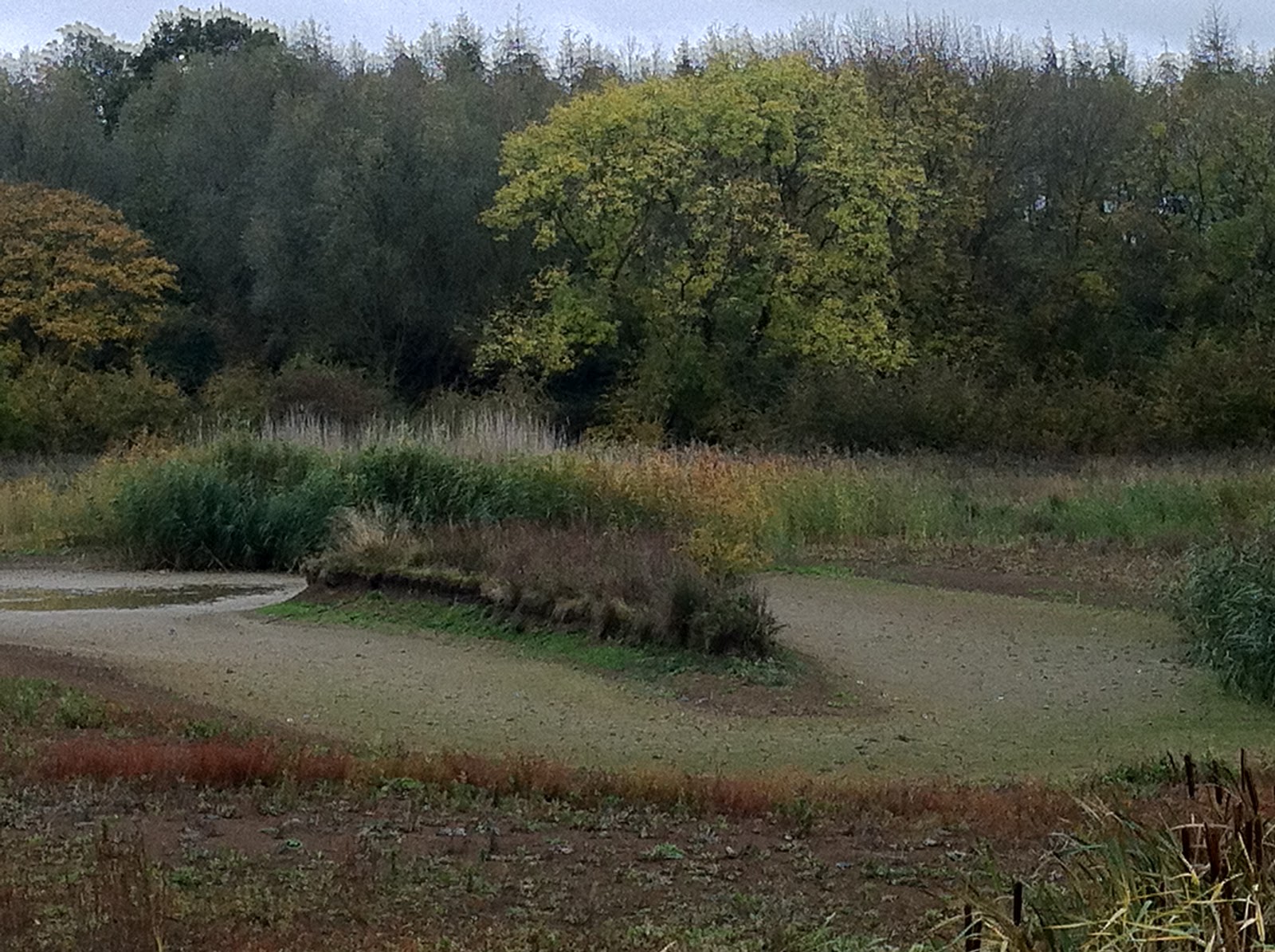
3. We're seriously in need of some water - the picture shows the sight that greeted me from the hide at the far end of the reserve. In case it's not obvious, that's supposed to be a shallow pool of water, a 'scrape', with an island in the middle.
Further upstream and into the Offchurch Bury estate, the river takes on a different character - narrower, shallower and faster. It screams 'chub' at every bend - although the ones I saw were of course holding station in a private / no-fishing stretch of course. Still, if they're here and they're downstream at the Princes Drive weir, then they'll be elsewhere along the river.
Starting at the Newbold Comyn car park I followed it up through the nature reserve, discovering a few things as follows:
2. Even if the fishing turns out to be poor, it's worth it at this time of year for the scenery and the wildlife - this one hour walk turned up kingfishers, bullfinches, green and great spotted woodpecker and a pair of noisy nuthatch.
3. We're seriously in need of some water - the picture shows the sight that greeted me from the hide at the far end of the reserve. In case it's not obvious, that's supposed to be a shallow pool of water, a 'scrape', with an island in the middle.
Further upstream and into the Offchurch Bury estate, the river takes on a different character - narrower, shallower and faster. It screams 'chub' at every bend - although the ones I saw were of course holding station in a private / no-fishing stretch of course. Still, if they're here and they're downstream at the Princes Drive weir, then they'll be elsewhere along the river.
31 October 2011
And the answer is...
... a single bronze maggot on a size 20 and ultra fine hook length. Pretty much what the answer always was really.
Sorry, I've run ahead of myself a bit there. That answer relates of course to the question that's been driving me mad for the best part of a month - how the hell do I catch anything in the Leam?
 Well, I was half way through my third attempt at Welches Meadow when it dawned on me. In fact Inspiration came from an unlikely source - a large branch that I'd snagged and dragged out. It was alive with tiny worms / larvae, which kind of made me realise (durr) that my array of bread, corn, soft pellets and pastes might not be the normal menu on this under fished and 100% natural waterway. Too much of my fishing since I started again last year has been spent on commercials - hence the heavy lines, biggish hooks and man made baits.
 So, with the inspiration that naturals might be the way forward here, I fined everything down, dug out the maggots I had leftover from Wednesday on the Avon and lo! we had fish.
 I swear no one in the history of fishing has ever been more pleased to see a 3oz roach. It was beautiful, as was the 5oz roach that followed it, a similarly sized perch and the stream of tiny chublet that rallied to the cause. Not much to show for three long mornings on the Leam perhaps, but the 'duck' was broken. The bigger fish are surely now there for the taking.
Sorry, I've run ahead of myself a bit there. That answer relates of course to the question that's been driving me mad for the best part of a month - how the hell do I catch anything in the Leam?

 So, with the inspiration that naturals might be the way forward here, I fined everything down, dug out the maggots I had leftover from Wednesday on the Avon and lo! we had fish.
  I swear no one in the history of fishing has ever been more pleased to see a 3oz roach. It was beautiful, as was the 5oz roach that followed it, a similarly sized perch and the stream of tiny chublet that rallied to the cause. Not much to show for three long mornings on the Leam perhaps, but the 'duck' was broken. The bigger fish are surely now there for the taking.
16 October 2011
'My' River Leam
The River Leam has been part of my life for 20 years or so. I've lived near it (hard not to in Leamington of course), I've walked its length from Leamington to Offchurch on many many occasions, I've birdwatched around it, and all in all I've grown rather fond of it.
The only thing I hadn't done with the river was fished it, something I resolved a couple of months ago to put right.
The first step was a couple of early morning sessions before work in August, trotting bread punch or maggot down a slow moving stretch up near the Grand Union Canal. These two sessions were very enjoyable indeed - the bread produced pristine hand-sized roach, and the maggot generally some scrappy little perch. But I suspected that autumn might be the the time to really tackle the Leam, so I put it to one side until October.
A bit of rain, I thought. A bit of flow. Perfect for fishing the sections that I know best, down through Newbold Comyn and Welches Meadow. Hmmm.
So, early October has arrived, it's nice and warm and there's been no rain at all. The Leam through Welches Meadow, far from being in 'full flow' (it never exactly races by) is completely static. In fact, thanks to a slight westerly breeze, the float was actually running slowly upstream for most of the morning.
This was my second of two consecutive Sunday's on the river, similar in terms of weather and conditions, identical in terms of results - zip, zilch, nothing at all. A nice opportunity to practice with a slider float (not something I've used seriously before), a pleasant place to sit (or even lie down) and birdwatch (several kingfisher fly-bys, grey wagtails, and today my first fieldfares of the year), but just one twitchy un-hittable bite on the tip to show for nearly 10 hours fishing.
There are plenty of reports of decent bream, roach, tench, eels and even carp in this stretch of river, plus the predators. And I will find them - eventually.
The only thing I hadn't done with the river was fished it, something I resolved a couple of months ago to put right.
The first step was a couple of early morning sessions before work in August, trotting bread punch or maggot down a slow moving stretch up near the Grand Union Canal. These two sessions were very enjoyable indeed - the bread produced pristine hand-sized roach, and the maggot generally some scrappy little perch. But I suspected that autumn might be the the time to really tackle the Leam, so I put it to one side until October.
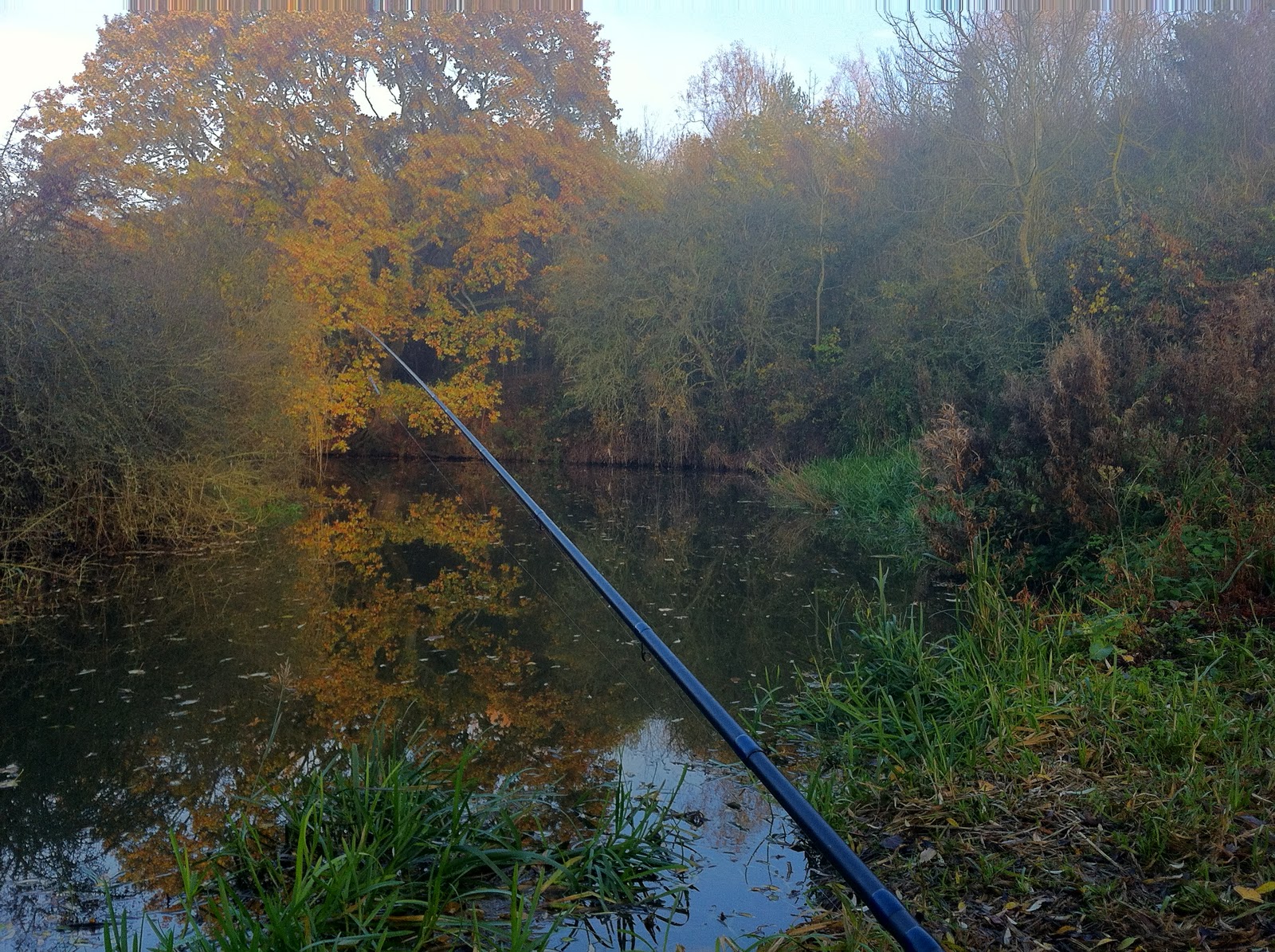
 |
| My view while lying on the bank of the River Leam - a completely inanimate tip rod. |
So, early October has arrived, it's nice and warm and there's been no rain at all. The Leam through Welches Meadow, far from being in 'full flow' (it never exactly races by) is completely static. In fact, thanks to a slight westerly breeze, the float was actually running slowly upstream for most of the morning.
This was my second of two consecutive Sunday's on the river, similar in terms of weather and conditions, identical in terms of results - zip, zilch, nothing at all. A nice opportunity to practice with a slider float (not something I've used seriously before), a pleasant place to sit (or even lie down) and birdwatch (several kingfisher fly-bys, grey wagtails, and today my first fieldfares of the year), but just one twitchy un-hittable bite on the tip to show for nearly 10 hours fishing.
There are plenty of reports of decent bream, roach, tench, eels and even carp in this stretch of river, plus the predators. And I will find them - eventually.
7 October 2011
Harbingers of winter
I heard them as soon as I got out of the car in Henley-in-Arden this morning - the high seep, seep of redwings.
Sure enough, there they were: two of them struggling south / south-west against a blustery wind.
Always a joy to see, of course, but a sobering reminder that the best of the year is very definitely behind us now (Indian Summer not withstanding). I'm fishing a big exposed lake in Hertfordshire tomorrow morning (Stanborough), so time to dig the thermals out I think.
Sure enough, there they were: two of them struggling south / south-west against a blustery wind.
Always a joy to see, of course, but a sobering reminder that the best of the year is very definitely behind us now (Indian Summer not withstanding). I'm fishing a big exposed lake in Hertfordshire tomorrow morning (Stanborough), so time to dig the thermals out I think.
28 September 2011
The unexpected lifer
In the dying hour of a glorious late September day I rushed to Napton Reservoir to see if I could finally set eyes on the long-staying black-necked grebe.
The good news is that I did, the finding made considerably easier for the fact that it was a) less than 10 yards from the shore, and b) enjoying the admiring attention of three birders from Nuneaton.
The grebe was beautiful despite its winter plumage, the red eyes being its most striking feature. Sadly a quick stroll around the water turned up nothing else remarkable, the best being half a dozen pochard, a few skylarks and yellowhammers here and there, and even a little flock of linnets which I don't see nearly often enough.
Napton Hill was all but silent, so I returned home to attend to the blog... only to discover that the black-necked grebe was my first lifer in more than than a year, something I had completely failed to realise. And what is more, it was one which I predicted back in 2006 might turn up at Napton - see here for My Secret Patch Wishlist.
Don't you just love it when a plan comes together, albeit somewhat belatedly and unintentionally!
The good news is that I did, the finding made considerably easier for the fact that it was a) less than 10 yards from the shore, and b) enjoying the admiring attention of three birders from Nuneaton.
The grebe was beautiful despite its winter plumage, the red eyes being its most striking feature. Sadly a quick stroll around the water turned up nothing else remarkable, the best being half a dozen pochard, a few skylarks and yellowhammers here and there, and even a little flock of linnets which I don't see nearly often enough.
Napton Hill was all but silent, so I returned home to attend to the blog... only to discover that the black-necked grebe was my first lifer in more than than a year, something I had completely failed to realise. And what is more, it was one which I predicted back in 2006 might turn up at Napton - see here for My Secret Patch Wishlist.
Don't you just love it when a plan comes together, albeit somewhat belatedly and unintentionally!
26 September 2011
The hallmarks of autumn
One by one the hallmarks of autumn have been falling into place.
The first sign of the season was very punctual indeed. On September 1st I drew open the curtains at the back of my house to catch sight of the season's first early morning mist.
As if alerted by this starting gun, little pockets of swallows and house martins started to gather here, there and everywhere - small fast-feeding families low over river, lake or meadow, preparing for the long journey ahead.
As I gathered the apple harvest in my garden just a few days later I was joined by a handful of juvenile chiffchaffs. These are a regular find in my garden at this time of year, but almost never at any other.
Elsewhere t'internet is full of news of exotic migrant waders and seabirds at hotspots like the nearby Draycote Reservoir (including several manx shearwaters, which I would greatly have liked to have seen). Even litle Napton Reservoir has played host to a black necked grebe for the last couple of weeks.
As the weather has slowly worsened, the temperature of the the water has also dropped notably. This makes the fishing unreliable at best, and without a warming sun it becomes almost impossible to spot the chub in the litte streams I stroll along most lunchtimes.
And of course the darkness, the only bit of winter I truly dislike, draws inexorably nearer - sunset is 7.15pm at the moment and retreating at a rate of knots.
The first sign of the season was very punctual indeed. On September 1st I drew open the curtains at the back of my house to catch sight of the season's first early morning mist.
As if alerted by this starting gun, little pockets of swallows and house martins started to gather here, there and everywhere - small fast-feeding families low over river, lake or meadow, preparing for the long journey ahead.
As I gathered the apple harvest in my garden just a few days later I was joined by a handful of juvenile chiffchaffs. These are a regular find in my garden at this time of year, but almost never at any other.
Elsewhere t'internet is full of news of exotic migrant waders and seabirds at hotspots like the nearby Draycote Reservoir (including several manx shearwaters, which I would greatly have liked to have seen). Even litle Napton Reservoir has played host to a black necked grebe for the last couple of weeks.
As the weather has slowly worsened, the temperature of the the water has also dropped notably. This makes the fishing unreliable at best, and without a warming sun it becomes almost impossible to spot the chub in the litte streams I stroll along most lunchtimes.
And of course the darkness, the only bit of winter I truly dislike, draws inexorably nearer - sunset is 7.15pm at the moment and retreating at a rate of knots.
2 August 2011
Hot. Damn Hot.
It's early August and Warwickshire is hot. Hot and desert dry.
Although the weather of the last few months seems to have involved a lot of rain, it clearly hasn't been enough to counteract the effects of the record-breaking dry spring we had.
The soil is dry and cracked. Lush green grass has been replaced with impressionist smears of yellow, brown, khaki, ochre and every imaginable variation thereof. With the birds lying low after breeding, the fields around me are eerily quiet, with a silence broken only by the occasional tweet, the flap-flap of a wood pigeon taking to the air and the low, persistent hum of a million grass-bound insects. Often the only sign of movement on my lunchtime strolls comes from the few butterflies and bees that are willing to brave the midday sun.
Unsurprisingly, the waterways are low, slow and gin clear. The narrrow, shallow brooks which criss-cross the countryside are currently a great deal more narrow and shallow than normal. I lingered by one today, finding a pool which was just a touch deeper than elsewhere along that stretch. Sure enough, there were the fish - a dozen chub lazily holding position against a soporific current, the largest of them perhaps 10 inches in length. Resisting the urge to rush back to the car for my ever-handy travel rod, I instead stood stock-still and simply watched them.
They were entrancing and calming, and in the bright midday sun they were as clearly visible as wild fish ever become to us land-dwellers. Of course that in turn made me equally visible to them - and with one slight turn of my head I sent them dashing upstream, downstream, hither and thither in search of cover.
However low it might be, water is the key to nature watching at this time of year. While the fields might be empty, sites such as Brandon Marsh and Draycote Reservoir (and dozens of smaller, less well-known waterways) will be home to big numbers of dragonflies, butterflies (and moths), a wide array of birds including migrant waders and raptors, and (of course) those fish.
So water is always worth seeking out in high summer - just don't forget to glance into the water as well as looking all around it!
Bird of the week: Red kite (Milvus milvus), the most graceful bird of prey we have (in my ever-so-humble). Not that I got round to mentioning it in this post, but one flew low over an Oxfordshire campsite at the weekend and give us our own personal display, not long after a Spitfire fighter plane had very generously done very much the same thing.
Although the weather of the last few months seems to have involved a lot of rain, it clearly hasn't been enough to counteract the effects of the record-breaking dry spring we had.
The soil is dry and cracked. Lush green grass has been replaced with impressionist smears of yellow, brown, khaki, ochre and every imaginable variation thereof. With the birds lying low after breeding, the fields around me are eerily quiet, with a silence broken only by the occasional tweet, the flap-flap of a wood pigeon taking to the air and the low, persistent hum of a million grass-bound insects. Often the only sign of movement on my lunchtime strolls comes from the few butterflies and bees that are willing to brave the midday sun.
Unsurprisingly, the waterways are low, slow and gin clear. The narrrow, shallow brooks which criss-cross the countryside are currently a great deal more narrow and shallow than normal. I lingered by one today, finding a pool which was just a touch deeper than elsewhere along that stretch. Sure enough, there were the fish - a dozen chub lazily holding position against a soporific current, the largest of them perhaps 10 inches in length. Resisting the urge to rush back to the car for my ever-handy travel rod, I instead stood stock-still and simply watched them.
They were entrancing and calming, and in the bright midday sun they were as clearly visible as wild fish ever become to us land-dwellers. Of course that in turn made me equally visible to them - and with one slight turn of my head I sent them dashing upstream, downstream, hither and thither in search of cover.
However low it might be, water is the key to nature watching at this time of year. While the fields might be empty, sites such as Brandon Marsh and Draycote Reservoir (and dozens of smaller, less well-known waterways) will be home to big numbers of dragonflies, butterflies (and moths), a wide array of birds including migrant waders and raptors, and (of course) those fish.
So water is always worth seeking out in high summer - just don't forget to glance into the water as well as looking all around it!
Bird of the week: Red kite (Milvus milvus), the most graceful bird of prey we have (in my ever-so-humble). Not that I got round to mentioning it in this post, but one flew low over an Oxfordshire campsite at the weekend and give us our own personal display, not long after a Spitfire fighter plane had very generously done very much the same thing.
6 June 2011
Devonian delights
A family holiday in Devon gave me the chance for just a little birding with, in particular, a trip to Yarner Wood.
This ancient oak forest is an absolute delight, with wooded valleys, heathland, rivers and waterfalls running red with copper mineral, and an absolute abundance of the woodland birds that are under so much pressure in this increasingly tree-less land of ours.
First up were the singing wood warblers, followed by a striking male redstart. Moving out on to the heath we found a tree pipit singing and parachuting between two trees; moving back into the woods there were good views of a pair of spotted flycatchers.
My son had a great time with the challenge trail that English Nature had laid out for half term - and I learned some interesting insect facts along the way. A wonderful and real hands-on experience of nature for any child - recommended.
Of course I was disappointed not to have connected with any of the 50 pairs of pied flycatchers in the wood - and equally thrilled when a male landed on a branch right in front of my car as I rolled out of the car park! Bingo - the 'holy trinity' of oak wood birds achieved (redstart, wood warbler, pied fly).
What a happy boy.
Bird of the day: Pied Flycatcher (Ficedula hypoleuca), a fantastic little bird which is all but impossible to see unless you head west or north. This was only my second or third, and my first in England (the others having been in Wales).
This ancient oak forest is an absolute delight, with wooded valleys, heathland, rivers and waterfalls running red with copper mineral, and an absolute abundance of the woodland birds that are under so much pressure in this increasingly tree-less land of ours.
First up were the singing wood warblers, followed by a striking male redstart. Moving out on to the heath we found a tree pipit singing and parachuting between two trees; moving back into the woods there were good views of a pair of spotted flycatchers.
My son had a great time with the challenge trail that English Nature had laid out for half term - and I learned some interesting insect facts along the way. A wonderful and real hands-on experience of nature for any child - recommended.
Of course I was disappointed not to have connected with any of the 50 pairs of pied flycatchers in the wood - and equally thrilled when a male landed on a branch right in front of my car as I rolled out of the car park! Bingo - the 'holy trinity' of oak wood birds achieved (redstart, wood warbler, pied fly).
What a happy boy.
Bird of the day: Pied Flycatcher (Ficedula hypoleuca), a fantastic little bird which is all but impossible to see unless you head west or north. This was only my second or third, and my first in England (the others having been in Wales).
16 May 2011
Close encounters
One of the joys of fishing is that it often brings me physically closer to water-loving birds than birding ever did - often simply a function of sitting still for hours on end. It is not unheard of for kingfishers to alight momentarily on fishing rods for example.
Sunday was a case in point. I sat just a few feet away from two banks of reeds while reed warblers and sedge warblers flitted past my eyes all morning (distracting when you're supposed to be watching a float). Behind me sang whitethroat and blackcap, across the lake was a persistent turtle dove, a cuckoo had a brief go at about 6.30am and then seemed to give up for the day, and above and around me were swallows, swifts, buzzards and plenty more besides. All very welcome company indeed when the fishing slows a little.
Of many and varied other sightings in recent weeks, the highlight was a modest marsh tit, another addition to my lunchtime Henley-in-Arden list - as is so often the way, I bumped into as I took a stroll along the canal at Preston Bagot.
Sunday was a case in point. I sat just a few feet away from two banks of reeds while reed warblers and sedge warblers flitted past my eyes all morning (distracting when you're supposed to be watching a float). Behind me sang whitethroat and blackcap, across the lake was a persistent turtle dove, a cuckoo had a brief go at about 6.30am and then seemed to give up for the day, and above and around me were swallows, swifts, buzzards and plenty more besides. All very welcome company indeed when the fishing slows a little.
Of many and varied other sightings in recent weeks, the highlight was a modest marsh tit, another addition to my lunchtime Henley-in-Arden list - as is so often the way, I bumped into as I took a stroll along the canal at Preston Bagot.
4 May 2011
Spring unfurled
When I last wrote in these pages (early April, here) spring had just sprung - the first warblers were back, the early flowers were out, and I was busy prophesising one last sting in the tail at the end of a particularly harsh winter.
Well, if you've been in the UK during the subsequent four weeks you may well have noticed that my prophesy spectacularly failed to come true. What we've mainly had (unless you count a week of cool NE winds as a last hurrah for winter) has been clear blue skies, loads of sunshine and the beginnings of an alarming drought. And while that's not been so great for my allotment (which is now starting to take on an alarming dust-like texture), it's been great for getting outside and seeing / hearing spring unfold into summer.
So while the first warblers had just arrived at the start of April, I've since enjoyed: my first cuckoo calls of the year (Easter weekend in Essex's Hatfield Forest); the purring coo of the turtle dove (just after Easter at a lake near Southam); lapwings wheeling and wailing in courtship above Warwickshire fields (near Ufton, Lighthorne and Warwick); a pair of tawny owls calling to each other and showing well above a caravan in Yorkshire's Goit Stock valley (along with two dipper pairs and breeding grey wagtails nearby); and the return of a full complement of summer species (with only the swift still missing from my usual checklist).
The first orange tip and brimstone butterflies have been joined by peacocks, small tortoiseshells, various whites and other I'm too dull-witted to identify with any safety. The same problem pertains to wild flowers - I'm on safe(ish) ground in early spring with wild garlic, lesser celandine, snowdrops and on to the bluebells. Now that a full array of flora is bursting into life, my limited expertise comes to a shuddering halt. Suffice it to say then that there are a lot of flowers and insects around, as well as the birds!
Bird watching has increasingly become less something I specifically go to and more something I just do. It's not often I head out to a nature reserve or set off anywhere with the express intent of watching birds, but wherever and whenever I am outdoors, whether cycling, fishing, gardening, walking, playing with the family or just sitting, I am bird watching, bird listening and bird enjoying.
And while my life list, year list and the rest are suffering no end, my enjoyment of another unfurling spring most certainly is not.
Bird of the month: Tawny owl (Strix aluco); elusive by virtue of its nocturnal nature, but my fairly regular trips to the Goit Stock in Yorkshire give me great opportunities to hear and see this wonderful creature of the night.
Well, if you've been in the UK during the subsequent four weeks you may well have noticed that my prophesy spectacularly failed to come true. What we've mainly had (unless you count a week of cool NE winds as a last hurrah for winter) has been clear blue skies, loads of sunshine and the beginnings of an alarming drought. And while that's not been so great for my allotment (which is now starting to take on an alarming dust-like texture), it's been great for getting outside and seeing / hearing spring unfold into summer.
So while the first warblers had just arrived at the start of April, I've since enjoyed: my first cuckoo calls of the year (Easter weekend in Essex's Hatfield Forest); the purring coo of the turtle dove (just after Easter at a lake near Southam); lapwings wheeling and wailing in courtship above Warwickshire fields (near Ufton, Lighthorne and Warwick); a pair of tawny owls calling to each other and showing well above a caravan in Yorkshire's Goit Stock valley (along with two dipper pairs and breeding grey wagtails nearby); and the return of a full complement of summer species (with only the swift still missing from my usual checklist).
The first orange tip and brimstone butterflies have been joined by peacocks, small tortoiseshells, various whites and other I'm too dull-witted to identify with any safety. The same problem pertains to wild flowers - I'm on safe(ish) ground in early spring with wild garlic, lesser celandine, snowdrops and on to the bluebells. Now that a full array of flora is bursting into life, my limited expertise comes to a shuddering halt. Suffice it to say then that there are a lot of flowers and insects around, as well as the birds!
Bird watching has increasingly become less something I specifically go to and more something I just do. It's not often I head out to a nature reserve or set off anywhere with the express intent of watching birds, but wherever and whenever I am outdoors, whether cycling, fishing, gardening, walking, playing with the family or just sitting, I am bird watching, bird listening and bird enjoying.
And while my life list, year list and the rest are suffering no end, my enjoyment of another unfurling spring most certainly is not.
Bird of the month: Tawny owl (Strix aluco); elusive by virtue of its nocturnal nature, but my fairly regular trips to the Goit Stock in Yorkshire give me great opportunities to hear and see this wonderful creature of the night.
12 April 2011
That lunchtime list in full
I promised last week that I'd sit down and calculate my lunchtime list in full.
So here, in no particular order, is the full list of bird species that I have seen in a series of short lunchtime strolls around Henley-in-Arden, Wooten Wawen and Preston Bagot over the last decade (give or take a bit):
grey heron, little egret, moorhen, mallard, mandarin duck, mute swan, kingfisher, buzzard, kestrel, sparrowhawk, great spotted woodpecker, green woodpecker, nuthatch, treecreeper, wren, robin, blue tit, great tit, long-tailed tit, willow warbler, wood warbler, chiffchaff, blackcap, whitethroat, dunnock, blackbird, song thrush, mistle thrush, redwing, fieldfare, chaffinch, siskin, goldfinch, bullfinch, greenfinch, lesser redpoll, linnet, meadow pipit, cuckoo, black-headed gull, lesser black-backed gull, jackdaw, rook, carrion crow, raven, swift, swallow, house martin, pheasant, red-legged partridge, goldcrest, wood pigeon, collared dove, stock dove, grey wagtail, pied wagtail, magpie, jay, house sparrow.
For the record that's 59 species, of which my personal highlights have been: a wood warbler high on a dead tree near The Mount, a cuckoo on a telegraph wire not to far away, an entire telegraph wire (the same one) full of linnets, a little egret on the weir in Wooten Wawen, a mandarin duck on the tiny river running through Henley-in-Arden, and a nuthatch on the roof outside my office window.
Bird of the decade: Cuckoo (Cuculus canorus), not the rarest of the bunch (that must be the wood warbler) but this cuckoo was entirely unexpected, gave great views at close quarters, and I had a thrilling half hour just leaning against a tree watching it. A magical moment that I can clearly remember 7 or 8 years on; the closest I've come to repeating it was last year when I heard a few snatches of song but could never locate the bird.
So here, in no particular order, is the full list of bird species that I have seen in a series of short lunchtime strolls around Henley-in-Arden, Wooten Wawen and Preston Bagot over the last decade (give or take a bit):
grey heron, little egret, moorhen, mallard, mandarin duck, mute swan, kingfisher, buzzard, kestrel, sparrowhawk, great spotted woodpecker, green woodpecker, nuthatch, treecreeper, wren, robin, blue tit, great tit, long-tailed tit, willow warbler, wood warbler, chiffchaff, blackcap, whitethroat, dunnock, blackbird, song thrush, mistle thrush, redwing, fieldfare, chaffinch, siskin, goldfinch, bullfinch, greenfinch, lesser redpoll, linnet, meadow pipit, cuckoo, black-headed gull, lesser black-backed gull, jackdaw, rook, carrion crow, raven, swift, swallow, house martin, pheasant, red-legged partridge, goldcrest, wood pigeon, collared dove, stock dove, grey wagtail, pied wagtail, magpie, jay, house sparrow.
For the record that's 59 species, of which my personal highlights have been: a wood warbler high on a dead tree near The Mount, a cuckoo on a telegraph wire not to far away, an entire telegraph wire (the same one) full of linnets, a little egret on the weir in Wooten Wawen, a mandarin duck on the tiny river running through Henley-in-Arden, and a nuthatch on the roof outside my office window.
Bird of the decade: Cuckoo (Cuculus canorus), not the rarest of the bunch (that must be the wood warbler) but this cuckoo was entirely unexpected, gave great views at close quarters, and I had a thrilling half hour just leaning against a tree watching it. A magical moment that I can clearly remember 7 or 8 years on; the closest I've come to repeating it was last year when I heard a few snatches of song but could never locate the bird.
Fresh arrival - the reed warbler
I'm doing a lot of fishing at the moment, and while you don't get much time to look around, you do get a lot of time to listen to birdsong. That makes it a great way to notice the fresh arrivals as they return from Africa.
A couple of weeks ago I heard my first swallows overhead as I fished near Southam, then chiffchaffs, and then last weekend I was accompanied all day by at least a couple of willow warblers. This evening it was the turn of the reed warblers, again my first of the year. Their rhythmic chirping was complemented by the musical blackcap, more willow warblers and a single song thrush. Two bold reed buntings flitted around me throughout.
A nice tench, a couple of modest carp and some skimmer bream ensured a pleasant evening all round.
A couple of weeks ago I heard my first swallows overhead as I fished near Southam, then chiffchaffs, and then last weekend I was accompanied all day by at least a couple of willow warblers. This evening it was the turn of the reed warblers, again my first of the year. Their rhythmic chirping was complemented by the musical blackcap, more willow warblers and a single song thrush. Two bold reed buntings flitted around me throughout.
A nice tench, a couple of modest carp and some skimmer bream ensured a pleasant evening all round.
6 April 2011
Growing the lunchtime list
In common with most people I don't automatically qualify for a day off just because the sun's out. I am lucky enough to have some nice spots for a lunchtime stroll though. So with March's good weather continuing into April I have been able to watch spring unfolding in a series of extremely pleasant 40 minute walks.
Today's walk along the canal from Preston Bagot was another little cracker - clear skies, bright sun, a gentle cooling breeze and birdsong filling the air.
A great-spotted woodpecker and the goldfinches were in their customary haunts near the bridge (along with a particularly belligerent mute swan who's taken up residence there). Four or 5 buzzards circled overhead, the chiffchaff song that has grown familiar over recent weeks was accompanied by two male blackcaps, both singing lustily and prominently, and two of our most powerful vocalists - the song thrush and wren - were giving of their best.
Then, just as I reached my 'turnaround point', I found two red-legged partridge running ahead of me on the two path. I haven't encountered this lovely species during more than a decade of lunchtime walks in this area, so that's another one for the lunchtime life list. When I get a moment I must write that list down and work out how it stands.
Bird of the day: Red-legged partridge (Alectoris rufa), an introduced species like the pheasant, and with many of the same characteristics - often found in the same kinds of places, with strong attractive markings and often shot at by hunting types!
 |
| Red-legged partridge: here's one I took earlier... |
A great-spotted woodpecker and the goldfinches were in their customary haunts near the bridge (along with a particularly belligerent mute swan who's taken up residence there). Four or 5 buzzards circled overhead, the chiffchaff song that has grown familiar over recent weeks was accompanied by two male blackcaps, both singing lustily and prominently, and two of our most powerful vocalists - the song thrush and wren - were giving of their best.
Then, just as I reached my 'turnaround point', I found two red-legged partridge running ahead of me on the two path. I haven't encountered this lovely species during more than a decade of lunchtime walks in this area, so that's another one for the lunchtime life list. When I get a moment I must write that list down and work out how it stands.
Bird of the day: Red-legged partridge (Alectoris rufa), an introduced species like the pheasant, and with many of the same characteristics - often found in the same kinds of places, with strong attractive markings and often shot at by hunting types!
25 March 2011
A sting in the tail?
Another lovely lunchtime stroll today, on a gloriously sunny March day.
Birds included a great spotted woodpecker, great views of a female kestrel on a telegraph wire, buzzards (plenty), chiffchaffs (now seemingly establishing approx. 3 territories along the stretch of canal from Preston Bagot towards Stratford), goldfinches, tits (blue, great and long-tailed), loads of wren activity and the usual mallards and swans.
So, a lovely 40 minute walk, spoiled only the the insistent lurking voice at the back of my mind. "20 degrees in March," it sneered. "It won't last. Winter's not done with you yet my lad."
And however lovely this week has been, history suggests the voice is right - winter normally has one last sting in the tail. Don't pack away the sweaters just yet.
Birds included a great spotted woodpecker, great views of a female kestrel on a telegraph wire, buzzards (plenty), chiffchaffs (now seemingly establishing approx. 3 territories along the stretch of canal from Preston Bagot towards Stratford), goldfinches, tits (blue, great and long-tailed), loads of wren activity and the usual mallards and swans.
So, a lovely 40 minute walk, spoiled only the the insistent lurking voice at the back of my mind. "20 degrees in March," it sneered. "It won't last. Winter's not done with you yet my lad."
And however lovely this week has been, history suggests the voice is right - winter normally has one last sting in the tail. Don't pack away the sweaters just yet.
22 March 2011
Who turned up the volume?
All new birdwatchers quickly discover that sound pretty much as important as sight in birding - you always hear plenty of species which you don't end up actually seeing, and even when you do see a bird, it was often the sound that helped alert you to them in the first place.
It takes a bit of practice to distinguish even the most common bird calls and songs, and sadly after many years I'm still struggling to be even averagely good at this (although it's a skill of which you don't need much to amaze non-birdwatchers, who nearly always seem to find it mind-boggling that anyone could tell a robin from a greenfinch by sound alone - and in case you're wondering, that particular task really is spectacularly easy).
So for most of us it's a case of practice makes perfect - and if you're going to practice, this is the time of year to get stuck in. Because, quite simply, it is around now that the bird volume gets cranked all the way up to 11.
Monday was a case in point. As I wandered along a stretch of Derby river and path not very far at all from the ring road, I was practically deafened - not by the passing traffic, but by the combined efforts of wrens, blackbirds, robins, a song thrush, goldfinches and greenfinches, all singing their hearts out (and there are some noisy buggers in that little list). Likewise, tonight in the garden was jolly pleasant, but you should have heard the noise from the house sparrows, collared doves and skylarks around me - I could barely hear the planes as they passed overhead!
And tomorrow morning I will be woken, as every morning this week, by an enthusiastic blackbird or two at about 5am. Hmmm, a mixed blessing this birdsong.
20 March 2011
A couple of local notes

Back in Radford Semele, I went for a teatime stroll through the neighbouring farmland for the first time in ages, and was rewarded with four yellowhammers high in a mature oak tree, the males absolutely beautiful in the bright afternoon sun.
19 March 2011
Springing back to Leam Valley

Now that's poor.
And ill-advised too, since - as I noted in my last post from the reserve - the place is starting to mature nicely. There's a huge amount of woodland management going on, and the three reed beds on the scrape in particular have finally taken hold in a decisive way, which should bode well for reed / sedge warblers this summer, as well as snipe, teal and perhaps water rail?
Well, today there were none of these on view, but there was a male shoveller on the scrape, my first for this reserve. A pair of reed buntings flitted around, the second pair I found on the day. Also on the scrape were six tufted ducks, in pairs.
 Elsewhere, there was a single redpoll in the middle of a loose flock of tit species (there were four here at the same time last year). A few goldcrest were in the conifers near the hide, along with a single coal tit. A single chiffchaff sang near the car park, and a song thrush was singing near the golf course.
I strolled down to Offchurch Bury weir hoping to find singing yellowhammers, but there were none. What I did find were about a dozen chub (to 15 inches or so, decent fish), just holding their position by the footbridge. I was hoping to find the grey wagtails as well, and there they were, considerably bolder than any I have encountered before - hence the photos, which were taken on a 6x zoom pocket camera.
The kestrel was pictured on the same camera, having been similarly obliging.
Bird of the day: Lesser redpoll (Carduelis cabaret), if only because it was such a good find, high on its own in an alder tree.
18 March 2011
And the final tally is...
I finished up my week of lunchtime canal walks with not one, but three new ticks for the list.
I balanced up the week by walking for the second time down the stretch of canal running from Preston Bagot towards Lowsonford (but not going so far this time due to lack of time).
The sun was out again, although a chill will kept the temperature down to 10 degrees or so (Celsius, I mean - you won't often find me venturing out with a light fleece on at 10 Fahrenheit (which is -12 Celsius, I just looked it up)).
Alongside the blue tits, redwings and goldfinch that kept me company most of the way, a little side path bursting with wild garlic turned up the first new bird of the week - a goldcrest, flitting through some tree-bound ivy.
Shortly after I caught glimpse of a bullfinch pair that dashed madly in front of me before settling in still-bare hawthorns not too far away. And the moment I'd stopped near the end of my walk to do a mental tally for the week, I heard the tap-tap-tap of a great spotted woodpecker - a female just a couple of metres above my head.
So that tally is: mute swan; mallard; grey heron; pheasant; kestrel; buzzard; raven; carrion crow; jackdaw; jay; magpie; great spotted woodpecker; green woodpecker; nuthatch; blackbird; mistle thrush; song thrush; redwing; fieldfare; robin; dunnock; wren; house sparrow; starling; wood pigeon; collared dove; grey wagtail; blue tit; great tit; long-tailed tit; chiffchaff; goldfinch; chaffinch; siskin; bullfinch; greenfinch; and goldcrest.
That makes 37 (excluding the red kites I saw while on my London train, although that too was technically a lunchtime birding session). Not a bad total with some good birds included, and a useful (to me) reminder that you don't need a nature reserve, three hours and a £500 pair of binoculars to enjoy birdwatching - although the latter would have come in handy on more than one occasion ;-)
Bird of the day: Goldcrest (Regulus regulus), one of those birds which is common enough but which you can never guarantee seeing on any given trip - or indeed in any given week. Probably helped by the fact that it is Britain's smallest songbird.
I balanced up the week by walking for the second time down the stretch of canal running from Preston Bagot towards Lowsonford (but not going so far this time due to lack of time).
The sun was out again, although a chill will kept the temperature down to 10 degrees or so (Celsius, I mean - you won't often find me venturing out with a light fleece on at 10 Fahrenheit (which is -12 Celsius, I just looked it up)).
Alongside the blue tits, redwings and goldfinch that kept me company most of the way, a little side path bursting with wild garlic turned up the first new bird of the week - a goldcrest, flitting through some tree-bound ivy.
Shortly after I caught glimpse of a bullfinch pair that dashed madly in front of me before settling in still-bare hawthorns not too far away. And the moment I'd stopped near the end of my walk to do a mental tally for the week, I heard the tap-tap-tap of a great spotted woodpecker - a female just a couple of metres above my head.
So that tally is: mute swan; mallard; grey heron; pheasant; kestrel; buzzard; raven; carrion crow; jackdaw; jay; magpie; great spotted woodpecker; green woodpecker; nuthatch; blackbird; mistle thrush; song thrush; redwing; fieldfare; robin; dunnock; wren; house sparrow; starling; wood pigeon; collared dove; grey wagtail; blue tit; great tit; long-tailed tit; chiffchaff; goldfinch; chaffinch; siskin; bullfinch; greenfinch; and goldcrest.
That makes 37 (excluding the red kites I saw while on my London train, although that too was technically a lunchtime birding session). Not a bad total with some good birds included, and a useful (to me) reminder that you don't need a nature reserve, three hours and a £500 pair of binoculars to enjoy birdwatching - although the latter would have come in handy on more than one occasion ;-)
Bird of the day: Goldcrest (Regulus regulus), one of those birds which is common enough but which you can never guarantee seeing on any given trip - or indeed in any given week. Probably helped by the fact that it is Britain's smallest songbird.
17 March 2011
Windhover at Preston Bagot
...Of the rolling level underneath him steady air, and striding
High there, how he rung upon the rein of a wimpling wing
In his ecstasy! then off, off forth on swing,
As a skate’s heel sweeps smooth on a bow-bend: the hurl and gliding
Rebuffed the big wind. My heart in hiding
Stirred for a bird,—the achieve of; the mastery of the thing!
Brute beauty and valour and act, oh, air, pride, plume, here
Buckle! AND the fire that breaks from thee then, a billion
Times told lovelier, more dangerous, O my chevalier!
- from The Windhover, by Gerard Manley Hopkins.
My week's 'lunchtime list' grew still further today with another stroll along the canal, this time back along the stretch from Preston Bagot towards Stratford.
First up were a pair of mistle thrushes, and then two infuriatingly elusive and thin-billed birds with very spotty flanks that just wouldn't show themselves properly (I just hope to God they were an obvious thrush species, even those same two mistle thrushes looking a bit too small in the gloom, rather than anything rare, because I never did nail down the id).
A raven flew low overhead shortly afterwards, and then I stood stock still to watch a pair of kestrels performing at close range around me for a good 15 minutes or so. It's far, far too long since I last took the time to watch these beautiful birds in detail, so I was grateful for this opportunity.
Bird of the Day: Kestrel (Falcon tinnunculus) - Gerard Manley Hopkins 'windhover' is a beautiful creature that should never fail to stir the heart. When I were a lad it was Britain's most common raptor; after 30 years of slow decline I suspect it has been long overtaken, round these parts at least, by the buzzard.
High there, how he rung upon the rein of a wimpling wing
In his ecstasy! then off, off forth on swing,
As a skate’s heel sweeps smooth on a bow-bend: the hurl and gliding
Rebuffed the big wind. My heart in hiding
Stirred for a bird,—the achieve of; the mastery of the thing!
Brute beauty and valour and act, oh, air, pride, plume, here
Buckle! AND the fire that breaks from thee then, a billion
Times told lovelier, more dangerous, O my chevalier!
- from The Windhover, by Gerard Manley Hopkins.
My week's 'lunchtime list' grew still further today with another stroll along the canal, this time back along the stretch from Preston Bagot towards Stratford.
First up were a pair of mistle thrushes, and then two infuriatingly elusive and thin-billed birds with very spotty flanks that just wouldn't show themselves properly (I just hope to God they were an obvious thrush species, even those same two mistle thrushes looking a bit too small in the gloom, rather than anything rare, because I never did nail down the id).
A raven flew low overhead shortly afterwards, and then I stood stock still to watch a pair of kestrels performing at close range around me for a good 15 minutes or so. It's far, far too long since I last took the time to watch these beautiful birds in detail, so I was grateful for this opportunity.
Bird of the Day: Kestrel (Falcon tinnunculus) - Gerard Manley Hopkins 'windhover' is a beautiful creature that should never fail to stir the heart. When I were a lad it was Britain's most common raptor; after 30 years of slow decline I suspect it has been long overtaken, round these parts at least, by the buzzard.
16 March 2011
Further adventures on the Stratford-upon-Avon canal
After a great start to my week of lunchtime bird walks near Henley-in-Arden (see Herald's of Spring, below), today took a turn for the greyer, the colder... but it still turned up the goods.
I spent much of yesterday on the train to London and back (red kites over the Chiltern, muntjac deer and hares in the fields of Oxfordshire), so I was looking forward to stretching my legs on a midday stroll along the two miles or so of canal from Preston Bagot towards Lowsonford and back.
The outward stretch turned up nothing much, but shortly after I turned for home I was stopped by the churring of two mistle thrushes in nearby trees. As they moved on, my bins moved past a superb male chaffinch and just caught a flash of movement - movement that was notable for one reason: it was down a tree trunk. That could only mean one thing - a nuthatch, the only UK bird that I can think of able to crawl down, as well as up, a tree trunk. Although they're common enough, I've not seen one for ages, so I was pretty chuffed.
Just a few steps on and I realised I was surrounded on all sides by a mixed flock of perhaps 200 fieldfares and redwings; another hundred yards or so and there were siskins high above me, in a mixed flock with goldfinches.
I finished with great views of a jay, and returned to the office in good spirits.
Bird of the day: Nuthatch (Sitta europaea), a stunning little woodpecker like bird, glorious in yellow and blue.
I spent much of yesterday on the train to London and back (red kites over the Chiltern, muntjac deer and hares in the fields of Oxfordshire), so I was looking forward to stretching my legs on a midday stroll along the two miles or so of canal from Preston Bagot towards Lowsonford and back.
The outward stretch turned up nothing much, but shortly after I turned for home I was stopped by the churring of two mistle thrushes in nearby trees. As they moved on, my bins moved past a superb male chaffinch and just caught a flash of movement - movement that was notable for one reason: it was down a tree trunk. That could only mean one thing - a nuthatch, the only UK bird that I can think of able to crawl down, as well as up, a tree trunk. Although they're common enough, I've not seen one for ages, so I was pretty chuffed.
Just a few steps on and I realised I was surrounded on all sides by a mixed flock of perhaps 200 fieldfares and redwings; another hundred yards or so and there were siskins high above me, in a mixed flock with goldfinches.
I finished with great views of a jay, and returned to the office in good spirits.
Bird of the day: Nuthatch (Sitta europaea), a stunning little woodpecker like bird, glorious in yellow and blue.
14 March 2011
Heralds of spring (the chiffchaffs are here!)
Inspired by a tweet'ed report (how appropriate) of chiffchaffs in Sheffield, I spent lunchtime on a birding walk to find my own.
From Preston Bagot I headed along the canal (Stratford direction) and within 10 minutes could hear my first chiffchaff of spring. It quickly fell silent but soon after I'd turned and started the walk back, I reconnected with not one but two birds, one calling somewhere near and the other feeding rapidly but gracefully in the trees lining the canal opposite me.
It's a moment that never fails to move me - the first of these beautiful, sleek little buff birds refueling, wagging their tails and singing their joy after a gruelling flight of several thousand miles from West Africa to here.
When added to a tally which also included a pair of grey wagtails, three displaying buzzards, a small flock of long-tailed tits, goldfinches aplenty, a grey heron and several calling green woodpeckers, I'd call that a pretty successful 40 minutes.
Bird of the day: Chiffchaff (Phylloscopus collybita), the one true herald of spring.
From Preston Bagot I headed along the canal (Stratford direction) and within 10 minutes could hear my first chiffchaff of spring. It quickly fell silent but soon after I'd turned and started the walk back, I reconnected with not one but two birds, one calling somewhere near and the other feeding rapidly but gracefully in the trees lining the canal opposite me.
It's a moment that never fails to move me - the first of these beautiful, sleek little buff birds refueling, wagging their tails and singing their joy after a gruelling flight of several thousand miles from West Africa to here.
When added to a tally which also included a pair of grey wagtails, three displaying buzzards, a small flock of long-tailed tits, goldfinches aplenty, a grey heron and several calling green woodpeckers, I'd call that a pretty successful 40 minutes.
Bird of the day: Chiffchaff (Phylloscopus collybita), the one true herald of spring.
9 March 2011
The water rule
Where there's water there's nearly always nature - a rule of thumb brought home to me again on Monday as I took a lunchtime stroll along the River Derwent in Derby.
Pleasant surprise #1 was that a female goosander (probably one of the three I first spotted a month ago) had moved up from the edge of town and was now swimming opposite the Council House in the very heart of the the city.
Pleasant surprise #2 came just a few hundred yards further on, when I was able to watch my first ever american mink as it picked its way along the far bank for several minutes.
It never ceases to amaze me what you can find if you've got a patch of water and a spare 20 minutes to explore. Keep 'em peeled!
Pleasant surprise #1 was that a female goosander (probably one of the three I first spotted a month ago) had moved up from the edge of town and was now swimming opposite the Council House in the very heart of the the city.
Pleasant surprise #2 came just a few hundred yards further on, when I was able to watch my first ever american mink as it picked its way along the far bank for several minutes.
It never ceases to amaze me what you can find if you've got a patch of water and a spare 20 minutes to explore. Keep 'em peeled!
6 March 2011
Back at Napton
I'm told that confession (see below) isn't enough on it's own. Nor is the intention to change. One needs to prove the intention to change if one is to be absolved.
So, bright and early (ish) this morning I set off this morning for Napton Reservoir, determined to get my feet and eyes back into the swing of birding things. It turns out that a lot of things haven't changed so very much since I last went birding back in October.
For a start, I only got about 100 yards from the car before I bumped into Richard and Dave, who confirmed that the year had got off to a slow start, and that nothing had dropped in today to change that pattern. Fortunately I have lower standards than either of them (!) and within minutes I was having a wonderful time, if only because it was good to be out again.
Alongside the regulars (c. 40 coot, 25 tufties, a dozen mallard, a few moorhens, a pair of mute swans and a couple of hundred gulls, about 40/60 common and black-headed) were 7 great crested grebes, 12 shoveller, 5 pochard, a few teal tucked into the edge of the reed bed, a snipe which flushed from a drainage dish, a couple of bullfinch near the entrance, plenty of jaunty chaffinches and, high in the sky to my right, a couple of skylark trilling high in the grey sky.
OK, it was hardly a mega haul, but the shovellers were (are) beautiful, the snipe was a nice surprise (thought it was going to take my head off as it flew out), and who doesn't enjoy watching great crested grebes in full courtship?
After a lovely stroll to all corners of the reservoir (and a chat to a couple of the fishermen - I shall be back for Napton tench this spring / summer), I headed up to the hill for something nice to finish the day. Apart from being reminded how beautiful blue tits actually are, there was little added from this short excursion.
Nice to be back though.
Bird of the day: Shoveller (Anus clypeata) - you have to say, that is one striking duck.
So, bright and early (ish) this morning I set off this morning for Napton Reservoir, determined to get my feet and eyes back into the swing of birding things. It turns out that a lot of things haven't changed so very much since I last went birding back in October.
 |
| Library photo |
Alongside the regulars (c. 40 coot, 25 tufties, a dozen mallard, a few moorhens, a pair of mute swans and a couple of hundred gulls, about 40/60 common and black-headed) were 7 great crested grebes, 12 shoveller, 5 pochard, a few teal tucked into the edge of the reed bed, a snipe which flushed from a drainage dish, a couple of bullfinch near the entrance, plenty of jaunty chaffinches and, high in the sky to my right, a couple of skylark trilling high in the grey sky.
OK, it was hardly a mega haul, but the shovellers were (are) beautiful, the snipe was a nice surprise (thought it was going to take my head off as it flew out), and who doesn't enjoy watching great crested grebes in full courtship?
After a lovely stroll to all corners of the reservoir (and a chat to a couple of the fishermen - I shall be back for Napton tench this spring / summer), I headed up to the hill for something nice to finish the day. Apart from being reminded how beautiful blue tits actually are, there was little added from this short excursion.
Nice to be back though.
Bird of the day: Shoveller (Anus clypeata) - you have to say, that is one striking duck.
5 March 2011
Confessions of an absent birder
I am far from being a Catholic, but there is an air of the confessional about this post. Forgive me, readers (if any are left), for I have sinned - it has been four months since both I last went birding and I last wrote in this blog.
Not really sins of course, except that the cardinal rule of both birding and blogging is regularity, and in that respect I have fallen dismally short. Of my absence from blogging you will of course be in no doubt, since you can see for yourself the cavernous gap, the epochal time period, between this post and the last. But at least I can try to persuade you that I haven't failed quite so dismally on the birding front, and reassure you that my absence from birdwatching (in the formal sense) has been slightly mitigated by the number of bird moments I have enjoyed during that time.
Such as? Well, heading into winter there were the vast flocks of fieldfare and redwing which followed me everywhere; the less common garden visitors such as long-tailed tits and a great spotted woodpecker; and the occasional 'gem' such as the siskins and the three goosander I found on a lunchtime walk in the very centre of Derby. As I sat fishing, and freezing, near Bishops Itchington not so long ago, I was joined by both a buzzard and a kingfisher in short order. On my journey, five lapwing had been tumbling over the fields near Ufton.
Moving into the very earliest part spring, my short lunchtime strolls have been punctuated by welcome sounds - the first great tit calls, then the song thrush, the chaffinch, the greenfinch and more. A male sparrowhawk flashed past me last week, a red kite swept low over my car as I drove through Oxfordshire, and a raven did the same in Offchurch one day. In significantly more peril were the red-legged partridge and the male pheasant which nearly ran under my car on successive days near Claverdon. And while lunchtimes have proved quite productive, working hours themselves turned up a pair of bullfinches outside one office window and a male great spotted woodpecker outside the other.
So, no birding but plenty of birds. Nothing rare but plenty to enjoy. But definitely no enough blogging. Sorry.
Bird of the winter: Goosander (Mergus merganser), definitely my favourite unexpected moment of the last few months. I could not have imagined that a short stroll along the river, just a few hundred yards from the main shopping area, would have turned up not one but three of these exquisite birds.
Not really sins of course, except that the cardinal rule of both birding and blogging is regularity, and in that respect I have fallen dismally short. Of my absence from blogging you will of course be in no doubt, since you can see for yourself the cavernous gap, the epochal time period, between this post and the last. But at least I can try to persuade you that I haven't failed quite so dismally on the birding front, and reassure you that my absence from birdwatching (in the formal sense) has been slightly mitigated by the number of bird moments I have enjoyed during that time.
Such as? Well, heading into winter there were the vast flocks of fieldfare and redwing which followed me everywhere; the less common garden visitors such as long-tailed tits and a great spotted woodpecker; and the occasional 'gem' such as the siskins and the three goosander I found on a lunchtime walk in the very centre of Derby. As I sat fishing, and freezing, near Bishops Itchington not so long ago, I was joined by both a buzzard and a kingfisher in short order. On my journey, five lapwing had been tumbling over the fields near Ufton.
Moving into the very earliest part spring, my short lunchtime strolls have been punctuated by welcome sounds - the first great tit calls, then the song thrush, the chaffinch, the greenfinch and more. A male sparrowhawk flashed past me last week, a red kite swept low over my car as I drove through Oxfordshire, and a raven did the same in Offchurch one day. In significantly more peril were the red-legged partridge and the male pheasant which nearly ran under my car on successive days near Claverdon. And while lunchtimes have proved quite productive, working hours themselves turned up a pair of bullfinches outside one office window and a male great spotted woodpecker outside the other.
So, no birding but plenty of birds. Nothing rare but plenty to enjoy. But definitely no enough blogging. Sorry.
Bird of the winter: Goosander (Mergus merganser), definitely my favourite unexpected moment of the last few months. I could not have imagined that a short stroll along the river, just a few hundred yards from the main shopping area, would have turned up not one but three of these exquisite birds.
Subscribe to:
Posts (Atom)