27 November 2005

Hawfinch and Bittern - Warwickshire wonderland

Possibly my finest ever self-found this morning - a Hawfinch at Draycote Reservoir. There had been reports of one in the country park during the week, but it was on the far side of the water that I found mine - well, to be fair it did fly down in front of my car! Nevertheless, I was able to watch it for a minute or so, drive down to grab a couple of birders fellow birders, and get back to find it again for more (albeit brief) views.

With Hawfinch sightings in Warwickshire being a rarity indeed (often just one or two a year) this was a fantastic find, but then when we left via the country park, we were able to spot a second bird, a beautiful male giving fantastic lingering views. A brilliant experience all round.


Normally that would be enough for any one day, but the double lure of breakfast and a reported Bittern at Brandon was enough to convince me to press on. Breakfast was fanastic, and then, after 20 minutes waiting in East Pool Hide, the Bittern moved, stalking left to right across a specially cut channel. Smashing. Then, from the far side of the water, I watched (and grabbed a record photo) while it adopted its camouflage position - head straight up in the air, totally still. Then it was off for a slow flight across the whole water before dropping down in Newlands.

What an amazing morning.

20 November 2005

Great Northern Divers and a proper winter

Ah, now that's more like it! Minus 4 degrees, a mist so thick you can't see the water's edge , and a Great Northern Diver on the local reservoir - that's what I call a proper winter's morning.

After a few busy weeks with little or no time for birding, I was up at the crack of dawn today and down to Draycote by 7.20am. The mist was a real pea-souper, and to start with I could see only a short distance to the very edge of the water. Gradually things improved, and I found most of the usual winter birds - large numbers of Coot, Moorhen, Tufties, Wigeon, Lapwing etc. I was also pleased to find my first winter Goosander (2) and Goldeneye (perhaps a dozen in all).

On the far side (Draycote Bank) I discovered a Great Northern Diver - a wonderful bird that when feeding actually spends more of its time beneath water than above it. I've often mused on which environment it would call home, given the choice.

Anyway, despite my six warm layers (including a fab new padded army jacket), I was in need of some warmth and nourishment after a couple of hours. So I headed off to nearby Brandon Marsh for a hearty breakfast, and then ventured out for a final hour's birding. Three Snipe, a Sparrowhawk, a Common Gull and my first Fieldfare of the season were among the highlights, along with a fox which we watched prowl the far bank for five minutes or more.

13 November 2005

Winter warmers on the patch

It's slowly starting to get colder round here, but I still think it's still ridiculously mild for mid November. I layered up for an early morning walk round Leam Valley today but just a few hundred yards from the house I began to think I might pass out from the heat (not hot as such, but certainly a good 5/6 centigrade). After a quick adjustment I set off minus one layer, a hat and the gloves, and strolled the mile or so down to the reserve.

I had one bird very much in mind this morning, and found it almost immediately - Redpoll. Three darker birds (Lesser) and one pale, almost frosted bird (Mealy?) were feeding off wiry grasses, surrounded by Blue and Great Tits. Although Redpoll are not uncommon in the winter, I don't see too many of them - indeed these were my first for 2005. Such long and clear views were a real treat.

As I moved along the river I found plenty more to be pleased with - Redwing feeding in the hawthorn trees, a splendid male Bullfinch attacking berries with gusto, Goldcrest hopping frantically through the trees, and a male Reed Bunting - another common but hard-to-find-in-these-parts bird.

The scrape was empty, so I headed across the fields up to Offchurch, the neighbouring village. I found few birds but enjoyed the walk enormously.

30 October 2005

A group day out in North Norfolk

Up at the crack of dawn this morning (thank goodness for the extra hour) to make the two and a bit hour drive to North Norfolk to meet some of the members of Birdforum.net.

About 20 people were there in all, from all across the country and of all ages and levels of birding experience. Together they were good value for a day out at one of the RSPB's finest reserves.

I arrived at 9am, and by 9.15am we had found one of the Yellow-Browed Warblers that have invaded the country this autumn - at last! This gorgeous little bird proved to be the only lifer of the day, but that is not to say there weren't other treasures along the way.


Out at sea were some Velvet Scoters among the Common Scoters, a Red-throated Diver, two Eiders, and then a Fulmar and two Gannets flew by. In scrub land near the car park we enjoyed the briefest views of a male Ring Ouzel, and on the pools a normally-elusive Jack Snipe fed busily but visibly, bobbing in characteristic style. Although I have no photos of him, above is one of many Common Snipes that fed nearby.

I am normally a solitary birder, but this group day was great fun. The organisers, should they be reading this, have my thanks.

26 October 2005

Stolen moments at lunchtime

A few minutes to stroll around some fields, a churchyard and a stream near my office today.

Instantly found myself surrounded by a tit flock - as well as Great and Blue Tits I managed to locate a Goldcrest, a couple of Wrens and a Robin.

Out in the fields I found a Kestrel posing high on a dead tree, joined for a few moment by a sleek Mistle Thrush with its dry, churring call. Scores of Redwing flew hither and thither overhead.

The chur of the thrush was quickly replaced by the harsh 'yaffle' of a Green Woodpecker which almost landed on me as it came flying round a nearby hedge.

Finally, a quick look at the stream on my way back turned up my Star Bird of the Day - a Grey Wagtail, fighting with a Robin by the waterside. Wonderful - if you add the Kingfisher from Monday's lunchtime stroll it's not been a bad week for stolen moments.

23 October 2005

Ryton Pools

A boozy weekend left me far to weak to contemplate serious birding (it's not as easy as it looks, this birding lark). Instead we went for a gentle Sunday afternoon stroll round the nearby Ryton Pools Country Park - and found some rather nice birds.

On Paget's Pool there were a dozen or so Gadwall, a couple of Tufties, and the usual array of Mallards, Coots and Moorhens. Persistently diving between them were three splendid Little Grebe.

The first pleasant surprise was a Snipe feeding on one of the central islands. The second was a Green Woodpecker, drinking at the water's edge and posing perfectly - it was one of those moments for which cameras were invented. Sadly my kit was at home, so I'll make do with my memory.

The third surprise wasn't a bird as such, but rather the promise of future birds. The council have put three Barn Owl boxes up in on the rough grasslands in the centre of the park. This is perfect habitat for Barn Owls so fingers crossed for occupants in the future - I have only seen these superb creatures in East Anglia and would dearly love to find one on my own patch.

16 October 2005

A day in north Warwickshire

I fancied a change today, so I headed up to the north of the county. There, in a fairly urban and often industrial setting to the north-east of Birmingham, is the Middle Tame Valley, a stretch of river, gravel pits, scrub land and parkland which together make up a vitally important bird habitat.

I started at the southern tip of the valley, at Whitacre local nature reserve, and quickly found Green Woodpeckers, two Jays, a Willow Tit and some Goldcrest. I then discovered that leaving my wellies at home was a big mistake. With all the main paths flooded, I headed off to Kingsbury instead.

Kingsbury Water Park is a very different kettle of fish - a huge municipal park covering a dozen or more pools, the river on one side and a canal on the other. Good (unflooded) paths lead to several bird hides, and although water levels were generally too high for waders, some patience was rewarded when up to six Snipe eventually showed themselves.

I then headed north again, this time on foot, walking up to Dosthill pits. Nothing of huge note here, except the huge flocks of Canada Geese and Lesser Black-backed Gulls. A couple of Linnet were a nice find, as were eight Redwing, my first of the season, flying low overhead.

11 October 2005

A break from DIY - Sparrowhawk and 'Blackwit'

A long weekend meant gardening and DIY - and a sanity-preserving trip to nearby Brandon Marsh nature reserve.

An exciting morning's birding was just what I needed to help me get away from DIY hell - unfortunately no one told the birds. As I met birder after birder, the story was the same. The rest of the UK may be awash with Yellow Browed Warblers, Cream Coloured Coursers and Laughing Gulls, but south and mid Warwickshire seem to have missed out for now.


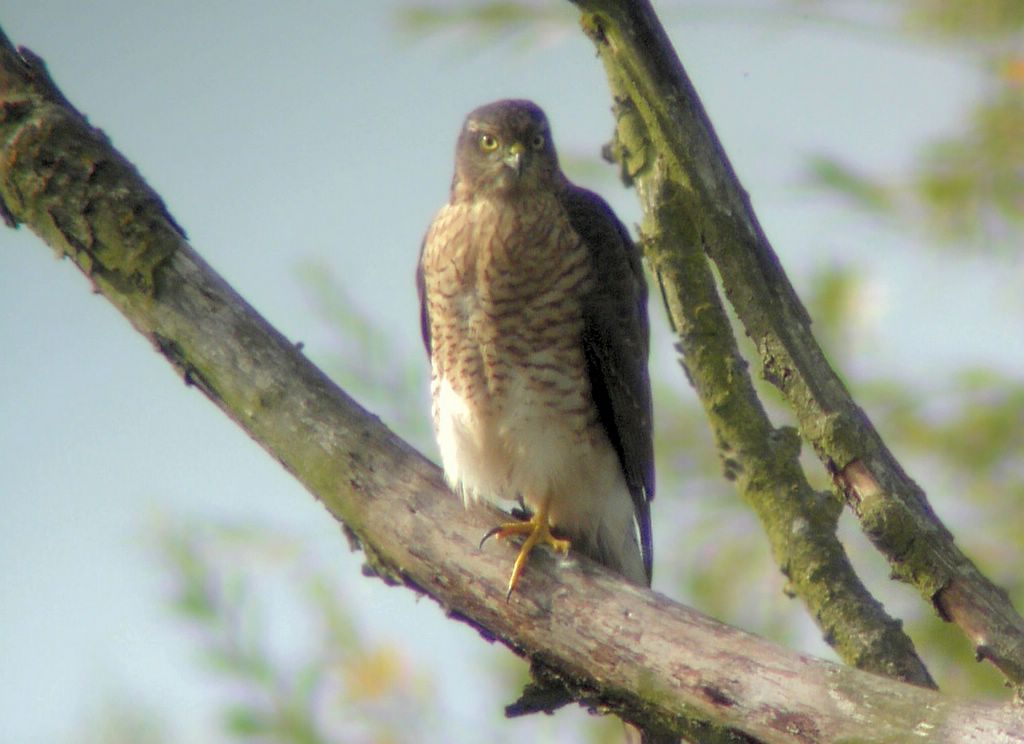
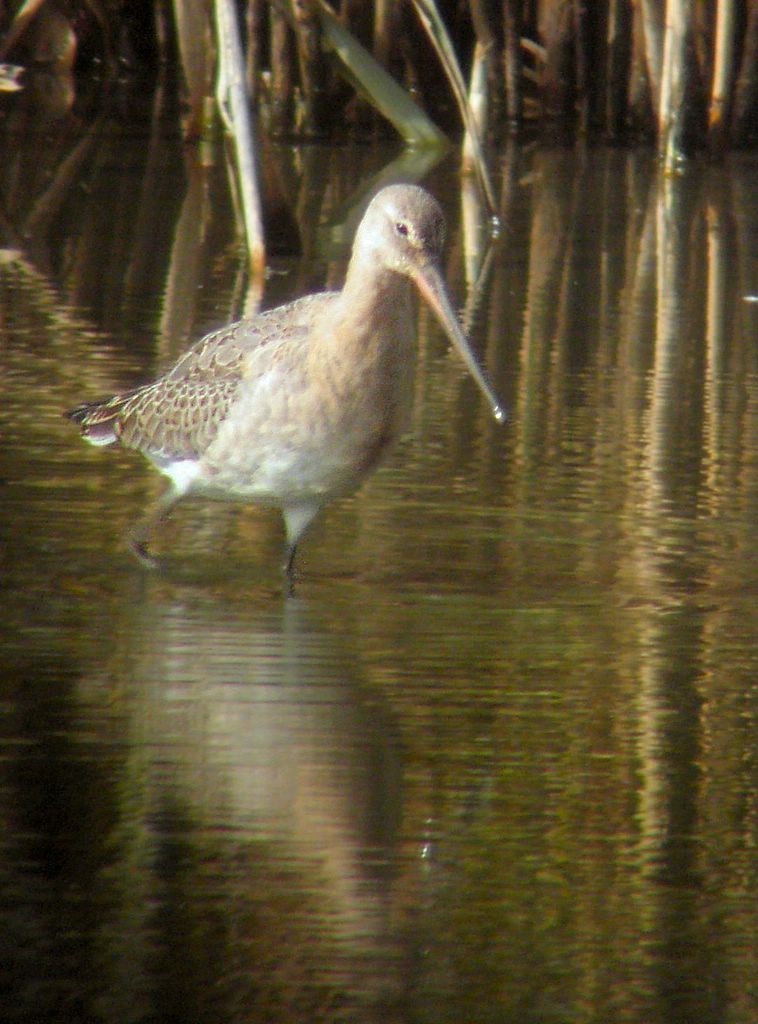
Still, nil desperadum. A Black-tailed Godwit was the one visitor of real note at Brandon (a rare visitor to this particular site) and an obliging male Sparrowhawk gave me a great photo opportunity that really made my morning.

2 October 2005

A Reed Warbler on the patch

An exciting find on the River Leam today - a Reed Warbler, my first for the patch.

Having wandered through most of the Leam Valley reserve with little to show, I headed up to the Offchurch Bury weir. And there, picking its way through the reeds and willow scrub was this pale juvenile warbler.

After ten minutes or so of tantalising glimpses, it finally showed properly - with its wide 'spoon' like tail, black-tipped primaries, longish bill and plain face. A splendid bird on a patch with so little in the way of reedbeds.

That was a turning point in the morning, and in short order I then connected with a Grey Wagtail, a Kingfisher, a Jay, a couple of Chiffchaffs, two Swallows and a House Martin - the last three being fairly late-staying summer migrants.

1 October 2005

Early October in the village

Back to the patch this weekend after the excitement of last week's trip to Norfolk.

Things were quiet in the fields surrounding my house, but just as I was hankering after the wide open spaces of East Anglia (or alternatively a nice bacon sandwich) three Buzzards flew low overhead to put on the most amazing display.

I know these birds well, and have watched them from that hilltop many times, but they never lose their majesty, grace or power. As they glided away (harried by a couple of unhappy Jackdaws), a female Kestrel dropped in, first hovering nearby then sliding in on the strong winds, finally coming to rest on a nearby fence.

Beautiful birds both, and enough, along with a pair of late Barn Swallows and two Sky Lark singing against a crisp blue sky, to put a spring in anyone's step. The bacon sarnie was nice as well.

29 September 2005

A 'Rouzel' for Breakfast and Cley for the day

We finished our Norfolk weekend with a trip to Cley, one of the most famous birding hotspots in the world.

It was not Cley, however, which produced our first thrill of the day. Instead it was breakfast in Hunstanton - no, not the sausages, but a young male Ring Ouzel in the back garden of our B&B.

This was the first 'rouzel' I'd ever seen, and it was clearly identifiable by the pale cresent on its chest (otherwise, to all intents and purposes, this thrush is identical in appearance to a Blackbird). I was delighted (and thus made a berk of myself by 'shouting' it to a room full of disinterested breakfasters - ho hum).


A great start to the day then, and Cley did not disappoint.

The grey weather soon cleared and we were into a good array of migrant birds - a Whimbrel, Wheatear, Whinchat and more Spotted Redshank being among the highlights (plus the Common Redshank in the photo, above left). Half-a-dozen Egyptian Geese were a nice find (above right), as was the Marsh Harrier flying low over the reeds - a magnificent sight of which one could never get bored.

24 September 2005

Red-Necked Phalarope and other Norfolk delights

Norfolk in September is reckoned to be about as good as it gets in birding terms, so I've been looking forward to this weekend for quite some time.

We arrived Friiday lunchtime and headed straight to the RSPB reserve at Titchwell. Bang - straight into my first Red-Necked Phalarope and the weekend's off to a flier!

Along with this very rare wader there was also a Temminck's Stint, some Curlew Sandpiper, a Marsh Harrier, Golden and Grey Plover, six female Pintail and two Little Egret. A lifer, some reasonably rare waders and an assortment of other favourites. Could the day get any better?

Well yes, it did. We popped into the Mariner pub for a pint on the way back to teh B&B, only to find a Barn Owl patrolling the field opposite. I even managed a rushed photograph as a record.


Thank you, birding gods. Dinner certainly went down well last night.

Today (Saturday) was still better in once sense at least - the weather was glorious. We headed off to a couple of places we'd never visited before - Wells Woods and then Holme. Wells was a lovely walk, but nothing too exciting on the birding front. Loads of Goldcrest (sadly no Firecrest or Yellow Browed Warbers among them), more Jays than I'd ever previously seen in one place, Chiffchaff, Willow Warblers, Long-tailed and Coal Tits and a Great Spotted Woodpecker represented the highlights of the morning.

So off we headed to the Holme reserve. We were expecting a lot, but to be honest, the less said about the birding here the better. I've rarely encountered fewer birds.

So it was back to Titchwell to round the day off with something a little more interesting. This we acheived with Spotted Redshank, Greenshank and a long spell watching a Sparrowhawk flap-flap-glide high over the pools.

Time for a well-deserved curry.

18 September 2005

The spectacular Blue Tit


Just because the Blue Tit is one of our most common garden birds, it doesn't make it any less stunning. Good looks, interesting behavious and bags of personality all add up to make the Blue Tit a fabulous creature in anyone's book - and I am well chuffed with this photo.

11 September 2005

Missed yellow brow, Curlew and Pec Sand at Draycote!

Started late at Draycote, and after a slow start on a chilly and grey autumnal morning I found some nice, if unspectacular birds. Plenty of Yellow Wagtails, my first county Greenshank of the year, the first returning Wigeon, and a couple of Common Sandpipers for example. Plenty to keep me interested at least.


Then I met an acquaintance who advised me of a Yellow Browed Warbler he'd just found on the opposite side of the reservoir, plus Curlew Sandpiper and Ruff. Later I browsed the internet to discover that a Pectoral Sandpiper had been added to the day list. Good job I'm not competitive - talk about missing out!

8 September 2005

Going, going, gone?

As expected, the Swallows and House Martins now seem to have left the village and surrounding fields.

Ironically, for the first time this summer a pair of Hobby flew through last night - no doubt wondering where their favourite prey items had gone. Just too late fellas!

Footnote: It's now Friday 9th September, and the Swallows and martins were high over the garden again this morning, chattering furiously as they fed. One last hurrah for the summer?

Footnote 2: It's now Friday, 16th September, and with the temperature starting to drop, they're still around - albeit in much smaller numbers. The House Martins are still near their nests at the far end of the village, a handful flying around the houses this afternoon. You can also still find the occasional Swallow in the village, but these are likely to be birds moving down from the north, rather than our original 'village' birds.

Footnote 3: OK, so this is getting silly. Wednesday, 21st September and the last few House Martins in the village are still here. Presumably a late, or second, brood must be about to fledge and move on - otherwise they are leaving it very late indeed.

5 September 2005

Goodbye to the hirundines

Awoke this morning to find more than 50 House Martins feeding frantically over my house. Yesterday I arrived home to find 20 or so Swallows chattering furiously on the telegraph wires outside the front of the house.

Both are signs that the birds (both from the hirundine family) are gathering in numbers to feed, build up strength and prepare for their long journey home - the House Martins to north west Africa and the Swallows all the way to South Africa.

4 September 2005

A morning in Leam Valley

A trip to my local patch this morning turned up a few nice birds.

There were Green Woodpeckers, skies full of Swallows and House Martins gathering food and strength for their long flight home to Africa, Chiffchaff, a male Blackcap, three Kingfishers (great views of one as close as 10 metres), and five Moorhen (including one youngster).

A Common Sandpiper was only my second for the area, so too a Little Egret, seemingly hooked up with a young Grey Heron for company.

And the highlight of the morning? A Grey Wagtail, my first for the patch. Replendent in is grey and yellow plumage, it preened and stretched for a minute or so, sitting on a discarded piece of metal in a nearly-dried muddy pool not far from the river.

29 August 2005

Rutland without Birdfair

Two weeks ago I visited Rutland Water during Birdfair, a three-day long festival of birding which attracts around 20,000 visitors to this magnificent reservoir each year. It is a great event, but with one possible downside - no one gets much birding done! So today I was back to make amends. It was certainly quieter, although with it being a Bank Holiday Monday, it was by no means empty. However, the real difference was the birds.

First up, the Ospreys for which Rutland is renowned. No sign of their 'homegrown' birds, the pair which have raised three young here this year. Instead I was treated to wonderful views of one of the youngsters that have been translocated here from Scotland this year. An excellent lifer, and long overdue.


Second were the Curlew Sandpipers. These were at the far side of the reservoir, feeding with Ruff and Dunlin, the latter making for a tricky half-hour of identification. However, eventually I was able to confirm to myself which were Dunlin and which Curlew Sands - the elongated and more curved bills, longer legs and bodies, and perhaps most notably of all, their pale cream supercillums (stripes above the eyes). These are amazing birds, having so recently bred in a short summer on the very edge of the Siberian arctic. The adults have gone through to Africa already, and here were the juveniles following on. And for me, that made two lifers in a day!


There were other good birds around too - a Greenshank, a Black-tailed Godwit, several Green Sandpiper and perhaps a dozen Snipe for example. All signs that return passage (autumn migration) is well underway, and contributors to a great day's birding.

28 August 2005

Black Terns in Essex

I visited Abberton Reservoir in Essex today for the first time - my in-laws live over that way so it was about time I got out a bit and explored that fine county.

Abberton is splendid, a huge water just south of Colchester, boasting a first class visitor centre and a track record of rare birds.

When I arrived I found a group of twitchers looking for a White-Winged Tern. Sadly they had no luck, but I was much easier to please - the flock of 20 or so Black Terns that were clearly on display represented a lifer for me!

18 August 2005

An early Sunday morning

You really can't beat a proper early morning. With the sun just coming up and few other people around it is the most serene of times.

After a full day's DIY on Saturday (just about the polar opposite of serene in my book) I headed off on this particular Sunday morning to two favoured local reserves. First up was Draycote Reservoir, where although it was a little cold, I was delighted to walk straight into 7 or 8 Yellow Wagtails, lovely birds which I rarely find anywhere but here. The last were in April, dropping in on their migration north, and now here were the fruits of that long journey - mostly juvenile birds on their way south for the first time. This bird is becoming increasingly hard to find, so it is always nice to find young uns.

Other birds at Draycote included an Oystercatcher, 4 Common Sandpipers (again returning south), a Swift (there are none left in my village now so sightings are becoming sporadic, Swifts being early returners to their African wintering grounds), a Sparrowhawk (great views as it flew in low over my head) and a Hobby (rubbish views of its tail disappearing over some trees).

Posted by Picasa Posted by Picasa

I then moved on to Brandon Marsh where, finally, I found the female Common Scoter that had been there for a week or so - a lifer for me!

Alongside this bird there was a Kingfisher, another Common Sandpiper, Green and Great Spotted Woodpecker, a pair of Lesser Black-Backed Gulls with their huge chick, and the last two Common Terns, their chick now old enough to fly but still reluctant. I would guess the three of them will be heading south again within a fortnight if not a week.

Autumn is well and truly upon us.