8 August 2016

Best 'til last

On a perfect Sunday morning - sunny and warm with a gentle breeze - I was back on patch after a week chasing some local rarities.

Leam Valley continues to look in fine fettle, but it was deathly quiet when I arrived. For a long while only the hither-thither jangling of Goldfinches broke the morning stillness. 

Birds eventually started to appear: a small flock of juvenile tits including a few willowchiffs (probably chiffchaffs, willow warblers are still uncommon here); a male blackcap around the hide; good views of both woodpeckers species; a jay; a pair of moorhen with two chicks on the scrape. But it still wasn't what you would call buzzing.

The real highlight of this first leg came as I crossed the meadow via the raised path. From here I was able to track a female kestrel as she left the woods to my left and then hunted - repeatedly but unsuccessfully - in the morning sun. Close, perfectly lit and perfectly poised, she was another reminder (if one were needed) that rarities and scarcities are only a small part of birding's appeal.

A quick hop to Ufton Fields soon unlocked another magic moment as I watched a male Bullfinch strip a grass seedhead just yards from the hide window. Again, the lighting and view were perfect.

And gradually Ufton went on to yield the rest of the species which I think of as its specialities - several Willow Warblers, a Garden Warbler, a Treecreeper, a Goldcrest and - saving the best 'til last - a family group of Spotted Flycatchers feeding around the far pool.

This understated beauty is a red listed conservation concern across the UK, and the position in Warwickshire is no different. They are still here, but in increasingly small and isolated groups. So a thriving family party is always a welcome sight - and all the more so when they are all around you, are happy to pose for a quick photo, and one of the youngsters seems keen to hover hummingbird-style just feet from one's face!

Bird of the Day: Spotted Flycatcher (Muscicapa striata) - a little beauty, delicately marked and fascinating in behaviour. It shouldn't be a scarcity but it is, so will always be a highlight of a morning on patch.

6 August 2016

It's a 'start

As birding summer presses on into birding autumn, things are starting to hot up across Warwickshire.

Monday's Wood Sandpiper was part of the larger wader-fall which began in earnest last week (as I write there are now two Wood Sands at Middleton, and reports there and elsewhere of Black-tailed Godwits, Dunlin, Curlew and Whimbrel moving through). 

Now the more elusive passerines are also starting to show up in hedgerow, hill and tree, including a report on Thursday of a pair of juvenile Redstarts at Napton Reservoir. 

With no Redstart at all on my patch or county lists - despite numerous previous attempts for one at Napton Res and Hill - I was obliged to head over after work, despite the ominous skies and yellow-exclamation-mark weather forecast.

With the faulty logic for which humans are so well known, I headed straight to the far sheep fields where Redstarts have been reported in previous years. A thorough inspection turned up plenty of Common Whitethroat and juv. Chiffchaff, very many biting insects (welcomed by the hundreds of swallows above), and the first of two massive downpours. 

But no Redstarts.

Fortunately a quick check of the fields back at the car park instantly turned up both the reported birds, moving along the hedge at the side of the entrance/exit track. One was particularly obliging, sitting high (for a Redstart) at the top of the hedge for a good five minutes, until a departing fisherman drove past and scared it away over the fields to the north.

Thank you to Boatbirder for sharing his discovery via Twitter. My own photos were merely black outlines in the gathering gloom, Boatbirder's distant record shots were at least in colour! 

Bird of the day: Common Redstart (Phoenicurus phoenicurus), a bird of mature oak woodland that is long since finished as a breeding species in Warwickshire, and is now largely confined to the west and north of Britain. The migrating birds which pass through the country every spring and autumn are therefore a real highlight, all the more so since this is among our most handsome passerines.

2 August 2016

Not Waderless!

Reports came in during Friday of a wader-fall at Brandon - six Black-tailed Godwits and a Curlew were among the key arrivals that caught my attention.

Sadly, by the time I could complete my work and get to Brandon, both species had flown. 

With the reserve feeling increasingly quiet, and the weather increasingly ominous, I was left with more usual fare: several Ringed Plovers, 200+ Lapwing, three Green Sandpipers, a Common Sandpiper and a couple of Little Egrets. 

Then came the inevitable heavy downpour which sent me on my way a trifle disappointed at yet another wader dip (see also Waderless, last week).

However, with return migration now well underway it was only a matter a time until something new turned up, and so it proved with Monday's reports of a Wood Sandpiper at Draycote Reservoir.

So, ignoring the rain and the fact that every other birder in the country was in Suffolk, I headed straight to the overflow where it was still being reported through the afternoon. 

It was easily found, busily feeding along the broad stretch of shore from the overflow back along the exposed Hensborough Bank. 

The snapshot doesn't do it justice, in particularly its spangly back which seemed almost black-and-white in the gathering gloom of a rainy summer's evening. That long, strong eye-stripe is a key diagnostic, along with the square white rump revealed in a quick burst of flight.

With the lowish water levels exposing so much of Hensborough Bank it looked perfect for waders, so it wasn't a huge surprise when a Dunlin (already in its winter drabness) flew in to join the juv. Little Ringed Plovers, followed by a Common Sandpiper. 

Two Little Egrets and a number of young Yellow Wagtails kept me company on a contented, if wet, walk back to the car.

Bird of the day: Wood Sandpiper (Tringa glareola), a welcome local highlight which crops up on passage every few years. Only a very few breed in the Highlands, the rest in Northern Europe. They are now on their way to Africa, this one taking an extremely westerly route.

21 July 2016

Waderless

The Green Sandpipers and recent Greenshank at Brandon March mean only one thing to an ever-optimistic patch watcher - autumn migration is already underway, albeit tentatively.

Mindful of the late summer / early autumn mornings when Green Sandpiper, Little Ringed Plover or Common Sandpiper have  dropped in at Leam Valley, I was up bright and early for a quick visit on Saturday.

Sadly, there were no waders in sight. What's more, there seems little prospect of any in the short term - the water level is much higher than it has been in recent summers, so the 20 or so Mallards (mainly hybrids in fact) were much more at home than any of our smaller waders are likely to be. 

Still, migration is only just beginning so there are a few months to go yet.

Plenty more to see around the reserve though, which is looking better and better under the careful management of Warwickshire Wildlife Trust (and, I'm sure, a dedicated team of conservation volunteers). 

A good amount of homogeneous 1960s tree planting has now been felled or cut back, leaving a better blend of trees and more diverse open spaces featuring a mix of ground cover and understory / scrub. Ideal for wild flowers, insects, nesting birds and more, and a real step in the right direction for a reserve which has always seemed to me to have so much promise.

Birding highlights included plenty of Chiffchaffs, a possible Lesser Whitethroat (lots of juv. Common Whitethroat around though, so I'm far from sure), great views of a number of Blackcaps, and a brief appearance from the regular Kingfisher.


17 July 2016

An evening at Brandon: The Movie

More fine weather on Thursday; it could almost be summer :-/

But an excuse, nevertheless, to rush down to Brandon Marsh for an evening of birding and playing with my new digiscoping / vidiscoping kit.

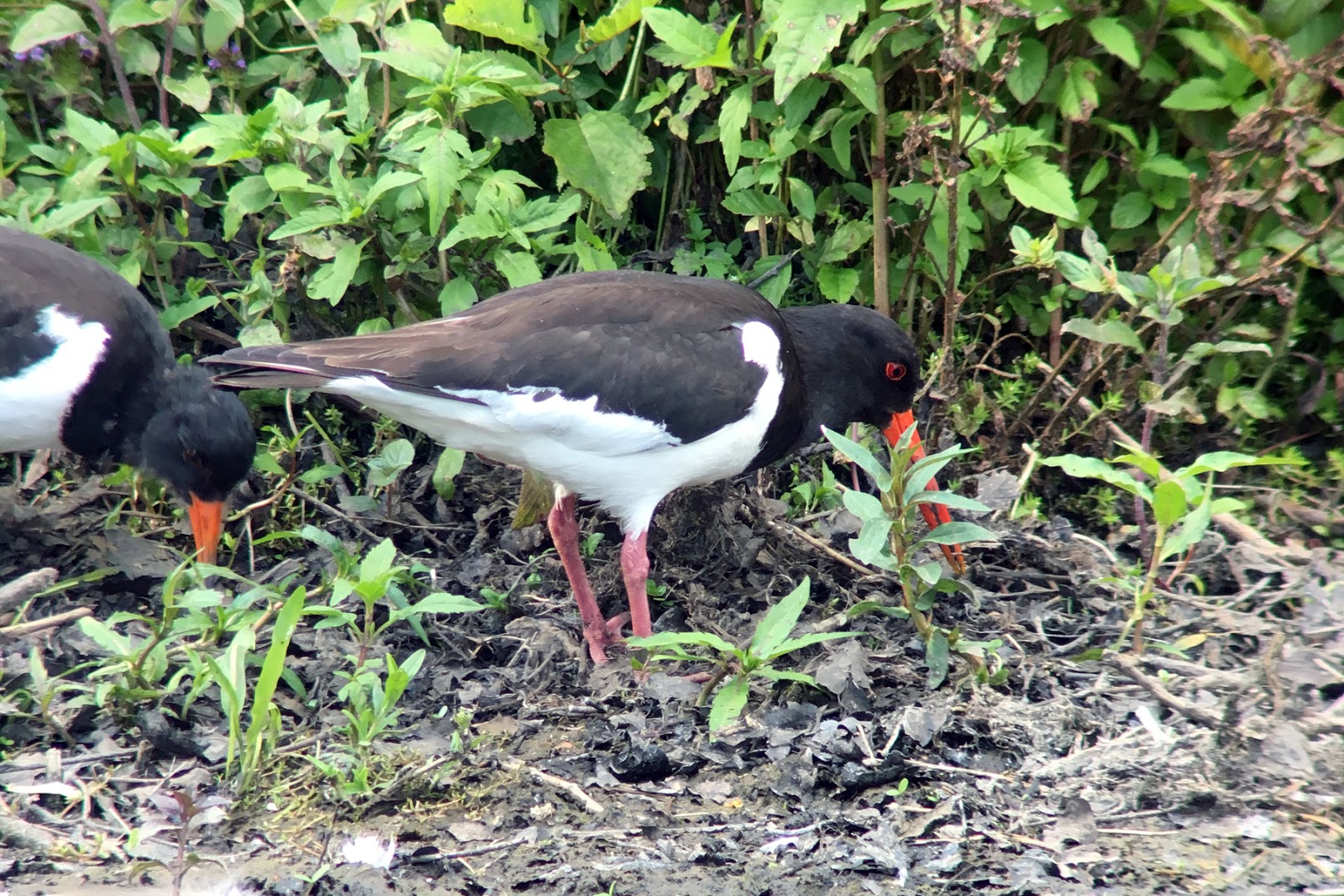
No Greenshank-like excitement on East Marsh this time, nor Hobbies at the Alban reedbeds. Instead I was able to grab some nice footage and images of close-to Oystercatchers, a Common Tern on a not-too-distant perch, and then spend a bit of time sketching these and others.

So the Common Tern first, as a short video (spoiler: the (modest) action sequence is at 00:53):


And then, because I can, as an animated gif. You won't be surprised to learn that there's an app for that :-)


The Oystercatchers were more of a challenge - they wouldn't stop moving! If I'm to catch video footage in those circumstances then I might need a steadier, more fluid tripod head. But in the meantime, here's a couple of jpgs and another gif.


Other birding highlights included  4 Ringed Plover and a Little Ringed Plover on the main island, and two Green Sandpipers at Teal Pool,

16 July 2016

Photography good. Video better?

I mentioned in my last post that I was intrigued and excited by the opportunity to use my iPhone's video as well as the still-image camera when digiscoping. It has taken only a couple of days for the advantages to become clear.

Take this short film of Swallow chicks for example. Taken right outside my office door just a few hours before they fledged from the nest, it isn't amazingly sharp or eye-poppingly bright.

But it does instantly demonstrate a number of advantages to video:


  • Insight: we thought there were three chicks; studying the footage carefully showed four mouths suddenly appear at feeding time.
  • Detail: this insight was possible thanks to some clever slo-mo technology applied to the video, extending the feeding episode from a couple of seconds to a more leisurely pace.
  • Timing: it is incredibly hard with a still camera, even with modern burst modes, to get four chicks with their mouth open. But video makes it a doddle - simply set it running, cut it to size later, apply the slo-mo to the key part (and extract a still image as well should you so wish, see examples below).
  • Quality: video simply demands less quality; for a photo to excite in this digitally perfect age it has to be pin sharp and compositionally perfect, but videos seem to engage audiences at a far lower quality.


There's undoubtedly more video to come on The Hornet's Nest, for all these reasons and more.

14 July 2016

A new toy! or Phonescoping arrives at the Hornet's Nest

It was only recently, as I re-read some old Hornet's Nest equipment reviews, that I realised I've been using pretty much the same birding gear for a decade or more.

Bins, scope, even my shoulder bag - all have been with me for many years and, aside from the odd new notepad. sketch book and pencil, there have been no new toys to play with.

Except cameras that is. Over the years I have chopped and changed a bit with cameras.

I was there in the early days of digiscoping - if not at the actual beginning then certainly in the first flush of innovation. Cameras were heavy and/or unreliable (Coolpix 990 or Contax SL300 anyone?), adaptors were clumsy and expensive, batteries depleted fast, and results were decidedly hit and miss. I got some great results, but got pretty fed up lugging all that gear about.

So from digiscoping I moved on to a superzoom camera (Panasonic FZ20, still regret selling it) and then a DSLR with cheap 300mm lens + teleconverter. 

But more than anything what this all taught me was that good birdwatching and good bird photography rarely go hand in hand. Sure, good bird photography requires field craft and knowledge of birds. But it also needs obsessive attention to an individual bird at the expense of all others; attention to light and composition; and a thousand technical details from pin-sharp focus to batteries. And then there are the hours 'developing' the images on a laptop.

So I pretty much quit bird photography all together, preferring instead to find wonderful Creative Commons licensed images to use in this blog, and to sketch my own birds as I find them in the field. My sketching is awful, but I learn vastly more about birds and bird ID from doing that than I ever did from photography.

However, there are undoubtedly occasions when a photograph would be useful - either for identification, confirmation, or perhaps to complete a sketch after the bird has flown.

A bit of reading around suggested that digiscoping in its latest guise - phonescoping - might be the answer. So this week I finally got my hands on a new toy - a Carson is-100 universal phone adaptor from Sherwoods near Wooten Wawen (thanks for the great service guys). 

This clever device is able to pair my iPhone 6s with either my Zeiss Diascope 65 or my Opticon MM2 ED scopes. The results are a revelation.

The smartphone camera is vastly better than the technology of years gone by, so the images - in good light at least - are plenty clear enough for my purposes, with bags of spare resolution for cropping. Additional features like video and slo-mo are the icing on the cake - I can see plenty of birding applications and look forward to playing in the coming months and weeks.

So there you have it - a small piece of plastic I can throw in the shoulder bag and be ready  to photograph at a moments notice. Wonderful. Here are the obligatory garden test shots (taken from a bedroom window at 20 metres or so); I'm sure there will be plenty more to come.


11 July 2016

The blur of pencil on paper

Nothing suggests a good bird like a busy notebook and sketch pad. Take Friday evening, for example, which saw a proper blur of pencil on paper as an unexpected wader greeted me at Brandon Marsh.

I arrived at Brandon just before 5pm with the vague aim of watching and sketching Hobbies for a while. And I did, eventually.

But first I was waylaid for nearly an hour at East Marsh. Because as I counted Common Tern chicks and sorted through the Lapwings, Oystercatchers, Ringed Plover and Little Ringed Plover, my scope came to rest on an elegant, but sleeping, wader.

Pale, slim and speckled, it looked for all the world like a Greenshank, a bird I haven’t seen in Warwickshire for absolutely ages (possibly since this digiscoped beauty at Draycote in 2005). 

 And when it lifted its head and started elegantly feeding around the island, I was able to confirm that it was indeed Tringa nebularia – an unexpected treat and a joy.

It’s not a terribly difficult bird to identify of course, but I took my time to work through its distinctive features – the green(ish) legs, the needle-thin and slightly upturned bill and, when it eventually fluttered gracefully from one side of the island to the other, a diagnostic white ‘cigar’ shape on its back.

Having watched and then sketched the bird to my own satisfaction (fortunately I set low, low standards for my own artistry), I moved on to Green Sandpipers at Teal Pool (now up to three in number), and then on the Ted Jury Hide for some Hobby sketching. Just one Hobby showed, but it did me the great service of sitting stock still in the nearest tree for half an hour – a great end to a great evening.


Bird of the day: Greenshank (Tringa nebularia), a returning migrant which will be found at shallow waters around the country over the next couple of months – but usually only as single birds. Their relative scarcity in inland counties like Warwickshire only adds to their elegant charm.

7 July 2016

The warp and the weft

One of birding’s many glories is the way it can be fitted around the warp and weft of everyday life.

Unlike fishing, cycling and my (many) other interests past and present, birding require no great preparation, no great amount of equipment and little forward planning. Simply pick up binoculars, notepad & pencil and step out the front door.

Southern Hawker at Snitterfield
So with a spare lunchtime hour on Monday I could head to Ufton Fields; in the same slot on Tuesday I was at Snitterfield Bushes; after dinner that night the fine weather called me to Leam Valley; and Wednesday lunchtime saw me on a canal side stroll near Edstone.

Birding is tough wherever you go at this time of year, but doubly so in woods. I heard plenty but saw few - warblers, Wrens and Song Thrush have all been in good voice. 

The real birding highlight was over water though - a pair of Kingfishers fishing and playing together for a good half hour at Leam Valley.

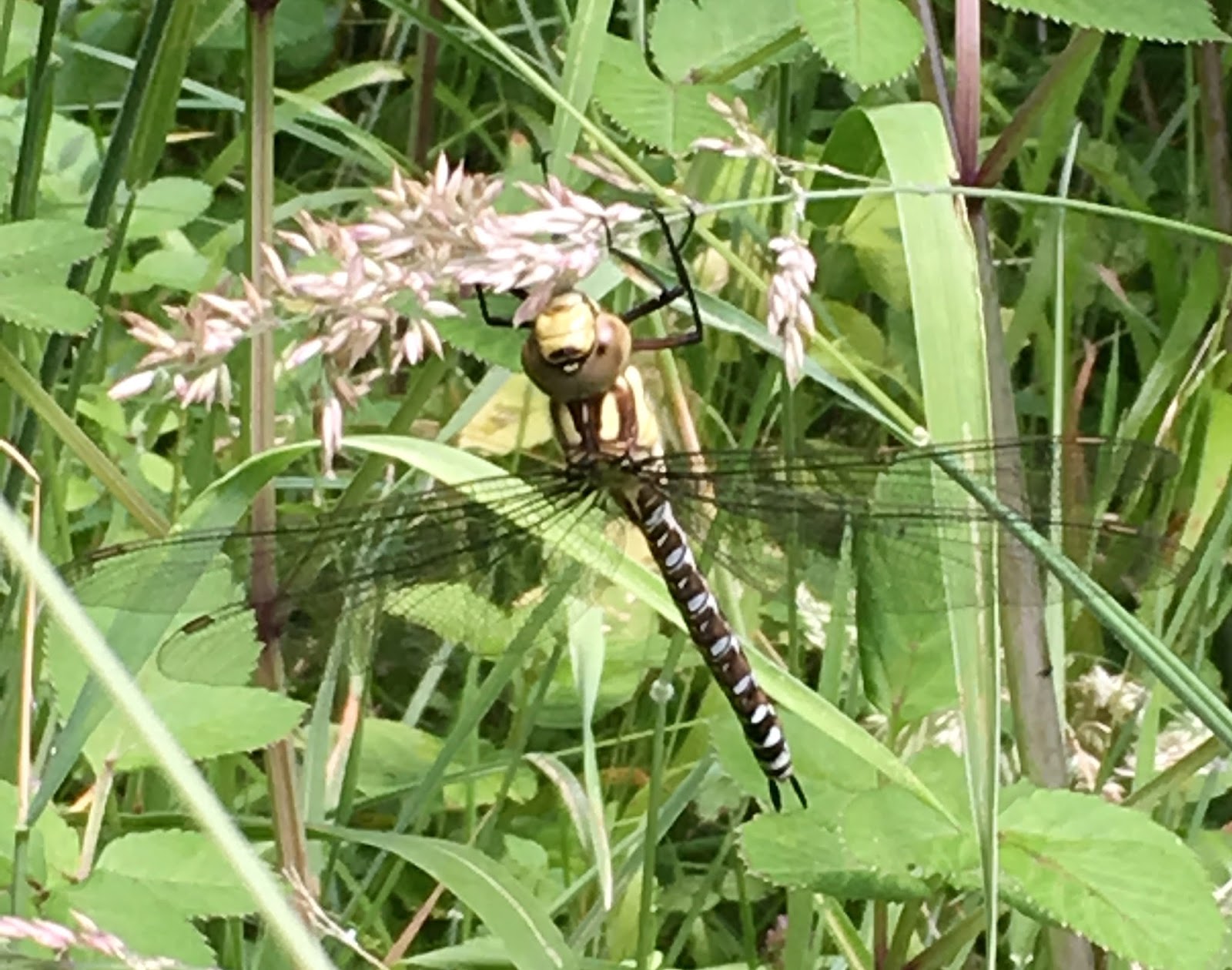
But non-birding highlights have been plenty, including late season spotted orchids throughout Ufton and Snitterfield, Marbled White butterflies at Ufton and two Southern Hawkers at Snitterfield.

Species of the week: Southern Hawker, simply an astonishing creature. The more you look the more amazing they are, and it’s well worth investigating their ‘back story’ (including most of a life spent underwater, with just weeks in this amazing, prehistoric state).

5 July 2016

A fine Hobby

The merest hint of warmer weather was enough to send me scurrying to Brandon Marsh for a Friday evening stroll.

It’s been a while since I’ve done an evening session, and I’d forgotten how gloriously tranquil it can be.

A couple of Common Terns provided the early entertainment, alternating between feeding two chicks and squabbling over their own share.

The Oystercatcher chicks are now up and around, and starting to look like small Oystercatchers in their own right (albeit very scruffy ones). Talking of scruffy, most of the ducks are now well into eclipse.

On the Teal Pool it was great to see my first two Green Sandpipers of the year, presumably females which have left their breeding grounds ahead of the young and male birds (as is their habit). One of these two certainly had the boldly-speckled back of a breeding bird, the other less so.

Photo: Ron Knight
News of both Barn Own chicks and Hobbies from the Ted Jury Hide had me scurrying to the end of the reserve – sadly neither appeared during the half-hour I had left.

But there’s always another day, and it happened to be Sunday. Back with J at my side, we were down to one Green Sandpiper but up to a full complement of two Hobbies.

These are thrilling birds – powerful, agile, elegant and beautiful. I could watch them for hours: perched one can only admire their colours, their markings and their poise; once airborne their hunting of dragonflies (and occasionally hirundines) is frankly astonishing to see.


Bird of the weekend: Eurasian Hobby (Falco Subbuteo), I think probably my favourite raptor. A summer visitor, the Hobby is best seen on warm days from June to September hawking over water, marsh and scrubland for dragonflies and small birds. 

2 July 2016

Spring into summer: four months in one post

Ah, the catch-up post – the tax demand of the blogosphere. No one wants to read it, few enjoy it when they do, and the longer you put it off, the worse it gets.

However, for the sake of keeping my own notes up to date (and remember that The Hornet’s Nest serves above all as my birding diary), I’m afraid that a short review of recent months is required.

Clearly disillusioned by my autumn dips (most notably on the Bearded Tits at Napton Reservour) my notebook suggests I took off all of December and January.

February saw a resumption though, with Draycote to the fore: drake Smew, Great Northern Diver, Greater Scaup, and a stunningly low fly-by of 200+ Golden Plover were among the highlights.

A country tick (photo by Jez)
March featured the miracle of a county tick. As I drove to work near Norton Lindsey one morning, the usual drag of being stuck behind a tractor was considerably alleviated by the sight of a Red Kite drifting slowly across my windscreen from left to right.

It’s taken years for me to finally connect with one of these beauties inside the county boundaries, and would you believe that not two weeks later I ran into another, this time while out cycling near Napton (and that only because I took a turn down the wrong lane for 200 yards).

By April and May I was back in full birding swing (in so far as I ever am these days).

An early April trip to Brandon Marsh threw up joys aplenty: 2 Black-tailed Godwit, 2 Little Egret, a male & female Pintail, my first Willow Warbler of the year, Redshank, Oystercatcher and a pair of Shelduck.

Spotted Flycatcher (photo: sebastien bertru
Just a few days later I enjoyed a magical evening at Napton Reservoir where hundreds of newly arrived hirundines swept low over the water and surrounding fields. 75% Swallows, 20% Sand Martins and 5% House Martins - plus great views of a Lesser Whitethroat and a beautiful White Wagtail.

I was all over May; I smashed it out of the park ;-) Yellow Wagtail at Napton Res (admittedly that was while I was dipping on a Redstart, but hey ho),  Common Sandpiper and Little Ringed Plover at Brandon, Red-legged Partridge as I cycled near Offchurch, and a beautiful (and very early) family of Spotted Flycatchers at another favourite local destination – the patch had truly come alive.

Two special trips bring this marathon catch-up to a conclusion.

In mid-May, J and I took our first (and much overdue) trip to Upton Warren in Worcestershire. We went principally to see the Avocets which are encouraged to breed there by the unusual brackish inland waters. But there was so much more besides. Ringed and Little Ringed Plover, Common Sandpiper, Little Egrets, great views of a Water Rail just in front of the tiny book hide and – this the crowning glory – three Black Terns feeding relentlessly over the larger of the waters, a small part of a widespread national fall.

By June we were in Devon, where a trip to Yarner Wood is always an absolute must. No Redstarts on this occasion, but I did connect with a female Pied Flycatcher and enjoyed the closest possible views of a brilliant yellow-and-white Wood Warbler.

Eurasian Golden Plover (photo: Sue)
Ancient oak woodland is in short supply in Warwickshire, but so (as you might have noticed) is coastline. That made Dawlish Warren at the mouth of Devon’s River Exe pretty hard to beat.

We were there for a family beach day, and found the nature reserve by chance. Something of a result all around, since at the end of a great beach + funfair day we took the opportunity to walk across to the main hide, finding as we went plenty of Stonechat, Linnets, a score or more of Oystercatchers, 2 Bar-tailed Godwits, 2 Whimbrel (my first for some years), Ringed Plover, Dunlin, Great Black-backed Gulls and, most surprisingly of all, a Golden Plover in virtually full breeding plumage – an unusual bird in these parts at any time of year, and in these colours a first for me.

Full circle then from February’s fly-by of winter-plumaged plover, and a gloriously bright conclusion to four months of episodic but enjoyable birding.

Bird of the season: Almost impossible to call, but I’m going for Spotted Flycatcher (Muscicapa striapa): admittedly one of the more common of the birds recorded in this post, but much declined in recent years. As a patch-birder at heart, finding a successful brood in the heart of my patch probably brings me more pleasure than any number of exotic rarities elsewhere (although as a county tick the Red Kite's were both a bit special, and that breeding-plumage Golden Plover did lift the heart more than a little).

15 November 2015

Getting away from dip, dip, dip, dip

After a week-and-a-bit of repeatedly dipping Napton's bearded tits (still not seen them after four, possibly five, visits) it was nice just to amble around Brandon Marsh with no particular agenda.

It was a decent session in the end, but blimey was it hard work to start with. The high wind didn't help, although thankfully we missed out on the forecast heavy rain. But the main challenge was finding any birds to get the pulse racing.

Out on East Marsh the winter wildfowl dominated - a handful of mallards and five tufties were overwhelmed by autumn incomers, with 40+ shoveler, 70+ teal and perhaps as many as 120 wigeon. Most welcome they were too, since when there's not much else on I can easily while away the hours watching, and listening to, a big flock of wigeon.

There were just three lapwing on the marsh, although later in the day 100+ did wheel in low overhead.

A long stint in the Ted Jury Hide produced absolutely nothing beyond a close-in moorhen which became my object of interest for 20 minutes or so as it picked its way through the water-weeds looking for morsels to eat. 

Fortunately things livened up on the walk back.

First a marsh tit 'sneezed' and then showed well as I left the hide. Then a little diversion down to the Riverpool Hide turned up a lesser redpoll, a good size tit flock and a kestrel. From the hide I caught a tantalising glimpse of a drake duck which was just a little too plain  in the face and a little too grey to be a mallard - almost certainly a female pintail.

Just before I reached the visitor centre a little gang of five siskin stopped beside me, and at the feeders there were reed bunting, coal tits and a nuthatch (sadly the brambling, with I definitely wasn't looking for *crosses fingers* didn't turn up).

Bird of the day: Moorhen (Gallinula chloropus) - we are all of us I'm sure guilty of being blinded to the majesty of this waterbird by its sheer ubiquity. But from it's blue-black head and bellow to its buff-brown back, from its pristine white tail to its glorious red-and-yellow bill, it's a stunner that birders can rely on from park pond to windswept nature reserve.

24 October 2015

A long weekend

Birding on Saturday AND Monday - oh the indulgence of it.

Saturday morning was bleak and grey at Leam Valley, but warm enough. I was hoping for some early autumn movement, and wasn't disappointed. 

A good haul of birds included my first siskins of the year, a small flock of maybe six to 10 birds. Among them was also my first lesser redpoll of the season.

Down on the scrape the teal numbers had grown, with still more birds emerging bright and cheerful from drab eclipse. Three fieldfare flew overhead, a large flock of goldcrest gathered towards the rear of the site, and jays crissed-crossed the whole time.

Incredibly autumnal then, if it wasn't for the final find of the day - the distinct, if faltering, sound of chiffchaff song. Presumably a first winter male, trying out its new vocal abilities having either moved south already or lingered late. A bizarrely summery note on which to finish the session.

Monday was a rare 'spare' annual leave day, so J and myself headed to RSPB Middleton for a proper day out. 

Our aim was 50 species, and we were pleased to reach that by the time we got back to the car. 

While I had been hoping to break my long-standing habit of missing / dipping bramblings (I didn't), and I later became aware we had missed the only passage wader on site (a ruff), it was still a decent haul. 

Highlights included more siskin, a redpoll, a couple of snipe, four or more little egrets, a sparrowhawk and at least three stonechat, possibly more - for a while we just kept bumping into them, which is always nice.

Bird of the weekend: Siskin (Carduelis spinus), a lively and pretty little finch, an autumn / winter visitor only in these parts. One of the easier autumn specials to find (just locate your nearest riverside alders) but still a thrill every time. 

18 October 2015

Midweek moments

Lunchtimes, mornings and evenings after work - this time of year is all about making the most of the light before the clocks go back at Halloween.

A quick lunchtime walk around Langley threw up a healthy handful of hedgerow, farm and field birds, with highlights including goldcrest, nuthatch, a pair of yellowhammer, marsh tit (in its usual run of shrub) and three coal tits. 

Over at the lake, the cormorants have returned - a peak of nine last week, just a couple around this time. 

A lunchtime dash around Leam Valley the next day was strangely quiet - strange that is until I realised there was a working party and two tractor-pulled mowers on site. The birds, quite wisely, seemed to have vacated until the work was done.

However, there were still half-a-dozen teal on the scrape, great views to be had of a female kestrel and, as I headed back for the car park, a grey wagtail sitting motionless on an apple bobbing in a shallow stream / ditch.

An early evening walk round Napton at the end of the week was little more productive - a great crested grebe was the only new bird on the water since my last trip. 

However, the evening was notable for my first autumnal flock of fieldfares, perhaps 25 of them dashing away in the middle distance. I saw the same number again past my back garden on Saturday morning, meaning the autumn is now most definitely here.

Bird of the week: Fieldfare (Turdus pilaris), a large, bright and bold winter thrush; very much a herald of autumn and a welcome part of Britain's winter landscape.

11 October 2015

Pushing ourselves

Today was a birding day, but I'm going to start with a reflection on fishing: my brother always catches more than me.

So why is that? Well, it would be churlish of me not to factor in his superior skill and experience (and I do so hope he never reads this). But another factor is definitely his sheer will to catch. While I'm looking at darkening skies and packing away, he'll be looking at those same skies and thinking: "there's another hour in this; still time for the big one." And so it often proves.

All of which I mention because I think this self-same will to win / optimism / cussedness is an admirable philosophy which can be equally well applied to many other ventures in life - not least birding. So today, whenever I felt like calling it a day, I told myself to stick it out and wait until I caught - I mean found - the big one. And the result was... well, this.

It was a stunning morning as I left the house at 07:30, the mist draped over hedgerow and field and a huge red sun rising over the treetops. When the last of that mist dissipated shortly after I arrived at Napton Reservoir it revealed nothing much, a lone pochard the only non-regular on or near the water.

Instead I spent a fruitful couple of hours hedge and field bashing, hoping (with little expectation) for a yellow-browed warbler but settling instead for some 1st winter yellowhammers, bullfinch, linnet, meadow pipit, a mistle thrush, my second lone redwing of the week and a magnificent sky full of sky larks. Flyovers included raven, a grey wagtail and two pairs of swallow stragglers.

You can't fault the view from
Brandon's Badger Tearoom :-)
Thirty-four species isn't a bad haul for a couple of hours on a small patch, but I still had an appetite for more birds. And for a full English breakfast, which - not at all coincidentally - is how I started my visit to Brandon Marsh.

The breakfast was great, but the sightings board and book didn't look quite so promising. With little having been reported over recent days I was beginning to think I should have made the trip up to Middleton Lakes RSPB on the off-chance that the GWE came back (it didn't).

Still, I told myself, Brandon is a big reserve - there could be anything out there, just waiting to be discovered. Hmmm. After another couple of hours my 'big' find (apart from the welcome site of the recently arrived wigeon) had been a couple of well-hidden snipe on east marsh - my first waders for the day, but not much to show for 4+ hours out and about.

So I decided to make a final stand at Jury Hide - here I vowed to sit until something really interesting dropped in (a peregrine or marsh harrier perhaps, or maybe even the now-mobile GWE!)

To be fair it only took 10 minutes of steely determination (ahem) before I spotted the tiniest movement in the hedges right at the back of the reedbed. A quick scope scan revealed a vivid male stonechat, clear as day even at 200 yards. He was quickly joined by a female and, after a few minutes watching them bounce along that hedgerow, I could finally head home happy that I had indeed seen the day through to a decent conclusion.

Bird of the day: Common Sni... nah, just kidding. It was Stonechat (Saxicola torquata), a long-time favourite of mine. October / November is the best time to find them in this part of the world, and Brandon Marsh as good a spot as any.

3 October 2015

It's not great, but it's mine

I suspect Leam Valley would be few birders' idea of a great patch. Certainly few 'serious' birders.

Despite a reasonable smattering of different habitats, this local nature reserve has proved a tough challenge over many years. Rewards have been modest, with the stand-out discoveries (modest as they have been) significantly outnumbered by visit after visit of same-old same-old mundanity.

It was only as I crossed the entrance footbridge just before 8 o'clock this morning that I realised just how much I'd missed it all :-)

Eerily still, grey but mild, it was a lovely morning to be out and about - even more so given the many-months break since I last ventured forth with binoculars.

The regulars all welcomed me back in turn. In the first dead tree a buzzard loomed large over a squabbling magpie and a great spotted woodpecker. Not much further along the river was a second buzzard and several green woodpeckers.

As ever I was hoping for waders at the scrape. As (nearly) ever there were none. But I was pleased to see a dozen or more female teal busily feeding, and even more pleased when I noticed the lone wigeon on the near shore - a female, and from memory only my second or third here.

Winter wildfowl briefly gave way to summer again as 6 swallows flew west; and then I stumbled across my bird of the day, a late - albeit not bizarrely so - yellow wagtail busily feeding alongside house sparrows and yellowhammers in a nearby ploughed field. Sadly it's not a bird I see much locally, apart from Draycote Reservoir's annual influxes - from memory I can recall a flock near Radford Semele, one of two birds at Ufton Fields and now this one.

Other finds of note were my first redwing of the year (high overhead), several nuthatch, and an intriguing snatch of explosive call which may well have been a cettis warbler. If so, it would another first for this site - I shall certainly be back soon to investigate further.

Bird of the day: Yellow wagtail (Motacilla flava), a lovely little bird which is all too rare as a breeding bird in Warwickshire these days, having suffered terribly from changing agricultural practice, draining and replanting of meadows and so on. A familiar tale for all-too-many species.


11 February 2015

Napton gulls

and I took a brisk lunchtime stroll around Napton Reservoir, determined to make the most the kind of late winter weather that puts one in mind very much of early spring.

The standout birding moment happened before we'd even set forth from the car park; almost 100 lapwing flying low over our heads, blinking black-white-black in the midday sun.

The flock split into two as we watched, and the smaller group of perhaps 30 birds came back to us twice while we were on site.

The reservoir itself had taken on a deep, rich blue colour which contrasted beautifully with the straw yellow of the winter reed bed. The far corner was iced over, providing a popular platform for a large gull flock.

My count of c120 common gulls is among my largest for the site, and the wide variation in their coloration got me thinking - not for the first time - that I should spend more time brushing up on my gull identification skills.

Elsewhere on the water there were pairs each of gadwall and wigeon; plenty of tufted duck and coot (no count, but my perception was that the latter were down on their peak winter numbers); and three great crested grebes.

In the surrounding fields and hedges we had good views of a pair of bullfinches, plenty of blue and great tits, a kestrel and a buzzard.

Bird of the day: Common gull (Larus canus), not common at all except as a visitor in winter (from our own coasts, but many more from Scandinavia & Baltic areas), when numbers can start to build up as today. There's something very attractive about this gentle-faced gull, and it's always a welcome break from the monotony of the more numerous and year-round black-headed gulls. 

8 February 2015

Two wheels good

Today was a beautiful late winter day, the kind that makes birding an absolute joy. But a promise is a promise, and I have pledged to join a 100 mile bike ride in May - meaning that a long, if reluctant, training session was required.

The good news is that if you live as I do near the mid-Warwickshire countryside, cycling and birding are by no means mutually exclusive.

In fact it's quite often the bird sightings which keep me going on a long ride - and with today's 40 miles taking the best part of 3 hours I had plenty of time to look.

It started well as I sped, still fresh legged, out of Offchurch and found my first singing skylarks of the year, as well as a small group of yellowhammers, the males vivid in the bright winter sun.

Shortly afterwards I found the first of what must have been a near double-figured haul of buzzards, and a kestrel wasn't far away. On my way into Birdingbury I rode alongside a flock of 20+ lapwing, resplendent in the bright, clean sunlight.

And, saving the best 'til last, a red-legged partridge ran alongside me in fields behind Long Itchington - a welcome year tick on what must have been the most physically demanding birding trip I have ever undertaken!

Bird of the day: Red-legged partridge (Alectoris rufa), an exotic looking game bird that brightens any walk across local farmland.

7 February 2015

Smew-tiful

Whatever your enthusiasm, life as a 'weekend warrior' can be tough - and never more so than in the depth of winter.

With work hours long but the days still short, many of us endure five days every week without the time or the light to properly 'do our thing'.

Cyclists reach for the turbo trainers, birders snatch a few moments fresh air at lunchtime, cricketers train indoors, anglers tie rigs, and photographers set up elaborate indoor macro shoots. 

But all of us yearn for a return of the long, light summer evenings.

For a birder, the nightmare scenario is the week-day rarity - in the worst case, a bird which arrives somewhere on Monday, is reported all week and then vanishes some time on Friday night.

You can always tell when there's been one around, because Saturday morning will see the site full of anguished weekend warriors all asking each other the same question: 'anyone seen the [insert species here]'.

Today at Draycote it was [insert black-necked grebe here] as we all searched in vain for this uncommon winter visitor. To be fair it had actually turned up last Sunday, not Monday, but since my last free day had been the Saturday before the effect was much the same.

Sadly, perhaps inevitably, while the grebe may still have lurked somewhere on this vast reservoir, there had been no sighting of it by the time I left just after midday today.

While disappointing, this didn't spoil the day as much as perhaps you might think.

In fact the grebe was just one of a number of target birds for the morning, each of which would be a year tick for me.

I knew exactly where one species would be, so I set off clockwise to find it. Pausing only to find the female pintails by the overflow, I was soon happily watching a flock of c.20 tree sparrows in hedges near the feeder at Draycote Bank. Hard to find anywhere else locally, but not here, so tick #1 for the day.

Second was the long-staying drake smew. This little beauty proved much more elusive, meaning I'd walked four of the five miles around the reservoir before I finally tracked it down just off Biggin Bay.
I don't see these rare winter ducks too often, and every time I do I am struck by just how exquisite they are - surely our most beautiful bird?

Tick #3 was a more prosaic one, simply a matter of locating one of Draycote's great black-backed gulls, which I did sitting on a bouy not far off the valve tower.

There was plenty more on show besides, of course: a dozen goosander near valve tower, plenty of goldeneye, teal, pochard and wigeon, and, as I finished my five mile circuit, the 2 white-fronted and 1 pink-footed goose swimming just off shore with a small group of greylags.

A grand finale to a typical weekend warrior trip.

Bird of the day: Smew (Mergus albellus), this small sawbill duck only occurs in tiny numbers over a British winter; the drake is an absolute smasher, so always worth the trip.


31 January 2015

Winter bounty

Inspired by Thursday's siskins I looked around (thank you yet again, internet) for a likely spot for some rarer winter finds. Inevitably I alighted on Draycote Reservoir.

Sooooo, it's 7.30am at a still-dark reservoir. The conditions are barbaric - close to zero, a scything north-westerly wind, driving icy rain, and a thin covering of snow underfoot. I'll be honest - at this point I am not a happy bunny.

But then, bang on cue, the honking of geese. There, exactly where expected in the fields between Farborough Bank and the sewage treatment plant, is a mixed flock of perhaps 300 geese. Mainly canada and greylag of course, but if I scan them closely enough...

The rather splendid Anser albifrons (photo: webted)
Ten minute later I had lost all feeling in my feet. Eleven minutes later this had ceased to matter as I found my first target, a lone pink-footed goose. Another minute on and I'd lost it again, with that treacherous voice in my head now thinking 'maybe it was just a small greylag in poor light'. 

And a few minutes later, while trying to relocate the pink-footed at the other end of the flock, I finally tracked down my second targets - a pair of white-fronted geese.

As ever, the weather and the early start and the sheer insanity of it all suddenly ceased to matter.

The pink-footed goose is of course splendid and rather uncommon in these parts (fields full of them in Norfolk of course, but that's not much good all the way over here). But the white-fronted is an even more marvellous proposition: beautifully black-striped across the belly at this time of year; pretty rare away from its normal wintering grounds (Slimbridge being perhaps the most important); and, most importantly on a morning like this, a county tick for yours truly.

I was on a roll, so perhaps I shouldn't have been so surprised at the way my third target came to hand. 

For some reason the reports of pintail (numbers unknown) near the inlet had me looking for a striking (and unmissable) male bird out on the water. So I had reason to be grateful that I took the time to scan a small flock of female mallards at the water's edge, for it was here that I found the subtle and oh-so-easily-overlooked female pintail dabbling with her browner and more coarsely marked mallard sisters.

Any disappointment I may have felt in finding a greyish (if handsome) female in place of the stunning drake was soon dispelled by the nearby goosanders - good numbers of male and female birds, both striking of plumage, and another year tick.

Bird of the day: White-fronted goose (Anser albifrons), presumably (assuming not escapees from a collection) two of the Russian birds which would normally overwinter at Slimbridge.