Showing posts with label brandon marsh. Show all posts

17 July 2016

An evening at Brandon: The Movie

More fine weather on Thursday; it could almost be summer :-/

But an excuse, nevertheless, to rush down to Brandon Marsh for an evening of birding and playing with my new digiscoping / vidiscoping kit.

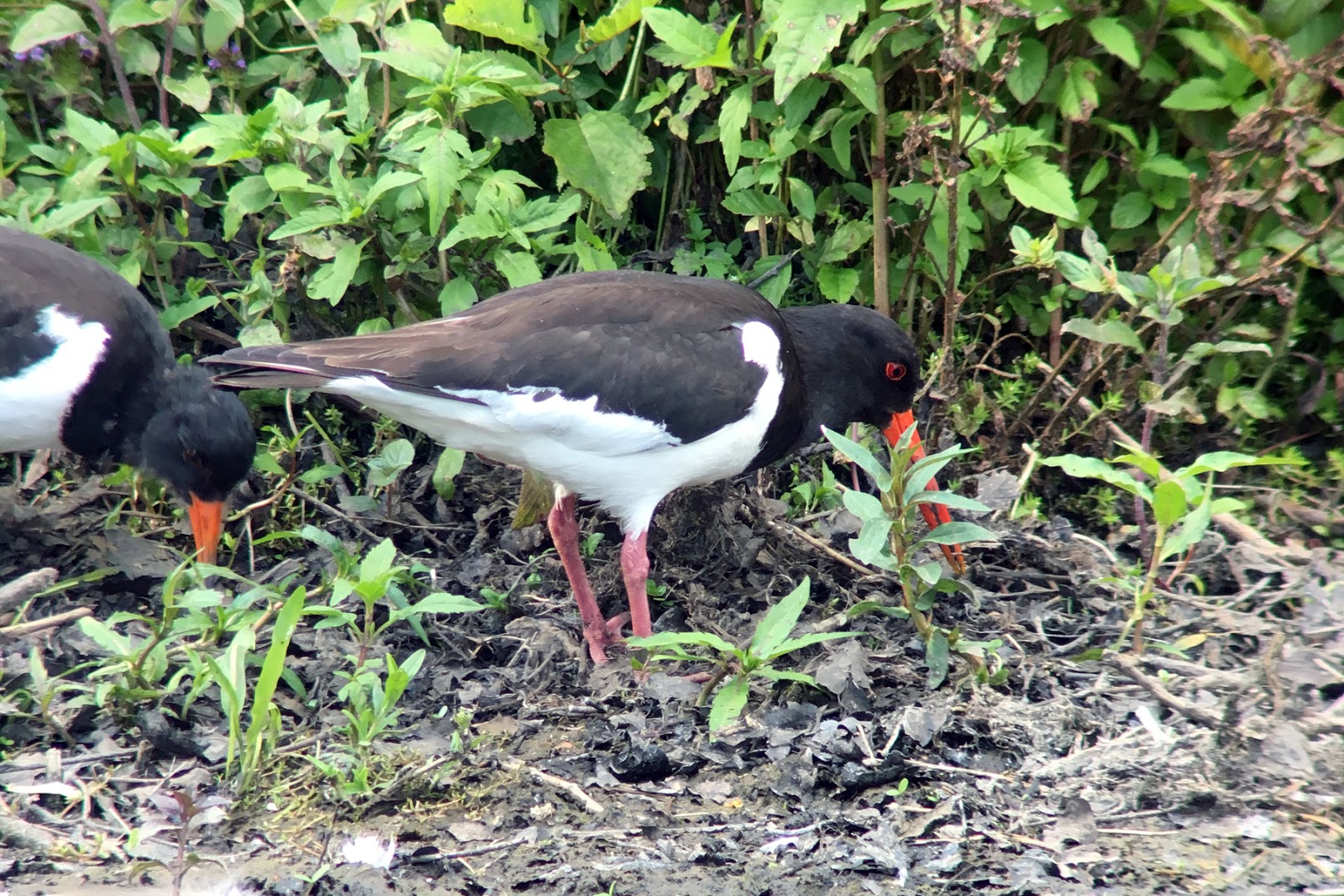
No Greenshank-like excitement on East Marsh this time, nor Hobbies at the Alban reedbeds. Instead I was able to grab some nice footage and images of close-to Oystercatchers, a Common Tern on a not-too-distant perch, and then spend a bit of time sketching these and others.

So the Common Tern first, as a short video (spoiler: the (modest) action sequence is at 00:53):


And then, because I can, as an animated gif. You won't be surprised to learn that there's an app for that :-)


The Oystercatchers were more of a challenge - they wouldn't stop moving! If I'm to catch video footage in those circumstances then I might need a steadier, more fluid tripod head. But in the meantime, here's a couple of jpgs and another gif.


Other birding highlights included  4 Ringed Plover and a Little Ringed Plover on the main island, and two Green Sandpipers at Teal Pool,

11 July 2016

The blur of pencil on paper

Nothing suggests a good bird like a busy notebook and sketch pad. Take Friday evening, for example, which saw a proper blur of pencil on paper as an unexpected wader greeted me at Brandon Marsh.

I arrived at Brandon just before 5pm with the vague aim of watching and sketching Hobbies for a while. And I did, eventually.

But first I was waylaid for nearly an hour at East Marsh. Because as I counted Common Tern chicks and sorted through the Lapwings, Oystercatchers, Ringed Plover and Little Ringed Plover, my scope came to rest on an elegant, but sleeping, wader.

Pale, slim and speckled, it looked for all the world like a Greenshank, a bird I haven’t seen in Warwickshire for absolutely ages (possibly since this digiscoped beauty at Draycote in 2005). 

 And when it lifted its head and started elegantly feeding around the island, I was able to confirm that it was indeed Tringa nebularia – an unexpected treat and a joy.

It’s not a terribly difficult bird to identify of course, but I took my time to work through its distinctive features – the green(ish) legs, the needle-thin and slightly upturned bill and, when it eventually fluttered gracefully from one side of the island to the other, a diagnostic white ‘cigar’ shape on its back.

Having watched and then sketched the bird to my own satisfaction (fortunately I set low, low standards for my own artistry), I moved on to Green Sandpipers at Teal Pool (now up to three in number), and then on the Ted Jury Hide for some Hobby sketching. Just one Hobby showed, but it did me the great service of sitting stock still in the nearest tree for half an hour – a great end to a great evening.


Bird of the day: Greenshank (Tringa nebularia), a returning migrant which will be found at shallow waters around the country over the next couple of months – but usually only as single birds. Their relative scarcity in inland counties like Warwickshire only adds to their elegant charm.

5 July 2016

A fine Hobby

The merest hint of warmer weather was enough to send me scurrying to Brandon Marsh for a Friday evening stroll.

It’s been a while since I’ve done an evening session, and I’d forgotten how gloriously tranquil it can be.

A couple of Common Terns provided the early entertainment, alternating between feeding two chicks and squabbling over their own share.

The Oystercatcher chicks are now up and around, and starting to look like small Oystercatchers in their own right (albeit very scruffy ones). Talking of scruffy, most of the ducks are now well into eclipse.

On the Teal Pool it was great to see my first two Green Sandpipers of the year, presumably females which have left their breeding grounds ahead of the young and male birds (as is their habit). One of these two certainly had the boldly-speckled back of a breeding bird, the other less so.

Photo: Ron Knight
News of both Barn Own chicks and Hobbies from the Ted Jury Hide had me scurrying to the end of the reserve – sadly neither appeared during the half-hour I had left.

But there’s always another day, and it happened to be Sunday. Back with J at my side, we were down to one Green Sandpiper but up to a full complement of two Hobbies.

These are thrilling birds – powerful, agile, elegant and beautiful. I could watch them for hours: perched one can only admire their colours, their markings and their poise; once airborne their hunting of dragonflies (and occasionally hirundines) is frankly astonishing to see.


Bird of the weekend: Eurasian Hobby (Falco Subbuteo), I think probably my favourite raptor. A summer visitor, the Hobby is best seen on warm days from June to September hawking over water, marsh and scrubland for dragonflies and small birds. 

15 November 2015

Getting away from dip, dip, dip, dip

After a week-and-a-bit of repeatedly dipping Napton's bearded tits (still not seen them after four, possibly five, visits) it was nice just to amble around Brandon Marsh with no particular agenda.

It was a decent session in the end, but blimey was it hard work to start with. The high wind didn't help, although thankfully we missed out on the forecast heavy rain. But the main challenge was finding any birds to get the pulse racing.

Out on East Marsh the winter wildfowl dominated - a handful of mallards and five tufties were overwhelmed by autumn incomers, with 40+ shoveler, 70+ teal and perhaps as many as 120 wigeon. Most welcome they were too, since when there's not much else on I can easily while away the hours watching, and listening to, a big flock of wigeon.

There were just three lapwing on the marsh, although later in the day 100+ did wheel in low overhead.

A long stint in the Ted Jury Hide produced absolutely nothing beyond a close-in moorhen which became my object of interest for 20 minutes or so as it picked its way through the water-weeds looking for morsels to eat. 

Fortunately things livened up on the walk back.

First a marsh tit 'sneezed' and then showed well as I left the hide. Then a little diversion down to the Riverpool Hide turned up a lesser redpoll, a good size tit flock and a kestrel. From the hide I caught a tantalising glimpse of a drake duck which was just a little too plain  in the face and a little too grey to be a mallard - almost certainly a female pintail.

Just before I reached the visitor centre a little gang of five siskin stopped beside me, and at the feeders there were reed bunting, coal tits and a nuthatch (sadly the brambling, with I definitely wasn't looking for *crosses fingers* didn't turn up).

Bird of the day: Moorhen (Gallinula chloropus) - we are all of us I'm sure guilty of being blinded to the majesty of this waterbird by its sheer ubiquity. But from it's blue-black head and bellow to its buff-brown back, from its pristine white tail to its glorious red-and-yellow bill, it's a stunner that birders can rely on from park pond to windswept nature reserve.

11 October 2015

Pushing ourselves

Today was a birding day, but I'm going to start with a reflection on fishing: my brother always catches more than me.

So why is that? Well, it would be churlish of me not to factor in his superior skill and experience (and I do so hope he never reads this). But another factor is definitely his sheer will to catch. While I'm looking at darkening skies and packing away, he'll be looking at those same skies and thinking: "there's another hour in this; still time for the big one." And so it often proves.

All of which I mention because I think this self-same will to win / optimism / cussedness is an admirable philosophy which can be equally well applied to many other ventures in life - not least birding. So today, whenever I felt like calling it a day, I told myself to stick it out and wait until I caught - I mean found - the big one. And the result was... well, this.

It was a stunning morning as I left the house at 07:30, the mist draped over hedgerow and field and a huge red sun rising over the treetops. When the last of that mist dissipated shortly after I arrived at Napton Reservoir it revealed nothing much, a lone pochard the only non-regular on or near the water.

Instead I spent a fruitful couple of hours hedge and field bashing, hoping (with little expectation) for a yellow-browed warbler but settling instead for some 1st winter yellowhammers, bullfinch, linnet, meadow pipit, a mistle thrush, my second lone redwing of the week and a magnificent sky full of sky larks. Flyovers included raven, a grey wagtail and two pairs of swallow stragglers.

You can't fault the view from
Brandon's Badger Tearoom :-)
Thirty-four species isn't a bad haul for a couple of hours on a small patch, but I still had an appetite for more birds. And for a full English breakfast, which - not at all coincidentally - is how I started my visit to Brandon Marsh.

The breakfast was great, but the sightings board and book didn't look quite so promising. With little having been reported over recent days I was beginning to think I should have made the trip up to Middleton Lakes RSPB on the off-chance that the GWE came back (it didn't).

Still, I told myself, Brandon is a big reserve - there could be anything out there, just waiting to be discovered. Hmmm. After another couple of hours my 'big' find (apart from the welcome site of the recently arrived wigeon) had been a couple of well-hidden snipe on east marsh - my first waders for the day, but not much to show for 4+ hours out and about.

So I decided to make a final stand at Jury Hide - here I vowed to sit until something really interesting dropped in (a peregrine or marsh harrier perhaps, or maybe even the now-mobile GWE!)

To be fair it only took 10 minutes of steely determination (ahem) before I spotted the tiniest movement in the hedges right at the back of the reedbed. A quick scope scan revealed a vivid male stonechat, clear as day even at 200 yards. He was quickly joined by a female and, after a few minutes watching them bounce along that hedgerow, I could finally head home happy that I had indeed seen the day through to a decent conclusion.

Bird of the day: Common Sni... nah, just kidding. It was Stonechat (Saxicola torquata), a long-time favourite of mine. October / November is the best time to find them in this part of the world, and Brandon Marsh as good a spot as any.

23 January 2015

You say you want a resolution?

New Year's resolutions are - and let's be frank here - an utter waste of time. Useless. Pointless. Not worth the paper, or pixels, on which they are written.

Of course I'm sure you're the exception that proves the rule - that wilful chap or chap-ess who turned their whole life around with a heartfelt promise made on the stroke of midnight. 

But for the rest of us, we have a different tale to tell; the shared experience of repeated failure, self-loathing and recrimination.

So you'd think I'd have managed to kick the resolution habit by now, and to be fair I have. By and large. 

Unfortunately one crept under the radar this year: a commitment to get some proper birding in and strive for a decent county year list. 

And, in common with all New Year's resolutions, this one is already disastrously stricken; holed beneath the water line and listing (ahem) precariously to port. In short, yet another resolution is set to be wrecked before the last week of January has even begun.

A Winter Dunlin (photo: Andrew C)
Just how wrong has it gone? Well, the sum total of this year's birding to date has been two short family trips to Brandon Marsh, a bit of garden birding and a walk around the office.

So not much then.

This means the county list so far includes little more than my garden regulars, the routine Brandon wildfowl and gulls, the obvious farmland birds I've seen while out cycling, and only a couple of even-slightly-less-than-common sightings: a lone dunlin at Brandon on New Year's Day; a flock of lesser redpoll; and a shelduck today on East Marsh.

I'll still count it all when I get a moment, and endeavour to do better in the coming weeks and months.

But my hopes aren't necessarily that high.

Bird of the fortnight: Dunlin (Calidris alpina), a common and unremarkable wader, but not so much so in land-locked, winter-locked Warwickshire. All the more unremarkable to look at in winter for the lack of the black belly patch it sports throughout the breeding season.


12 November 2014

Come sunshine, rain and pie

I started a busy birding weekend in driving rain and finished it in fine autumnal sun; the funny thing is that both were equally enjoyable.

Napton Reservoir can be bleak enough at the best of times - it seems to attract winds that nowhere else can find. With some cold heavy rain added to the mix it wasn't the most promising start to a weekend, but there was enough about to make for a rewarding hour or so.

No notable wildfowl on the water, just c.80 coots, c.30 tufted ducks, c.40 black-headed gulls, a handful of common gulls and a great-crested grebe - plus a big flock of 50 canada geese and a single greylag.

There were only a few fieldfares and redwings around the perimeter - I've yet to see a large flock of either this year - but there were well over 100 starling moving. Three snipe flew while I was there, and two groups of lapwing flew east - three then five, the latter group touching down momentarily. A male bullfinch and a kestrel were also present.

The sun was out by Sunday morning, and my customary bike ride was considerably enlivened by passing views of a flock of c.20 golden plover in fields near Long Itchington.

Male Goldeneye (Credit: Bill Thompson/USFWS)
Later that morning it was off to Brandon Marsh for what is becoming something of a family routine - lunch then birding.

Pie Week went down well with the troops (steak and mushroom, thanks for asking) and then we headed off for a reasonably thorough look around the reserve.

Our reward was a total of 42 species found: highlights including a sparrowhawk and three snipe at East Marsh Pool, great views of great spotted woodpecker and nuthatch at the feeders, and three goldeneye - a male and two female, back at East Marsh.

Bird of the weekend: Goldeneye (Bucephala clangula), a gorgeous diving duck (well, the male at least); a winter-only visitor in these parts with the tiny UK breeding population confined to Scotland.

7 November 2014

Chat-tastic

Napton had been in the finest possible birding form last weekend (see previous post) with plenty on and around the reservoir and a few extra ticks on the hill.

My favourite birds at the reservoir were the small flock of meadow pipits I finally located in hedges at the back of the water, but also of note were: four lapwing flying south; plenty of snipe flights (who knows how many individual birds on site?); 12 common gulls among the black-headed; two big arrivals of starling (c40 in the first group, close to 100 in the second); three fieldfare overhead; a male sparrowhawk dashing low over a nearby field; and nine wigeon.

But, as previously reported, with brunch beckoning I forced myself to drive past the Long Itch diner and on to Brandon Marsh, conscious that the long-staying stonechats were still being reported. One Full English later and I was in the new Ted Jury hide, looking at not one but two neat little 'chats - a female and a male, the latter with fairly muted head colouring rather than the striking black I'm more used to seeing in spring. A first winter male perhaps?

Both were extremely obliging, hopping from bush top to reed stem to post to tree stump, only occasionally dropping from view.

With a sprinkling of wildfowl on the East Marsh hide, plus a kestrel, a buzzard and some regular visitors to the Brandon feeders I was able to conclude a day with a creditable 47 species. 

Bird of the day: Stonechat (Saxicola torquata); much as I loved the little 'mipits' at Napton, the stonechat has to be the bird of the day. A regular but scarce find for most inland birders, it's a distinctive and attractive bird with the commendable habit of sitting at the top of bushes and vegetation (unlike some birds I could mention - yes, cettis warbler, I'm looking at you). 

6 November 2014

Patch Wars! Leam Valley vs Napton (vs Brandon Marsh)

No two sites on my local birdwatching patch are the same. This is by design, of course, since the perfect patch is one which has as many habitats as possible; and different habitats mean, in turn, different species.

But besides habitat, there is another crucial difference between the different sites - productivity. Never mind the quality, feel the quantity. 

Take for example the case of Leam Valley vs Napton (reservoir and hill). 

A typical walk through Leam Valley, such as the lunchtime one I took earlier this week, can often turn up very little for much of its duration. Sure there will be from common birds some song and movement around the trees and hedgerows; an occasional moorhen disturbed from its bankside shelter; and perhaps a buzzard calling high overhead. 

But often there will be next to nothing, and the real hope all the way out will be that the scrape will deliver. And often it does - but with more meagrely measured offerings than some other sites (as we shall see in a moment). 

This week's visit was one such occasion, with those meagre but no less rewarding highlights on and around the scrape including: great and repeated views of a kingfisher fishing in front of the hide; a small flock of brightly-coloured chaffinches and goldfinches; and - star bird of the day - three shovelers, a male and two females (initially overlooked as mallards by a stupid and over-eager eye).

Compare and contrast with Napton on Saturday morning. It was my first full session at Napton for many a long while, and it was fantastic in every respect. Great weather, high spirits and a monumental bird count. 

Where to start? On the reservoir itself there were fairly typical numbers of coot (80+), tufted ducks (25), mallards (18) and gulls - 70-odd black-headed and about 20 common. Snipe seemed to flush from every bank and reedbed, I counted more than a dozen flights in all. New on the water were 9 wigeon; 4 lapwing flew south; three fieldfare flew past; and decent numbers of starlings arrived in two biggish groups - 50 then 100+.

Away from the water I was teased for a while with distinctive 'seep, seep' calls; eventually I was able to track them down and identify a little flock of meadow pipit, a welcome bird which I don't see often enough. Plenty of skylarks passed in good voice overhead, a mistle thrush did likewise, a few pied wagtails moved around the reservoir edge, and a male sparrowhawk made a spectacular, but unsuccessful, low pass over a field of starlings. 

By contrast the hill was quiet, but I still managed to add jay, great spotted and green woodpeckers plus another mistle thrush to the morning's tally. 

So there you have it. Both rather wonderful trips, but in such different ways - one a detailed and close study of a handful of birds, the other an overwhelming spectacle of everything that autumn birding has to offer.

And by way of a final comparison, it was on to Brandon.  So what does a specialist nature reserve managed to perfection for more than 20 years have to offer? Well, a bumper crop of wildfowl for one; plus (and saving the best 'til last here), a pair of stonechat from the new Ted Jury Hide.

Oh, and a tearoom serving a full English breakfast. The perfect end to a morning of 46 bird species - a happy marriage of quantity and quality in equal measure.  

Bird of the week: Stonechat (Saxicola torquata) - I could honestly have picked any number of birds this week, but this little gem has edged it. Normally a bird of western and southern heathland and coast, they disperse more widely in the winter, so a real possibility wherever you are. More on them in the next post.

27 October 2014

Time for a chat?

I suspect my son's enthusiasm for Brandon Marsh might have as much to do with the tearoom milkshakes as it does for the wildlife, but I wasn't complaining as once again he chose it as the destination for a family trip :-)

East Marsh was lively, the lapwings and black-headed gulls being kept company by good numbers of teal and shovellers; with a handful of common and lesser black-backed gulls, a single cormorant and two snipe on the far bank.

The long-staying green sandpiper was on the Teal Pool, and of course there were plenty of other birds around (Charlie enjoyed particularly good views of a great spotted woodpecker on the feeders).

19 October 2014

Young eyes

OK, so I'm no Ian Wallace*. But I had thought my ID skills would remain better than my young son's for a few years yet...

So it was something of a surprise when, as I guided him around the view from Brandon's East Marsh hide with the words "...and there on the far island you can see three greylag geese...", I received the reply: "well that one's not!"